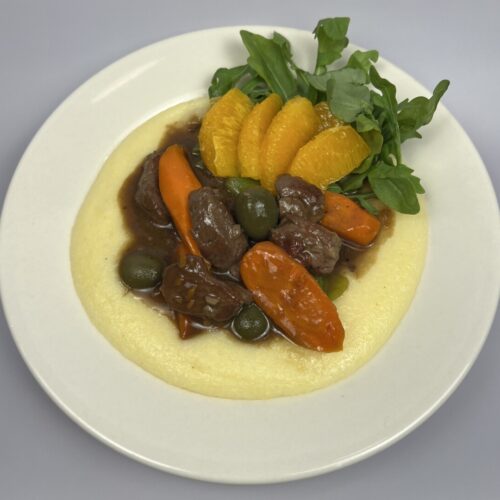
Daube Provençal of Lamb
with Creamy Polenta and Winter VegetablesDaube is the classic stew of southern France, a dish similar to those called ragoûts in other regions. This recipe was developed with lamb but, with a little longer cooking time, you can successfully substitute small cubes of beef chuck. Reduced red wine and Provençal herbs give this dish its distinctive flavor. As in restaurant cooking, the stew base is made entirely ahead of time but, for freshness, the add-in vegetables are braised and incorporated just before service. Because the stew base keeps for a long time in the refrigerator and freezes well, you may wish to scale up the recipe times two, three, or more. Daube has a natural affinity for polenta, but you can serve it over buttered noodles, as well.
Ingredients
step 1 ingredients
- 3/4 c red wine
step 2 ingredients
- 1/3 carrot
- 1/8 yellow onion
- 1 large garlic clove
step 3 ingredients
- 1 navel orange
step 4 ingredients
- 1 1/2 lb bone-in lamb shoulder chops
step 5 ingredients
- to taste kosher salt
- 3 Tbsp pure olive oil (not extra-virgin)
- 3 Tbsp butter
- 3 Tbsp flour
- 2 c beef bone broth or beef stock
- 1 Tbsp tomato purée
- 2 bay leaves
- 2 thyme sprigs
- 2 sage sprigs
step 6 ingredients
- 2 leeks
- 2 carrots
step 9 ingredients
- 1 Tbsp butter
- 1/2 c water
- to taste kosher salt
step 10 ingredients
- 1/2 c instant polenta
- 1/2 tsp kosher salt
- 2 c water
- 1/4 c half-and-half or light cream
step 11 ingredients
- 10 green olives (preferebly Castelvetrano, unpitted)
step 12 ingredients
- 1 oz baby arugula or other winter greens

Instructions
PREP: Mise the recipe ahead of time.
1. Concentrate the wine:
- Pour the wine into a small saucepan and place it over low heat. When the wine begins to exude steam, monitor the heat so that the wine barely shivers. Don’t allow it to boil or even simmer.
- Watch the wine carefully as you do other tasks. When the wine has reduced by about half, remove from heat.
2. Fabricate the aromatic vegetables:
- Peel and fine-mince the carrot.
- Mince the onion.
- Mince the garlic.
3. Zest and section the orange:
- Wash the orange and pat it dry. Use a swivel peeler to remove 4 wide strips of zest from the orange. Don’t press too hard on the peeler; you want only the orange-colored part of the zest and none of the underlying white pith. You’ll use the zest strips in step 5.
- Use a flexible boning knife to cut off the orange’s top and bottom ends. Trim away the remaining rind by cutting from the top to the bottom in curving slices all around the orange.
- Cut the orange into sections by cutting inside the membrane to release each section.
- Place the orange segments in a container and refrigerate.
4. Fabricate the meat:
- Wipe the lamb shoulder with a damp paper towel. Trim away visible fat.
- Use a flexible boning knife to remove the meat from the bones in as large pieces as possible. Trim away any connective tissue from around the edges of the muscle bundles.
- Cut the meat into rectangles about the size of your thumb.
5. Make the ragoût:
- Preheat an oven to 325°F.
- Heat a sauté pan medium-hot, add the olive oil, and sautè the lamb about 1 minute to brown it on all sides. Season with a little salt. Do not allow the fond (browned residue on the bottom of the pan) to get too dark. Turn the heat to low and remove the lamb to a heavy oven-proof casserole.
- Add the butter to the sautè pan along with the minced onions and carrots. Sautè over low heat for a minute or two until the vegetables become light golden brown. As you stir, scrape up the fond, which should release from the pan.
- Add the garlic, sautè a few seconds longer, and then stir in the flour. Cook, stirring, until the flour becomes light brown in color.
- Stir in the stock slowly, to avoid forming lumps. Add the tomato purée and reduced wine. Bring the sauce to a simmer and season with a little salt. Cook about 5 minutes until the sauce lightly thickens.
- Pour the sauce over the lamb in the casserole. Add the bay leaf, thyme sprigs, sage sprigs, and orange zest strips and stir to submerge them in sauce.
- Cover the casserole and bake for 30 minutes.
- Remove the casserole from the oven. Check the consistency of the sauce and, if getting too thick, stir in a little water.
- Cover the casserole and return it to the oven. Bake about 15 minutes longer.
- Remove from the oven and check the doneness of the lamb. It should be tender, so that a knife inserted meets with just a little resistance.
- If necessary, adjust the consistency of the sauce: if too thick, thin out with a little water. If too thin, pour off most of the sauce into a sauté pan and reduce to a nappé [glossary link] consistency.
- Taste, evaluate seasoning, and correct the salt if necessary.
- If prepping ahead, cool the ragoût to room temperature and store in a container.
6. Fabricate the add-in vegetables:
- Peel the step 5 carrots and cut on the diagonal into 1-inch lengths.
- Trim away the root end of the leek and also the dark green stems, leaving only the white and very pale green section. Cut a lengthwise slit into the leek, cutting only to the center.
- Rinse the leek under cold running water while gently opening out the layers. Check carefully for grit between layers.
- Squeeze the leek closed, and then cut it on the diagonal into 1-inch lengths.
- If prepping ahead, store the vegetables in a plastic bag with a dry folded paper towel in the bottom.
7. Assemble the remaining mise-en-place for the recipe.
HOLD: Refrigerate all ingredients up to 5 days.
COOK! Finish and plate your dinner.
8. If you prepped ahead, preheat an oven to 400°F. Return the ragoût to its casserole, cover, and gently reheat it.
9. Braise the add-in vegetables:
- Place a sauté pan over medium heat and add the step 9 butter. When the butter sizzles, add the carrots and leeks with a pinch of salt. Sauté, stirring carefully so that the leeks don’t fall apart, for about 1 minute until the vegetables are coated with butter and beginning to brown.
- Add the water and cover the the pan. Cook at a lively simmer for about 2 minutes until the vegetables are tender. If the water absorbs/reduces away, add more as needed. When the vegetables are done, a knife inserted in them will meet just a little resistance.
- Uncover the pan and reduce away any remaining moisture.
10. Make the polenta:
- Place the polenta in a saucepan and slowly stir in 1 c of the water in a thin stream to avoid forming lumps. Add the step 10 salt.
- Bring the polenta to a simmer and cook, stirring often, for about 4 minutes until it thickens into a consistency like soft mashed potatoes.
- Taste and evaluate the texture. Some brands will still have a grainy mouthfeel at this point; if necessary stir in some of the remaining 1 c water and continue cooking until the polenta is smooth. Stir and scrape the pan to avoid scorching.
- Stir in the cream. Taste, evaluate the seasoning, and add salt if needed. Cover the pan and hold at the back of the stove.
11. Finish the ragoût:
- Pick out the bay leaves, herb stems, and orange zest from the ragoût and discard them.
- Gently fold in the carrots, leeks, and olives.
12. Plate:
- Spoon the polenta into the center of warm pasta plates or wide soup bowls.
- Ladle the ragoût onto the polenta, portioning the ingredients evenly.
- Insert a bouquet of arugula in the polenta at the back right of the plates.
- Mound the orange sections in front of the arugula.
Nutrition
Calories: 1161kcalCarbohydrates: 77gProtein: 57gFat: 63gSaturated Fat: 24gPolyunsaturated Fat: 5gMonounsaturated Fat: 29gTrans Fat: 1gCholesterol: 208mgSodium: 1808mgPotassium: 1912mgFiber: 7gSugar: 17gVitamin A: 14924IUVitamin C: 56mgCalcium: 249mgIron: 9mg
Tried this recipe? Hope you liked it!Share your experience with the PrepHoldCook community. We’d love to hear from you — please leave a comment in the form below.