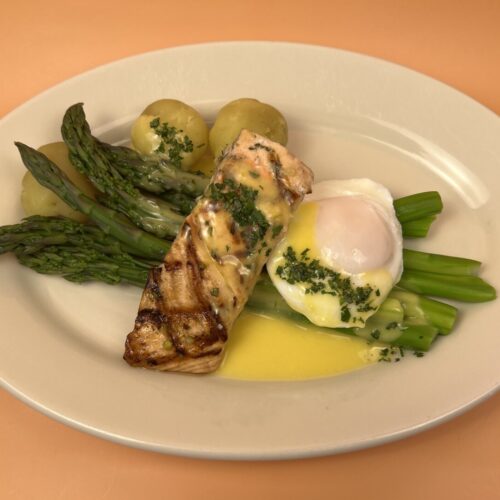
Grilled Salmon with Asparagus, New Potatoes, and Deconstructed Hollandaise
Moist and meaty char-grilled salmon, tender asparagus, and sweet little new potatoes are a traditional late-spring culinary combination often served with Hollandaise, a classic egg-based emulsion sauce that’s notoriously tricky to make. This recipe delivers the tangy flavor and lush mouthfeel of Hollandaise without all the stress. In this “deconstructed” version a poached egg enriches a simple lemon butter sauce, enhancing both fish and vegetables for a delicious seasonal dinner.
Ingredients
step 1 ingredients
- 1/4 lemon
- 1 scallion
- 1 tarragon sprig
- 1 Italian parsley sprig
- 1/3 c pure olive oil (not extra-virgin)
- 1/8 tsp kosher salt
- 1 pinch fine-ground white pepper (optional)
step 2 ingredients
- 2 6-oz salmon fillets
step 3 ingredients
- 6 small new potatoes
step 4 ingredients
- 14 oz thick asparagus spears
step 5 ingredients
- 1/3 lemon
- 3 oz butter, preferably Irish or French, cold
- to taste kosher salt
step 8 ingredients
- 1/2 tsp white wine vinegar
step 9 ingredients
- 1 tarragon sprig
- 1 Italian parsley sprig
step 13 ingredients
- 2 eggs, preferably local free-range

Instructions
PREP: Mise the recipe ahead of time.
1. Mix the marinade:
- Use a swivel peeler to remove 1 strip of zest from the step 1 lemon. Mince the zest and place it in a container just large enough to accommodate the salmon. Squeeze in the lemon juice. (For efficiency, also prep the step 5 lemon zest and juice and set aside.)
- Mince the scallion, tarragon, and parsley. Add to the container.
- Add the olive oil, salt, and optional white pepper to the container and mix to combine.
2. Fabricate and marinate the salmon:
- If necessary, skin the salmon fillets and remove any pin bones. (To view a video of this process, follow the link in the lesson section of this post.)
- Place the salmon fillets in the container with the marinade and turn it to coat all surfaces.
- Refrigerate for at least 1 hour and up to 12 hours. (After 12 hours remove the salmon from the marinade and store both separately.)
3. Par-cook and peel the potatoes:
- Bring water to the simmer in a saucepan.
- Scrub the potatoes under cold water, then place in the saucepan. Cook at the simmer for 7 to 10 minutes, depending on size, until a paring knife inserted in a potato meets just a little resistance.
- Remove the potatoes from the water and cool to room temperature. Don’t refresh.
- Use a paring knife to peel the skin from the potatoes.
- If prepping ahead, place the potatoes in a plastic bag.
4. Peel and par-cook the asparagus:
- Bring about 3 inches of water to the boil in a sauté pan, and place a bowl near the stove.
- Remove the tough base from each asparagus spear by grasping the tip end with one hand and the base end with the other hand. Gently bend the spear; it will break at the spot where the spear changes from tender to tough. Discard the base ends.
- With light strokes, use a swivel peeler to peel the lower half of each spear.
- Immerse the asparagus in the boiling water, recover the boil, and blanch for 40 seconds to 1 ½ minutes until a paring knife inserted in a spear of asparagus meets moderate resistance.
- Transfer the asparagus to the bowl and refresh it under cold running water for about 3 minutes.
- Remove the asparagus from the water and blot dry on paper towels.
- If prepping ahead, place the asparagus in a plastic bag with a folded paper towel in the bottom.
5. Mise the lemon butter sauce:
- Use a swivel peeler to remove 1 strip of zest from the step 5 lemon. Mince the zest and place it in a container. Squeeze in the lemon juice.
- Cut the butter into ½-inch cubes. Spread out the butter cubes on a sheep of wax paper or parchment. Loosely roll up, place in a plastic bag, and refrigerate.
HOLD: Refrigerate the salmon in its marinade for up to 12 hours; after that time, pour off and reserve the marinade. Hold all ingredients up to 2 days longer.
COOK! Finish and plate your dinner.
6. Set up for grilling the salmon:
- Preheat a gas or charcoal grill to a high temperature.
- Have ready a sizzle pan or small sheet tray, tongs, flexible spatula, basting brush, and a sheet of aluminum foil.
- Turn the oven on to its lowest-heat setting.
7. Set up the vegetables for reheating:
- Place the asparagus and potatoes in separate, microwave-safe containers with lids or covered with plastic wrap. If using plastic wrap, don’t allow it to touch the food.
- Place the potato container and the asparagus container in the microwave so that the vegetables will be ready reheat in step 12.
8. Set up for poaching the eggs:
- Obtain a non-stick sauté pan just large enough to accommodate the eggs. Fill with water to about ½ inch from the rim.
- If you’re unsure of the freshness of your eggs, add the optional vinegar to the water.
- Bring the water to the simmer.
- Have ready a perforated spoon, a doubled paper towel folded into a thick pad, and a small warmed dish for each egg.
9. Mince the step 9 tarragon and parsley.
10. Grill the salmon:
- Determine the thickness of each salmon fillet. Estimating 8 minutes per inch of thickness, calculate the total grilling time for each one.
- Use tongs to lift each salmon fillet out of the marinade, and pause to allow excess marinade to drip off into the container. Place each fillet diagonally on the grill grid, shiny-side-up. Grill for about ¼ of the total cooking time.
- Use the brush to baste each fillet with a little marinade. Avoid applying too much marinade lest the oil cause a flare-up.
- Use tongs and/or a spatula to check whether the salmon fillets have loosened from the grill grid and have attained grill marks. When ready, rotate each fillet 90 degrees to achieve cross-hatch grill marks, and grill for another ¼ of the cooking time.
- Baste again, and then turn the fillets over.
- Grill for the remaining cooking time, basting for one last time.
- Transfer the salmon to the sizzle pan, placed with the cross-hatch side up. Check the doneness with an instant-read thermometer inserted in the center of a fillet; internal temperature should reach about 135°F; carryover cooking will raise the temperature to the required 140°F. Cover the pan loosely with the foil.
- Place the sizzle pan in the low oven, and turn the oven off.
11. Make the lemon butter sauce: (To view a video of this procedure, follow the link in the lesson section of this post.)
- Place the step 5 lemon zest and juice in a small sauté pan with a little salt. Bring to the simmer.
- Remove the pan from the heat and, using a plastic spatula, stir the butter into the lemon juice until the butter melts and emulsifies into a thin, homogenous sauce. Don’t overheat and allow the butter to “break,” with the yellow fat separating from the liquid.
- Evaluate the seasoning and, if necessary, adjust the salt and/or lemon.
- Hold warm on the back of the stove.
12. Reheat the vegetables:
- Microwave the potatoes and asparagus for 2 or more minutes until hot through.
13. Poach the eggs: (To view a video of this procedure, follow the link in the lesson section of this post.)
- Bring the water in the sauté pan to the boil.
- Crack each egg on the side of the pan and, holding the egg as close as possible to the water, open the egg shell and slip the egg into the water. Alternatively, crack each egg into a small, shallow dish and slide it into the water.
- Adjust the heat to maintain a brisk simmer. (If the eggs aren’t completely submerged, add more hot water or use the spoon to baste water over the tops.)
- Poach the eggs for about 1 minute until the whites are gently set and yolks are still soft.
- Use the perforated spoon to lift the eggs out of the water. Blot on the paper towels, and place each one in a clean, warmed dish.
14. Plate:
- Arrange a portion of the potatoes across the back left of each warmed dinner plate.
- Arrange a portion of the asparagus diagonally across the front of each plate with the tips leaning against the potatoes and the base ends at the front right.
- Place a salmon fillet in the center of each plate on top of the asparagus, arranged on the opposite diagonal from the asparagus.
- Place a poached egg on the base ends of the asparagus next to each salmon fillet.
- Use a plating spoon to nap a portion of the sauce over the salmon, asparagus, and egg on each plate.
- Garnish with a diagonal line of minced herbs.
Nutrition
Calories: 1112kcalCarbohydrates: 42gProtein: 48gFat: 86gSaturated Fat: 30gPolyunsaturated Fat: 10gMonounsaturated Fat: 40gTrans Fat: 1gCholesterol: 349mgSodium: 574mgPotassium: 2115mgFiber: 9gSugar: 6gVitamin A: 3068IUVitamin C: 64mgCalcium: 151mgIron: 9mg
Tried this recipe? Hope you liked it!Share your experience with the PrepHoldCook community. We’d love to hear from you — please leave a comment in the form below.