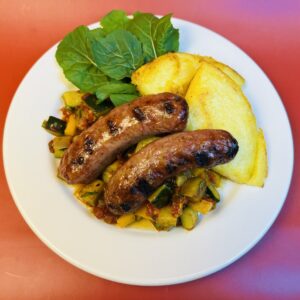
Grilled Sausage with Italian Ratatouille and Crispy Polenta Wedges
In Provence, the classic combination of zucchini, onions, peppers, and eggplant simmered in a fresh tomato sauce is called ratatouille, the best-known iteration of the dish. Our "Italianized" version is more boldly seasoned with garlic and features a distinctive blend of fresh herbs. Top this seasonal side dish with spicy, juicy, char-grilled Italian sausages and team it with crisp-fried cornmeal polenta for a memorable early fall dinner.
Ingredients
step 1 ingredients
- 1 1/2 tsp pure olive oil (not extra-virgin)
- 1/2 c instant polenta
- 1/2 tsp kosher salt
- 2 1/2 c water
step 2 ingredients
- 12 oz ripe local tomatoes or Kumatos (or other vine-ripe tomatoes)
step 3 ingredients
- 1 medium-size zucchini
- 1/2 large yellow bell pepper
- 1/4 yellow onion
- 1 large garlic clove
- 8 oz eggplant, preferably Chinese or Japanese
step 5 ingredients
- 2 tsp pure olive oil (not extra-virgin)
step 7 ingredients
- 2 Tbsp pure olive oil (not extra-virgin)
- to taste kosher salt
- 2 Tbsp extra-virgin olive oil
step 8 ingredients
- 4 4-oz Italian sausage links
step 9 ingredients
- 1 small basil sprig
- 1 small oregano sprig
- 1 small parsley sprig
- 1/3 small rosemary sprig
step 10 ingredients
- 1 1/2 oz arugula or baby arugula

Instructions
PREP: Mise the recipe ahead of time.
1. Par-cook the polenta:
- Choose a nonstick sauté pan of the correct size for the number of portions you are making: 6” pan for 2 portions; 7” pan for 4 portions; 8” pan for 6 portions. Add the step 1 olive oil to the pan.
- Place the polenta in a saucepan with the salt, and then whisk in the step 1 water to make a smooth, loose-textured mixture.
- Place the pan over medium heat and bring to the simmer, whisking occasionally to avoid lumping.
- After about 5 minutes, when the polenta thickens, switch to a heatproof plastic spatula or spoon, turn the heat to low, and continue stirring for 8 to 10 minutes until the polenta is thick enough to hold a firm shape.
- Taste to evaluate the mouthfeel: The polenta should have a rustic, slightly coarse texture. (If the texture is overly grainy, stir in a little more water and continue cooking until the texture softens to your liking and the polenta is thick.)
- Adjust the salt if necessary.
- Place the sauté pan over high heat for a few seconds to thin the oil, then remove from heat and swirl the pan to coat both bottom and sides with oil.
- Scrape the polenta into the sauté pan and smooth the top surface.
- Cool to lukewarm, then place the sauté pan in the refrigerator for at least 1 hour to set the polenta solid.
- If prepping ahead, slide the sauté pan into a plastic bag and seal it shut. (If you need the sauté pan for other uses, remove the now-solid polenta from the pan and seal it in a bag.)
2. Make tomato concassé:
- Bring a pot of water to a rapid boil.
- Prepare a bowl of cold water and place it near the stove.
- Use a spider or slotted spoon to lower the tomatoes into the boiling water.
- Boil just until the skin loosens, 10 to 20 seconds, depending on the ripeness of the tomatoes. (The tomatoes should not cook: the tomato flesh should remain raw and firm.)
- Immediately lift the tomatoes out of the boiling water into the cold water. Place the bowl in the sink under a stream of cold water and refresh the tomato for 2 to 3 minutes. Remove and drain.
- Core the tomato and slip off the skin.
- Cut the tomato in half crosswise, then remove and discard the seeds.
- Coarse-chop the tomato flesh.
- Place the concassé in a container.
3. Fabricate the ratatouille vegetables:
- Wash the zucchini. Trim off the ends, but don’t peel them. Quarter the zucchini lengthwise and then remove the seeds. Cut the zucchini into ½-inch dice.
- Cut the bell peppers and onions into ½-inch dice.
- Mince the garlic.
- Wash the eggplant, but don’t trim or cut it yet.
- If prepping ahead, store the vegetables in plastic bags or containers.
4. Assemble the remaining ingredients:
HOLD: refrigerate all ingredients up to 4 days.
COOK: Finish and plate your dinner.
5. Fry the polenta wedges:
- Use a plastic spatula to loosen the polenta disk from the sauté pan and slide it onto a cutting board. Cut the polenta into wedges (2 per person).
- Place the sauté pan over medium heat and add half the step 5 oil. Return the polenta to the sauté pan, rounded side down, reassembling the wedges into a disk. Occasionally check the bottoms of the polenta wedges as they cook, to ensure they don’t scorch. (Using minimal oil, the bottoms may acquire dark brown flecks; this is OK.) Cook for about 10 minutes until the bottoms of the wedges become golden brown and crisp.
- Use a heatproof plastic spatula to turn over the polenta wedges, and add the remaining step 5 oil around the edges of the pan. Press down on the top surface to help the polenta make contact with the pan surface. Cook for another 10 minutes or so until both sides of the polenta wedges are crisp and brown.
6. Set up your grilling station:
- Preheat the grill to medium-high heat.
- Have ready a paring knife, tongs, a sizzle plate or small sheet tray, and a sheet of aluminum foil.
7. Start the ratatouille:
- Trim off the stem and blossom ends of the eggplant. Peel it and cut it into ¾-inch dice.
- Place a small bowl and a medium-size bowl next to the stove, and have ready a lid for your sauté pan.
- Place the sauté pan over high heat and add half of the step 7 pure olive oil. Heat until very hot, then carefully add the eggplant with a pinch of salt. Sauté, adding more pure olive oil if needed, for about 1 minute until the eggplant dice brown at the edges. Transfer to the small bowl.
- Add a little more pure olive oil, add the zucchini with a pinch of salt and sauté for about 1 minute. Transfer to the larger bowl.
- Add a little more pure olive oil, then add the peppers and onions with some salt. Sauté about 1 minute, then transfer to the larger bowl.
- Remove the pan from the heat until the pan cools down a little.
- Add the step 7 extra-virgin olive oil along with the garlic. Turn on the heat to medium and warm the garlic just until it sizzles and becomes fragrant; don’t let it brown.
- Add the tomato concassé to the pan, stir to combine it with the oil and garlic, and then cook, stirring often, for about 5 minutes until the tomatoes thicken and begin to sizzle.
- Add the zucchini, peppers, and onions to the pan, cover it, and cook at a brisk simmer until the vegetables are just tender. (Don’t add the eggplant yet.)
8. Grill the sausages:
- Use the paring knife to poke 8 to 10 holes through the casing of each sausage.
- Place the sausages on the grill grids and close the lid. Grill for about 1 minute, then give the sausages a quarter turn. Repeat three times, until the sausages brown on all sides and are cooked through to an internal temperature of 155°F.
- Transfer the sausages to the sizzle plate and cover loosely with the foil. Carryover cooking will raise the internal temperature to the required 160°F.
9. Finish the ratatouille:
- Remove the leaves from the basil, oregano, parsley, and rosemary sprigs. Medium-chop the leaves.
- Add the eggplant dice to the ratatouille and return it to the simmer. Evaluate the texture: if too thick, add a little water. If the sauce seems watery, pour off the liquid into another sauté pan, reduce it over high heat, and return it to the pan.
- Evaluate for salt and adjust if necessary.
- Stir in the herbs.
10. Plate:
- Spoon a portion of ratatouille onto the center of each plate.
- Overlap 2 polenta wedges at the 2 o’clock position on each warmed dinner plate, with the points toward the center.
- Make a bouquet of arugula and plant it in the ratatouille to the left of the polenta wedges.
- Arrange 2 sausages on each plate, on top of the ratatouille.
Nutrition
Calories: 1330kcalCarbohydrates: 54gProtein: 40gFat: 107gSaturated Fat: 30gPolyunsaturated Fat: 13gMonounsaturated Fat: 58gCholesterol: 170mgSodium: 2261mgPotassium: 1718mgFiber: 8gSugar: 12gVitamin A: 2350IUVitamin C: 108mgCalcium: 146mgIron: 5mg
Tried this recipe? Hope you liked it!Share your experience with the PrepHoldCook community. We’d love to hear from you — please leave a comment in the form below.