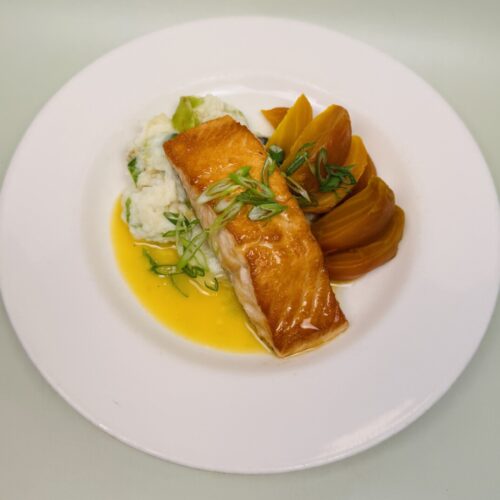
Irish Cider-Glazed Salmon with Golden Beets and Colcannon
The rich, full flavor of early spring salmon becomes even tastier when crowned with a sweet-tart apple cider glaze and then roasted golden brown. Team these delectable fillets with roasted beet wedges and the traditional Irish mash-up of braised cabbage and fluffy purée potatoes for a satisfying cool-weather dinner.
Ingredients
step 1 ingredients
- 2 medium-size beets, preferably golden
step 2 ingredients
- 10 oz russet potatoes
- 1 tsp kosher salt
- 1 Tbsp butter, preferably Irish
- 1/3 c half & half or light cream
- to taste fine-ground white pepper, optional
step 3 ingredients
- 10 oz green cabbage
- 3 scallions
step 5 ingredients
- 1 lb skin-on boneless salmon fillet (see recipe note)
step 6 ingredients
- 1 c non-alcohol apple cider (see recipe note)
- 1/2 c white wine
- 1 tsp Dijon mustard
- to taste kosher salt
- 2 oz butter, preferably Irish, cold
step 9 ingredients
- 1 Tbsp butter, preferably Irish
- to taste kosher salt
- 1/2 c water
step 10 ingredients
- to taste kosher salt
step 11 ingredients
- 2 tsp canola oil or other neutral-flavor oil

Instructions
PREP: Mise the recipe ahead of time.
1. Roast the beets:
- Preheat an oven to 425°F.
- Trim off the stems and roots, and then scrub the beets under cold running water.
- Place the beets in an aluminum foil-lined baking dish with water to a depth of about 1/2 inch. Cover the dish with more aluminum foil, and bake for 45 minutes or longer until a knife pierces the centers with just a little resistance.
- Uncover and cool to room temperature.
2. Boil and purée the potatoes:
- Peel the potatoes and cut them into rough 1-inch dice. Place them in a saucepot, add cold water to cover by ½ inch, and add the step 2 salt.
- Bring to a brisk simmer and cook, uncovered, for about 8 minutes until a knife pierces a potato chunk with little resistance. Be careful not to overcook the potatoes.
- Pour the cooking water off of the potatoes, using a slotted spoon to hold them back. Leave about ½ inch water in the bottom of the pan.
- Add the step 2 butter to the potatoes. Use a handheld electric mixer to whip the potatoes into a purée. Don’t over-mix. When the potatoes are smooth, whip in the half-and-half. The consistency should be soft, fluffy, and thinner than mashed potatoes. If necessary, season with additional salt and optional white pepper.
- If prepping ahead, cool the potato purée to room temperature and place it in a microwave-safe container.
3. Fabricate the colcannon vegetables:
- Core the cabbage and cut it into thick shreds about ½ wide. If prepping ahead, place the cabbage in a plastic bag with a folded paper towel in the bottom.
- Trim the root ends off of the scallions.
- Mince the white part of one of the scallions and place it in a small container.
- Cut the remaining green part of the scallion on a sharp diagonal into fine slices and place them in another container.
- Finally cut the two remaining scallions on a sharp diagonal into 1-inch lengths. If prepping ahead, place the scallion lengths in a plastic bag with a folded paper towel in the bottom.
4. Fabricate the roasted beets:
- Peel the beets and cut them into wedges.
- If prepping ahead, place the wedges into a plastic bag.
5. Fabricate the salmon:
- If necessary, cut off the thin, fatty salmon belly from the fillet and skin the salmon as shown in the lesson section of this post (and in the linked video).
- Use your fingers to press on the salmon, feeling for any pin bones. If necessary, use kitchen tweezers or sanitized needle-nose pliers to remove the bones.
- Cut the salmon into equal-size portions weighing about 7 oz each.
- If prepping ahead, place the salmon portions in a plastic bag.
6. Mise the cider glaze/sauce ingredients:
- Combine the cider, wine, mustard, and salt in a small container.
- Cut the step 6 butter into rough ½-inch cubes and place them in a plastic bag.
7. Assemble the remaining ingredients.
HOLD: refrigerate the salmon up to two days; refrigerate the remaining ingredients up to 5 days.
COOK! Finish and plate your dinner.
8. Make the cider reduction and cider glaze:
- Pour the cider/wine/mustard mixture into a sauté pan and reduce this liquid over medium heat to about half its original volume. Pour half of this liquid back into the container, and reserve it for making the sauce.
- Continue reducing the liquid remaining in the sauté pan. As it thickens, gradually lower the heat. Stir and scrape the sides of the pan with a heatproof plastic spatula, taking care not to let the mixture scorch. Reduce to a syrupy consistency and hold on the back of the stove.
9. Braise the cabbage:
- Place a nonstick sauté pan over medium heat, add the step 9 butter, and then add the cabbage and 1-inch scallion lengths with a pinch of salt. Sauté for about 2 minutes until the cabbage wilts and begins to lightly brown.
- Add the step 9 water, cover the pan, and simmer briskly for about 2 minutes longer until the cabbage is tender. Listen carefully for bubbling to stop and for sizzling to begin; don’t allow the cabbage to scorch.
- Remove from heat and hold covered until ready to assemble.
10. Set up the beets for reheating:
- Place the beets in a microwave-safe dish, sprinkle with a little of the step 10 salt, and then cover the dish with plastic wrap.
11. Pan-roast the salmon:
- Preheat an oven to 425°F.
- Place a heavy, preferably carbon-steel sauté pan over high heat and wait for it to become hot.
- Blot the salmon dry on paper towels. Measure the thickness of the fillets at their widest point.
- Squeeze the oil into the sauté pan, season the salmon with a little of the step 11 salt, and then place the salmon fillets in the pan with the rounded, presentation side down. Sauté for less than 1 minute until the bottoms are lightly browned.
- Turn over the fillets and sauté for about 30 seconds.
- Remove the fillets to a sizzle pan or small tray with the rounded sides up.
- Scrape the cider glaze over the tops of the salmon, coating them evenly. Pour a little water into the sizzle pan to help prevent excess glaze from scorching. Rinse out the cider glaze sauté pan and return it to the stove.
- Place the sizzle pan in the oven and roast the salmon for about 8 minutes per inch of thickness, until the flesh is no longer springy when pressed and the glaze is just beginning to brown. The interior temperature should reach 140°F for a center that’s slightly translucent but hot through. (During carryover cooking the temp will rise to the required 145°F.)
12. Assemble the colcannon:
- Heat the potato purée in the microwave oven until hot.
- Fold the potato purée into the cabbage mixture, cover the pan, and place it over low heat. Stir occasionally until hot through. You may need to add a little water to loosen the texture and prevent scorching.
13. Make the cider butter sauce:
- Add the remaining cider mixture back into its original sauté pan, add the step 3 scallion whites, and reduce to about ⅓ c.
- Remove the pan from heat. Use a heatproof plastic spatula to stir in a few cubes of the step 6 butter, which should slowly melt and emulsify into the liquid. You should not see streaks of yellow butter. (If at any time you do, add a few drops of cold water and stir vigorously to re-emulsify.) Add a few more butter cubes and continue stirring, returning the pan to the heat as needed to continue melting and emulsifying the butter.
- Remove from heat, evaluate the seasoning, and add more salt if necessary.
14. Plate:
- Place the beets in the microwave oven and heat them for about 90 seconds until hot through.
- Mound an equal-size portion of colcannon slightly left of center on each warmed dinner plate.
- Place a salmon fillet diagonally across the front of each plate, propped against the colcannon.
- Arrange an equal portion of beets on the back right of each plate.
- Spoon a portion of butter sauce across the salmon and beets on each plate.
- Sprinkle a line of sliced scallion greens across the salmon and beets.
Notes
If purchasing boneless, skinless salmon fillet portions, you'll need a 7 oz portion per person.
The sugar content and body of apple cider varies significantly by season and producer. To achieve a thick, glossy glaze with good acid balance, you may need to adjust the glaze ingredient proportions depending on what kind of cider you're using. If you have fresh, local, unfiltered cider (a refrigerated product sold in fall and early winter) you may need less cider and more wine. If you have thinner, less-sweet processed cider (unrefrigerated), you may need to use more cider in order to concentrate its sugar.
Nutrition
Calories: 969kcalCarbohydrates: 58gProtein: 53gFat: 58gSaturated Fat: 27gPolyunsaturated Fat: 9gMonounsaturated Fat: 18gTrans Fat: 1gCholesterol: 230mgSodium: 1699mgPotassium: 2469mgFiber: 8gSugar: 24gVitamin A: 1642IUVitamin C: 69mgCalcium: 199mgIron: 5mg
Tried this recipe? Hope you liked it!Share your experience with the PrepHoldCook community. We’d love to hear from you — please leave a comment in the form below.