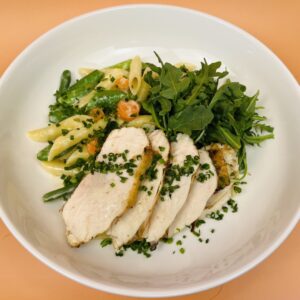
Penne Primavera with Pan-Roasted Lemon Chicken Breast
In this classic springtime dish, a cornucopia of colorful, seasonal vegetables combines with al dente pasta in a creamy Parmigiano cheese sauce. You can serve the pasta component solo as a primi, or Italian first course, or make it a light vegetarian entrée. If you make the full recipe—topping the penne with juicy, lemon-marinated, pan-roasted chicken breast—this pasta dish makes a hearty meal.
Ingredients
step 1 ingredients
- 1/2 lemon
- 1 garlic clove
- 1/4 c white wine
- 1/4 tsp kosher salt
- 1/8 tsp dried oregano
- 1/8 tsp dried thyme
- 1/4 c extra-virgin olive oil
step 2 ingredients
- 1 (1 1/2 lb) bone-in, skin-on chicken breast half (or 1 [6-oz] boneless, skinless chicken breast per person)
step 4 ingredients
- 6 oz asparagus, preferably thick stalks
- 2 oz sugar snap peas
- 1 young carrot (the type with leafy tops intact)
- 2 oz green beans
- 1/2 small turnip
- 6 oz fresh peas in the pod (or 1/4 c frozen peas per person)
step 6 ingredients
- 2 oz Parmigiano-Reggiano cheese
step 8 ingredients
- 1 Tbsp pure olive oil (not extra-virgin)
- 1 tsp butter
step 9 ingredients
- 1/2 oz chives (or the green part of a scallion)
step 10 ingredients
- 1 Tbsp kosher salt
- 5 oz penne pasta, preferably made in Italy
step 11 ingredients
- 1 1/2 c heavy cream
- to taste kosher salt
step 14 ingredients
- 1 1/2 oz baby arugula (or other microgreens)

Instructions
PREP: Mise the recipe ahead of time.
1. Make the marinade and lemon seasoning for the penne:
- Use a swivel peeler to remove 2 strips of yellow zest from half the lemon. Mince the zest. Place half of the minced zest in a container large enough to hold the chicken breasts. Place the remaining minced zest in a small container for seasoning the penne.
- Squeeze the juice from the lemon. Place 1/2 tsp juice into the small container with the lemon zest, and place the remaining juice in the chicken container.
- Peel the garlic and use a garlic press to crush it into the chicken container.
- Add the wine, step 1 salt, oregano, thyme, and extra-virgin olive oil to the chicken container and stir to combine.
2. Fabricate the chicken:
- If using a bone-in, skin-on chicken breast, remove the bones. Remove the tender and save it for another use. Trim away any connective tissue and fat. Reserve the bones for stock-making, or discard.
- OR—If using boneless, skinless chicken breasts, trim away any connective tissue and fat.
3. Marinate the chicken:
- Place the boneless skin-on breast in the marinade and turn it to coat evenly. Refrigerate for at least 2 hours or for up to 24 hours. After 24 hours, remove from the marinade and blot dry before further holding. Reserve the marinade.
- OR— Place the boneless, skinless breasts in the marinade, turn to coat, and refrigerate for 1 hour or for no longer than 3 hours. Remove from the marinade and blot dry before further holding. Reserve the marinade.
4. Fabricate the primavera vegetables:
- Snap the tough ends off of the asparagus stalks. If the asparagus is medium-thick to thick, use a swivel peeler to peel the lower ends of the stalks. Cut into 1-inch diagonals.
- Trim off the stem ends of the snap peas and pull off any strings from both sides. Cut larger snap peas in half on the diagonal.
- Peel the carrot and cut it into rounds a little less than ¼ inch thick.
- Trim the ends from the green beans and cut into 1-inch diagonals.
- Peel the turnip and cut into small batonnets (¼ x ¼ x 1 ½ inch).
- Shell the peas. (If using frozen peas, simply thaw them on a paper towel, do not cook.)
5. Blanch and refresh the primavera vegetables:
- Bring at least 1 gal water to the boil. Have ready a “spider” strainer and a bowl of cold water in the sink.
- Working with each type of vegetable separately, immerse the vegetables into the boiling water just long enough for them to cook crisp-tender. (Test by tasting a piece of each type.) Use the strainer to transfer each batch of vegetables into to the cold water, running a thin stream of tap water into the bowl to maintain the cold temperature.
- Drain the vegetables and blot dry on paper towels.
- If prepping ahead, place the vegetables in a plastic bag with a folded paper towel in the bottom.
6. If necessary, fine-grate the Parmigiano-Reggiano.
HOLD: Refrigerate all ingredients up to 4 days.
COOK! Finish and plate your dinner.
7. Bring at least a gallon of water to the boil. Have ready a “spider” strainer and a ladle.
8. Pan-roast the chicken:
- Preheat an oven to 425°F.
- Blot the chicken dry on paper towels.
- Place a sauté pan over medium heat until hot. Add the oil and butter, and then add the chicken breast skin side-down (or convex presentation side-down). Sauté about 5 minutes until the skin (or bottom-side) becomes golden brown. (Sauté boneless breasts only about 2 minutes.)
- Turn over the chicken and sauté about 1 minute longer.
- If the chicken breast is very thick, turn it thickest side-down and sauté about 1 minute longer until golden brown on the bottom.
- Transfer the chicken to a sizzle pan or baking dish and baste it with some of the marinade. Roast the skin-on boneless breast about 8 minutes, basting once more with some of the reserved marinade.
- insert an instant-read thermometer in the thickest part of the breast; when almost cooked through the internal temperature should reach 160°F; the temperature will increase to 165°F through carryover cooking as it rests. Boneless breasts need only a minute or two in the oven to finish cooking.
9. Cut the chives crosswise into very thin rounds.
10. Boil the penne:
- Add the step 10 salt to the boiling water.
- Drop the penne into the boiling water, stir to separate it, and return to the boil.
- Cook, stirring often, about 7 minutes until just under al dente in texture.
11. Start the sauce:
- Add the cream to a nonstick sauté pan and bring to the boil. Reduce to about half its original volume.
- Add the lemon juice and zest, then add the primavera vegetables and some salt.
12. Finish the penne:
- Use the “spider” strainer to transfer the penne into the sauté pan with the cream and vegetables. (Some of the hot pasta cooking water will come along with the penne; this is necessary.) Keep the pasta water at the simmer.
- Bring the sauce, pasta, and vegetables to the simmer and cook over medium heat, stirring often, for about 1 minute until the vegetables are hot and the cream has thickened into a thin sauce.
- Turn off the heat and fold in the cheese. The sauce should thicken around the vegetables. Once the cheese is in the sauce, don’t return the pan to heat.
- Taste to evaluate the seasoning; add more salt if needed.
- Cover the pan and hold in a warm place until ready to plate.
13. Slice the chicken:
- Place a small cutting board onto a sheet tray. Transfer the chicken breast(s) to the cutting board and cut them across the grain on the diagonal into slices, while maintaining the original shape of the chicken breast(s). Retain the juices.
14. Plate:
- Evaluate the consistency of the penne sauce. If it’s too “tight” (thick and not flowing), use the ladle and a plastic spatula to fold in a little more hot pasta-cooking water.
- Use a large spoon to mound the penne slightly left of center into warmed pasta bowls.
- Mound some of the arugula on the penne at the top right of each plate.
- Slide a knife under each portion of the sliced chicken breast, keeping the shape intact, transfer it to the right front of each pasta bowl, and fan it out, partially leaning on the arugula.
- Make bouquets of the remaining arugula and plant them upright to create height on the plate.
- Sprinkle a line of chives across each plate.
Nutrition
Calories: 1645kcalCarbohydrates: 88gProtein: 58gFat: 120gSaturated Fat: 55gPolyunsaturated Fat: 10gMonounsaturated Fat: 48gTrans Fat: 0.2gCholesterol: 299mgSodium: 4433mgPotassium: 1412mgFiber: 13gSugar: 20gVitamin A: 10718IUVitamin C: 91mgCalcium: 623mgIron: 7mg
Tried this recipe? Hope you liked it!Share your experience with the PrepHoldCook community. We’d love to hear from you — please leave a comment in the form below.