

Your Cooking Lesson
Advice, explanation, and in-depth information to help you achieve recipe success.
Seafood and citrus is a time-tested flavor combination that brings out the best of each ingredient. And winter is peak season for enjoying citrus fruit from warmer climes. Although lemon is the usual pairing with seafood, for variety it’s great to feature other members of the citrus family. In this recipe, blood oranges take center stage.
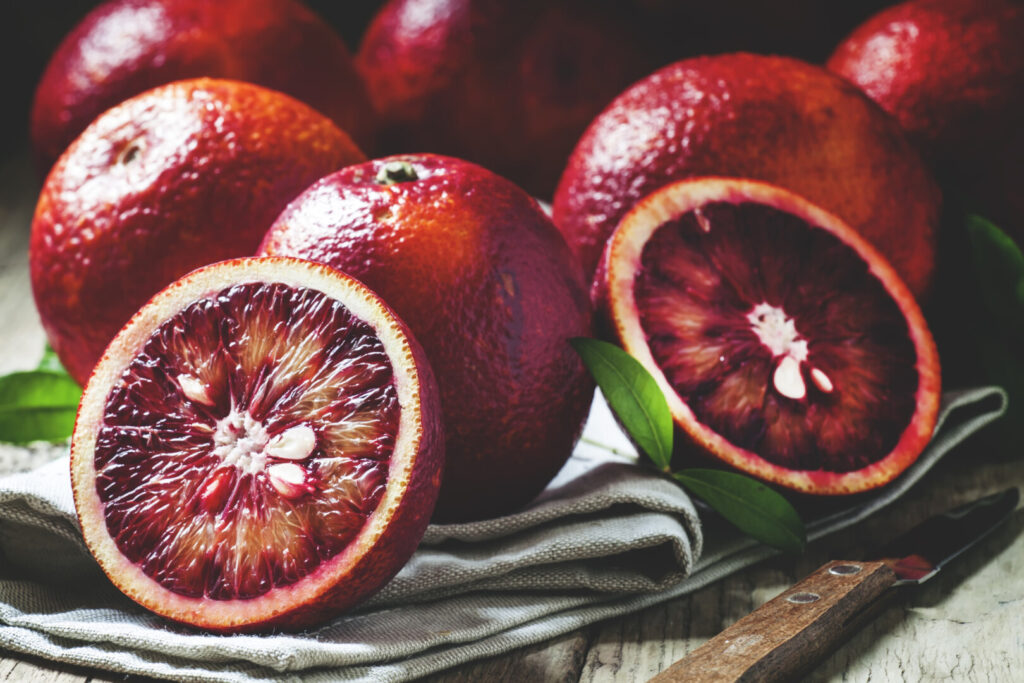
Blood oranges take their somewhat gruesome name from the deep-red color of their flesh. (In an apparent attempt at better PR, some produce companies are now calling them “raspberry” oranges.) No matter how they’re marketed, the bright red color of these oranges results from the presence of anthocyanins, a pigment family more commonly found in berries, cherries, pomegranates, beets, and red cabbage. As well as giving these foods their beautiful colors, anthocyanins function as antioxidents that are beneficial to health. Not all blood oranges are as deeply colored as the ones shown on the left, but all have a reddish tinge and a distinctive blood orange flavor.
The taste of blood oranges varies slightly by cultivar and growing conditions but, in general, they’re sweet with good acid balance and a subtle berry-like flavor.
Blood oranges likely originated in the Mediterranean region, where they’ve been cultivated since the 18th century. Some of the best are grown in Sicily. Today blood oranges also are grown in Texas, Florida, and California.
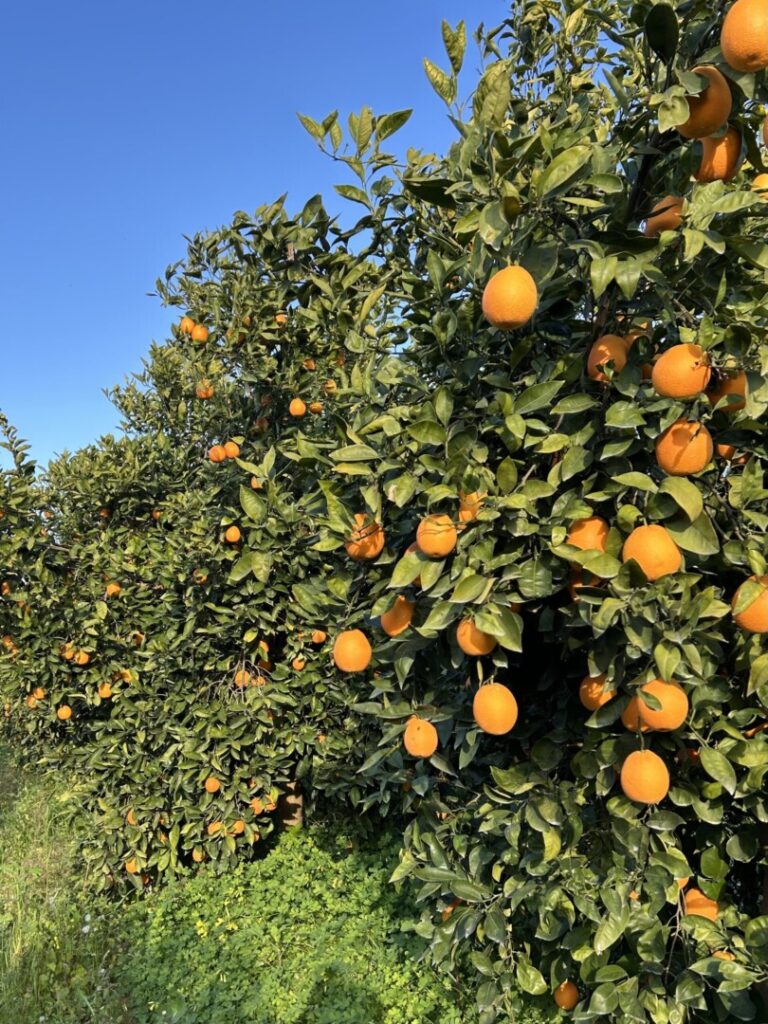
This dish features blood oranges in two ways:
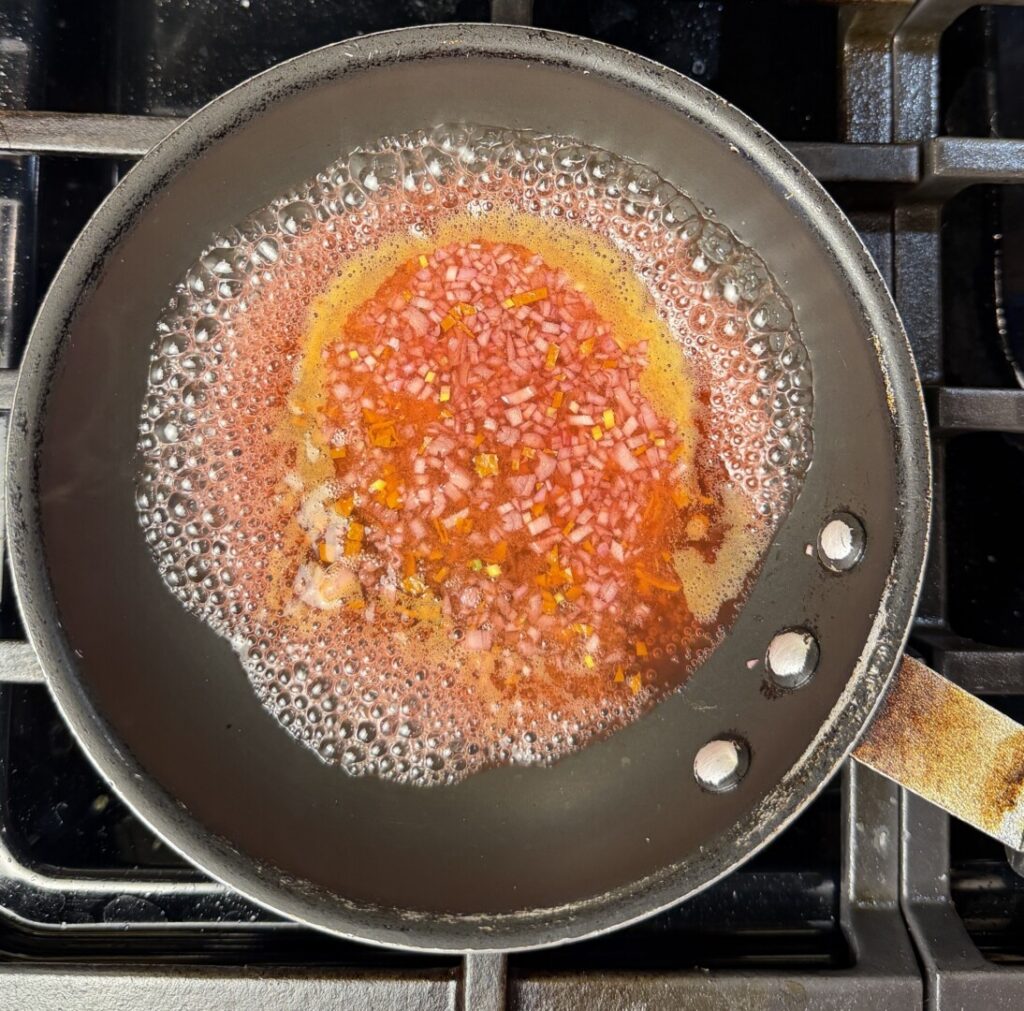
The Sauce
To make this bright and tangy pan sauce, the juice and zest of blood oranges are reduced to form the liquid base of a raw butter emulsion sauce. (The best known of such sauces is the classic sauce beurre blanc, or white butter sauce, based on white wine, white wine vinegar, and minced shallots.) Once the flavorful liquids are sufficiently reduced and slightly cooled, chunks of cold butter are whisked into the reduction to slowly melt without allowing the butterfat to separate from the butter’s milk solids. The result is a thick, rich, creamy-textured sauce perfect for enhancing lean white-fleshed fish. Using a blood orange juice reduction imparts a unique flavor and stunning orange-pink color.
The Garnish
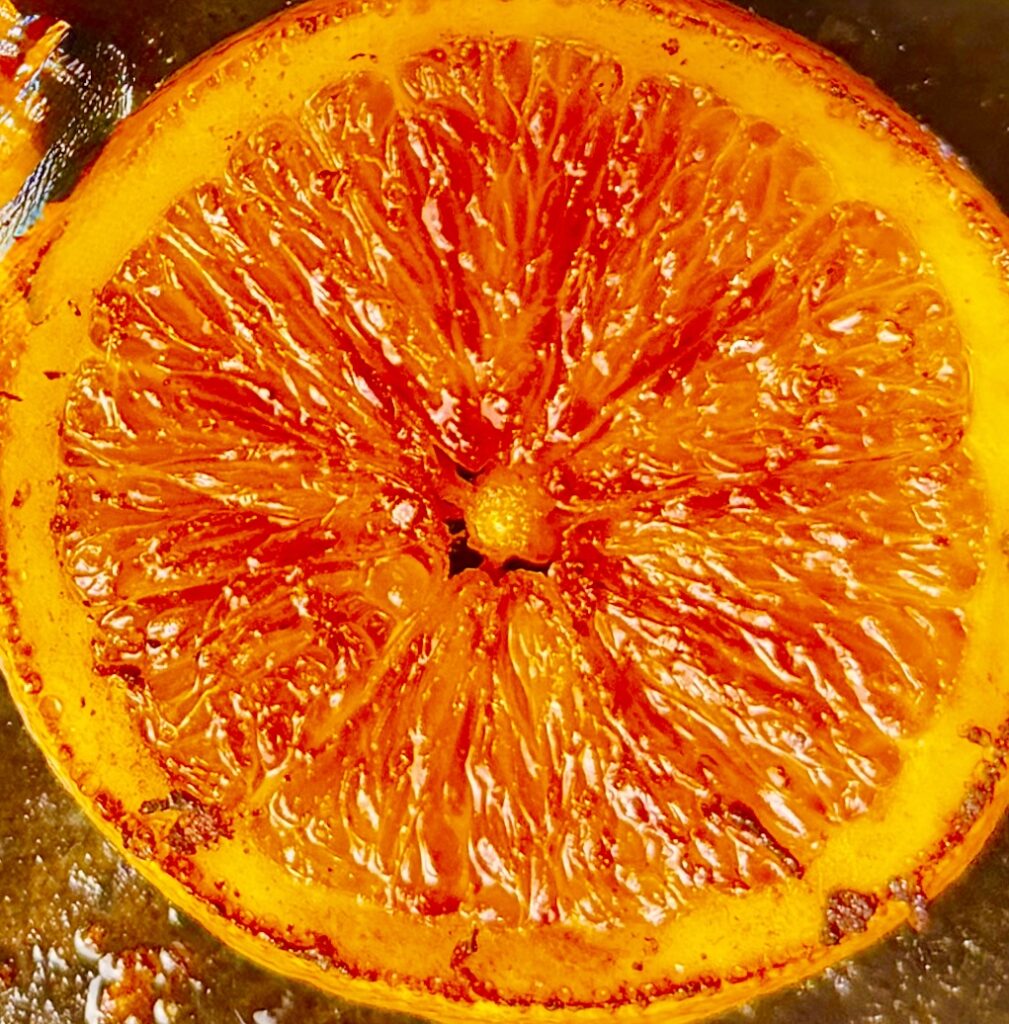
This dish doubles down on lively orange flavor by adding a pan-seared blood orange slice as a garnish. Searing in hot oil warms and softens the slice’s orange flesh and lightly caramelizes the rind. As with most modern plate garnishes, the orange slices are meant to be eaten. The tart, slightly bittersweet flavor of the slice contrasts nicely with the rich mouthfeel and sweet flavor of the sauce.
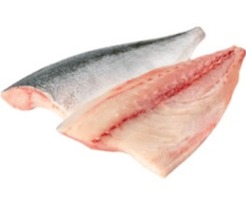
For this recipe you can use just about any type of fish, from very lean (such as cod, haddock, or hake) to moderately fatty (such as red snapper, halibut, grouper, or striped bass). Even wild salmon would work fine if you trim off most of its dark-colored fat. In testing and photographing this recipe I used amberjack, often known by its Japanese name hamachi.
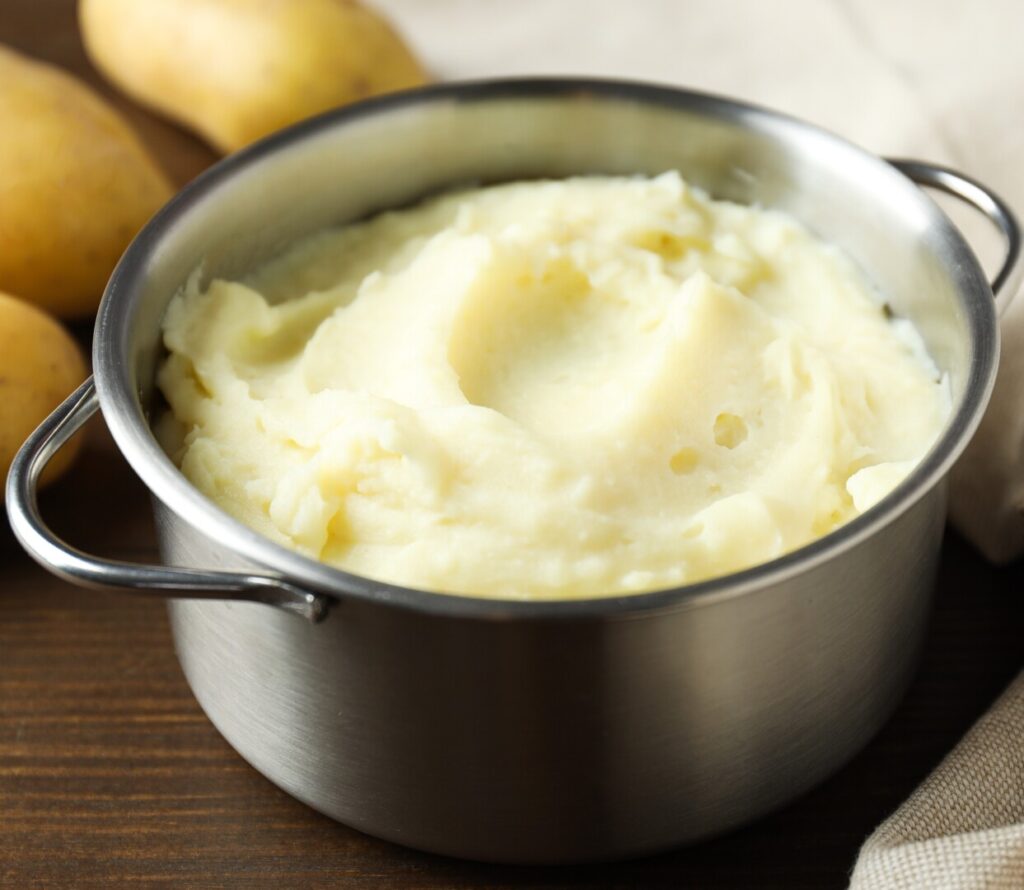
Fish and potatoes are the traditional pairing in classic French cuisine, and these light and airy purée potatoes are the perfect complement to the savory fish and rich, tangy-sweet sauce. Purée potatoes are looser and fluffier than mashed. Because of the rich butter sauce, we’ll keep the butter and cream in these potatoes to a minimum, and lighten them using some of their cooking water.
Slightly bitter wilted spinach acts as a foil for the sweetness of the carrots and sauce.
Let’s prep!
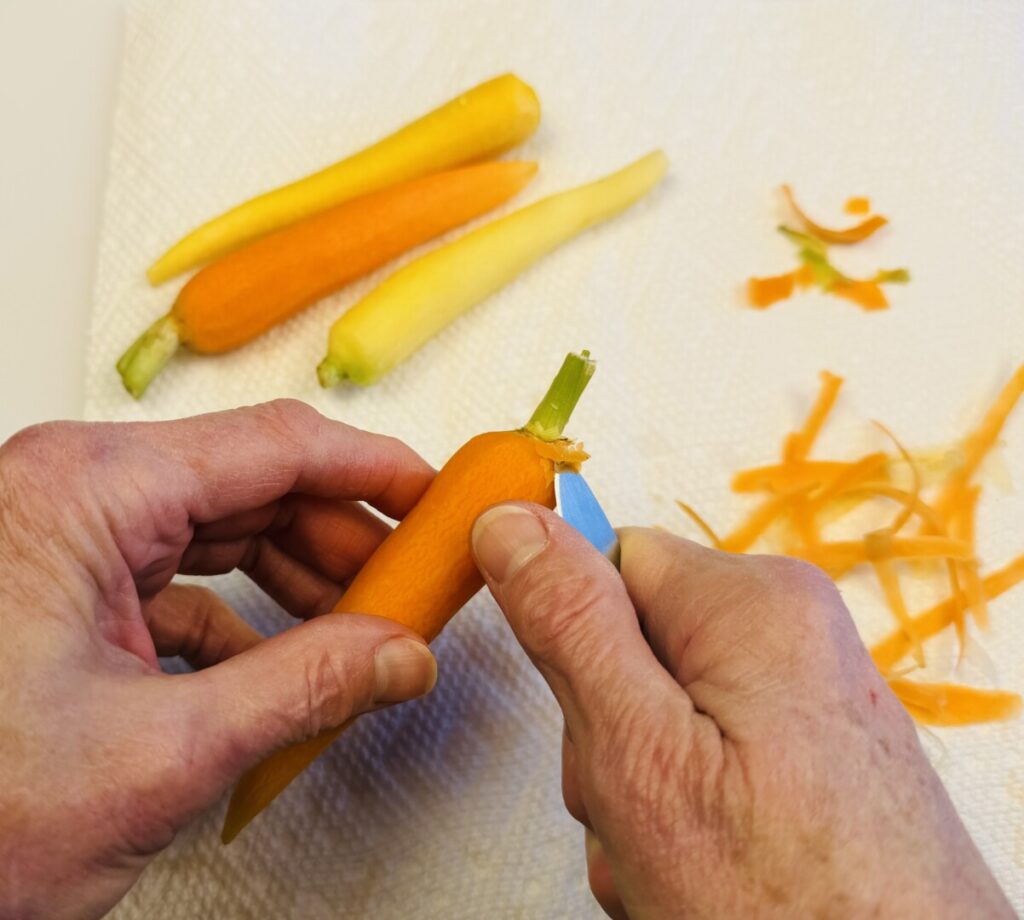
Start by fabricating and par-cooking the carrots. Multicolor young carrots make a visually stunning accompaniment to almost any dish. They’re usually sweeter and more tender than fully mature carrots, as well. Although these carrots usually are sold pre-peeled, during the shipping and holding process the exteriors of the peeled carrots often lose color and flavor due to oxidation. I usually shave off the outer layer with a swivel peeler to reveal the more brightly-colored flesh beneath. Use the tip of a paring knife to carve off any discolorations where the wide “shoulder” of each carrot meets the stem.
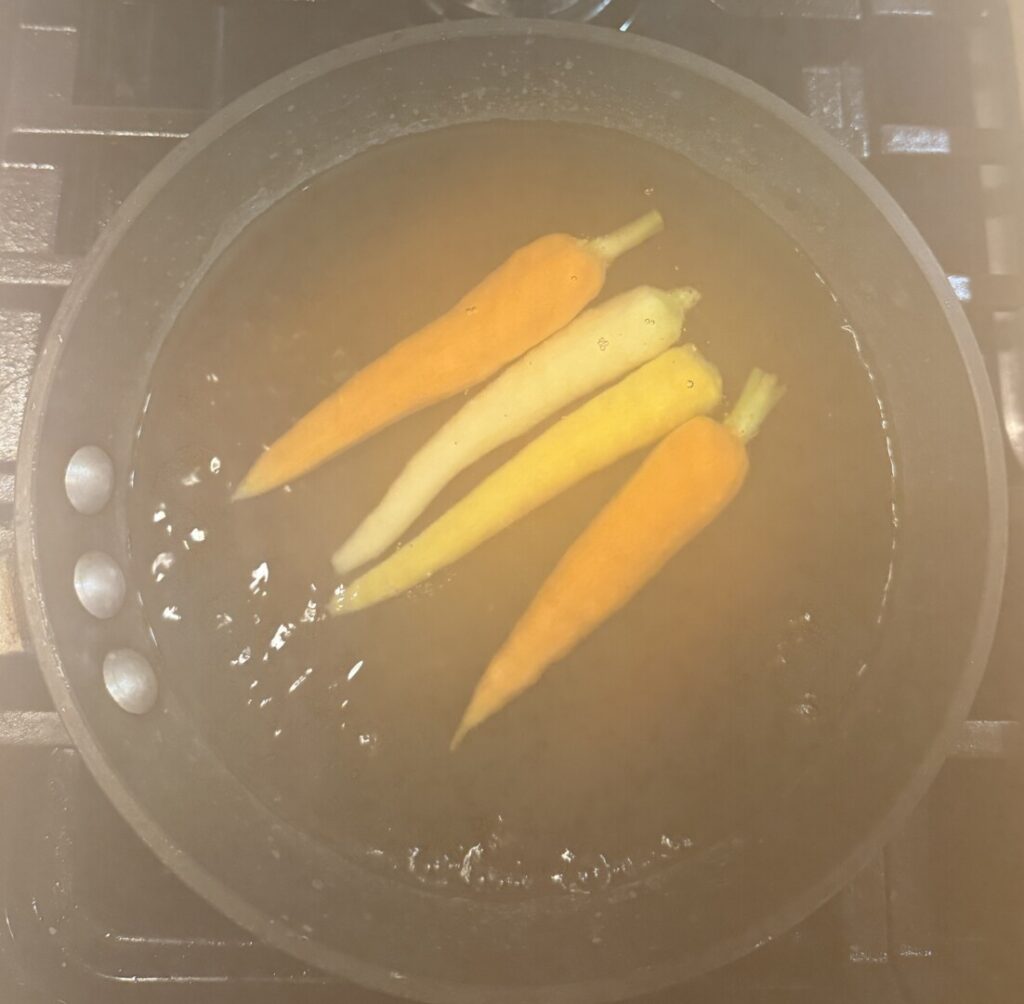
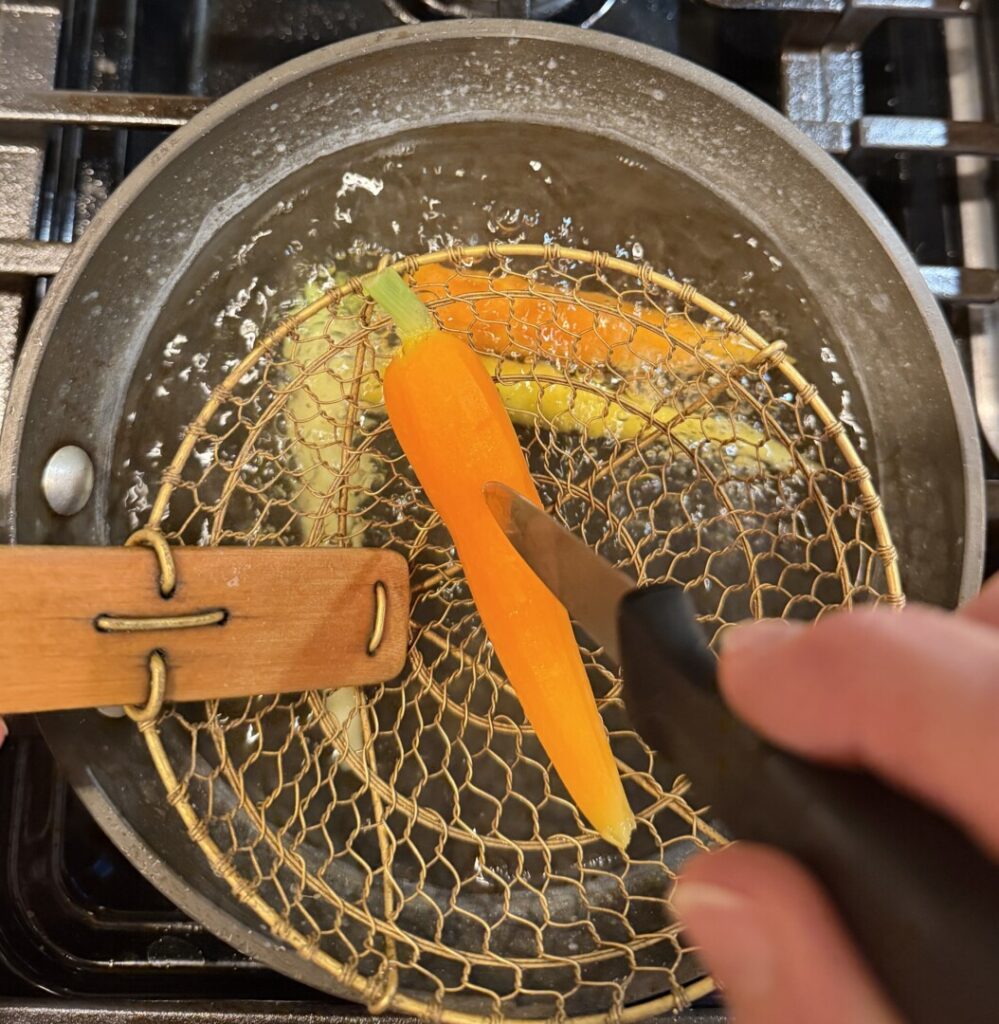
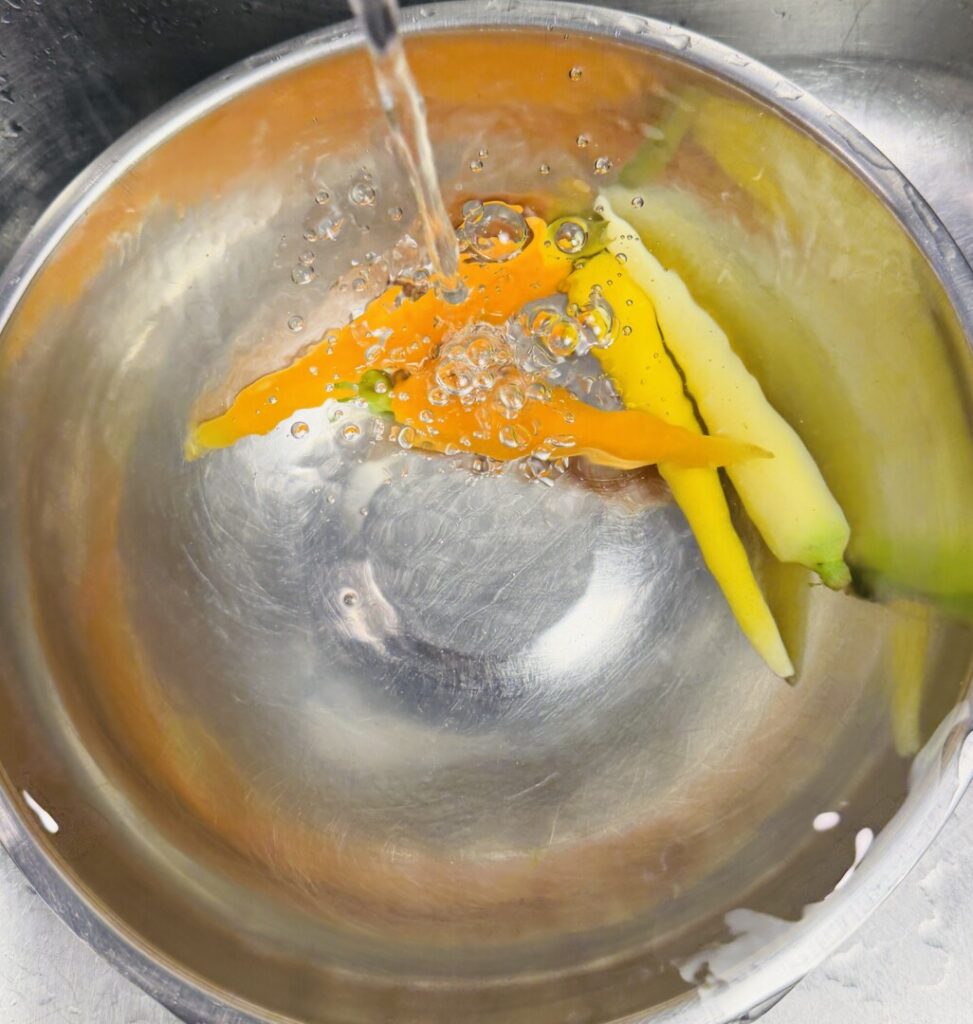
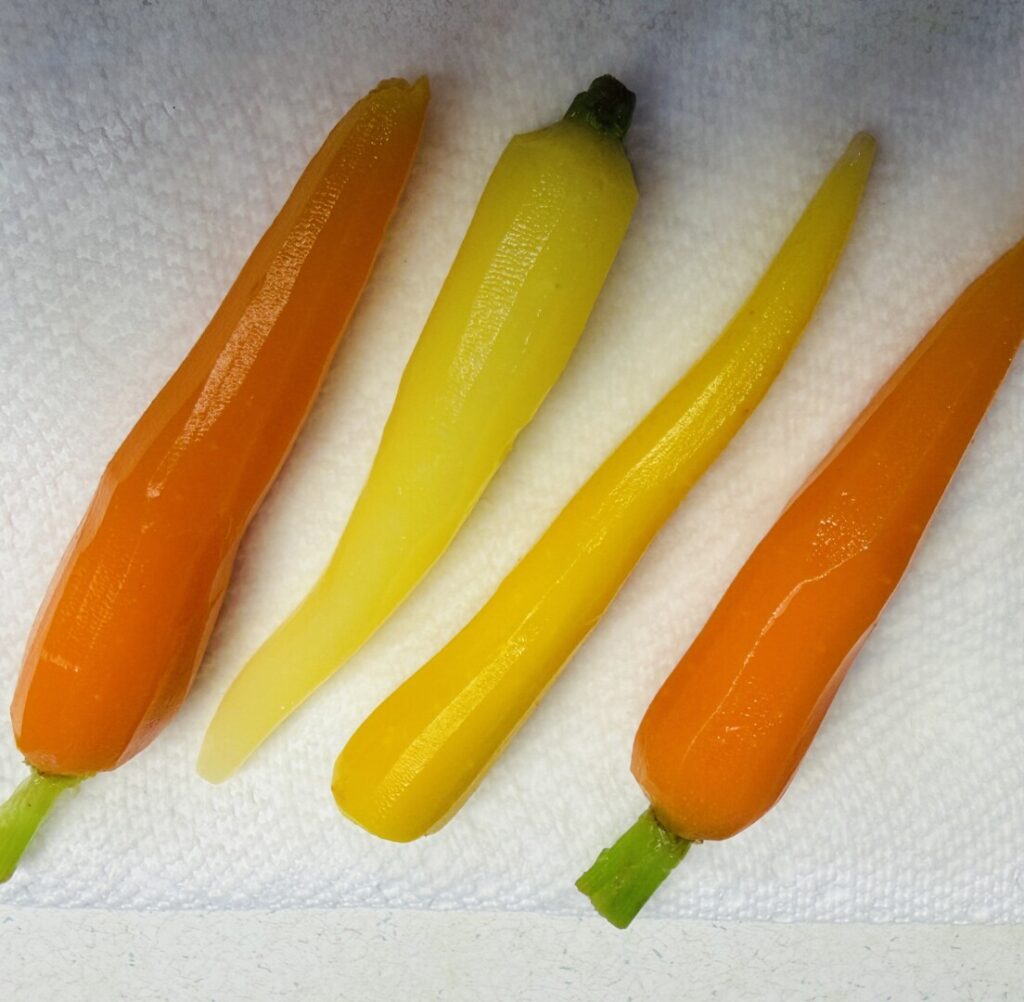
Blanch the carrots in boiling water until crisp-tender; a knife inserted in a properly cooked carrot should slide in with just a little resistance. Refresh under cold water and then blot dry on paper towels.
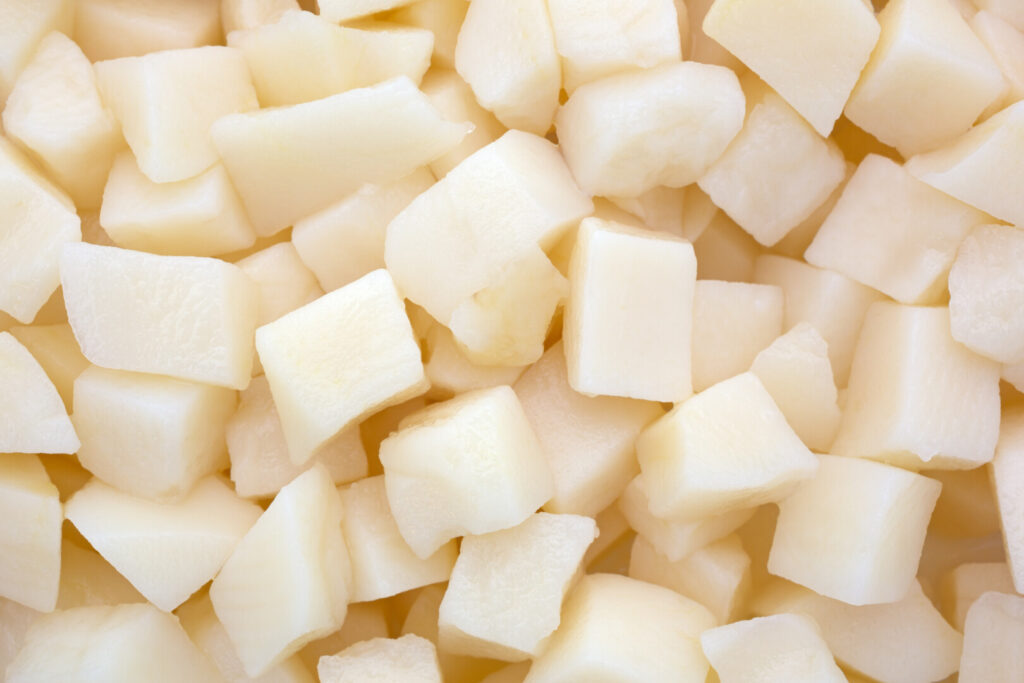
Purée potatoes are best when freshly made. But you can save valuable minutes at dinnertime by peeling and dicing the potatoes ahead as part of prep. Store them in a container completely immersed in cold water to prevent enzymatic browning.
While you’re at it, measure out the butter and cream.
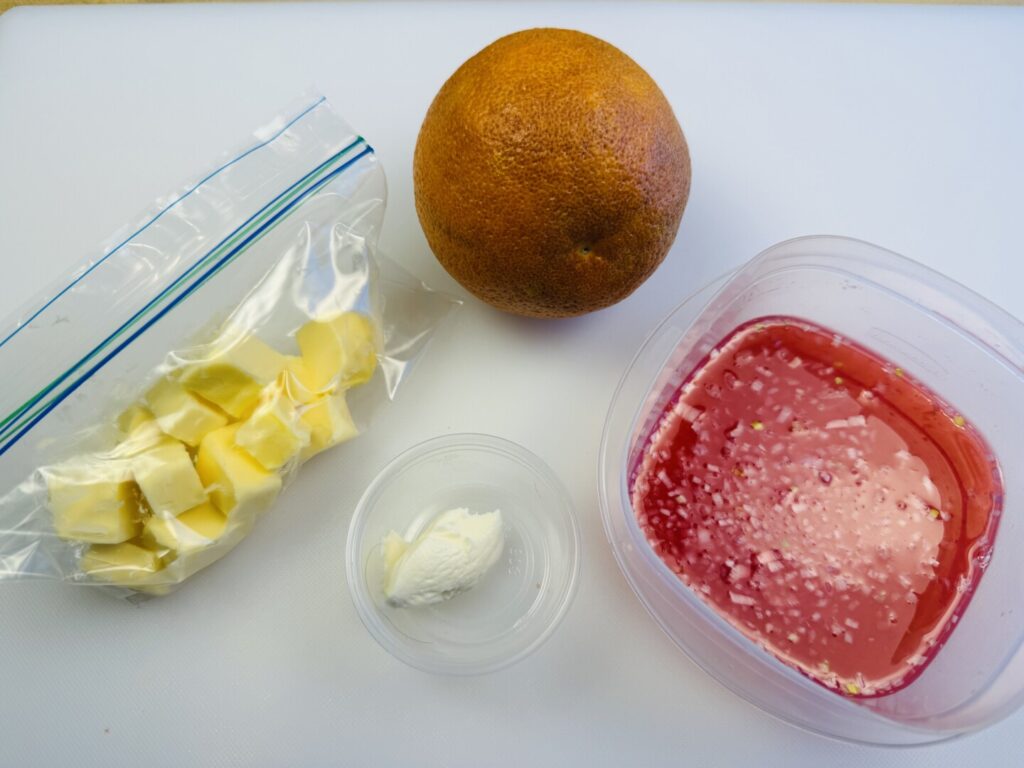
To prep the sauce, squeeze the blood orange juice into a container and then add minced shallots, a little salt, and some lemon juice to bring up the juice’s acidity level. Cube the butter and measure out the crème fraîche or cream.
The additional orange is for the garnish slices you’ll cut when they’re needed.
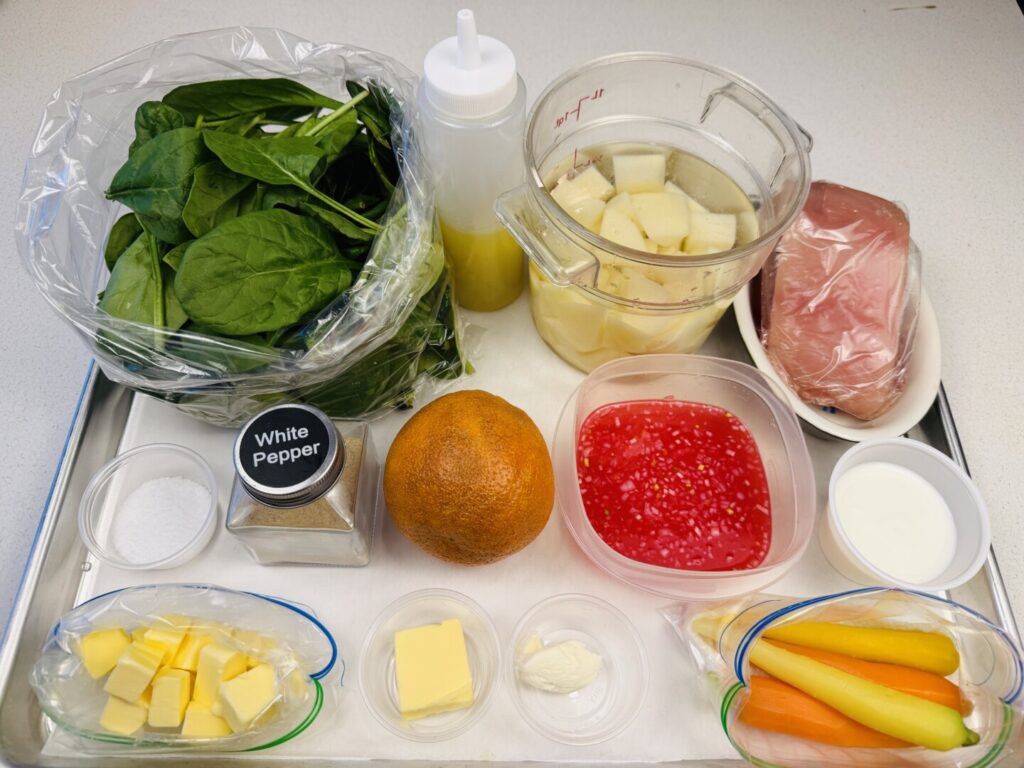
Assemble the remaining ingredients and your prep is complete. Here’s your mise tray:
It’s dinnertime—let’s COOK!
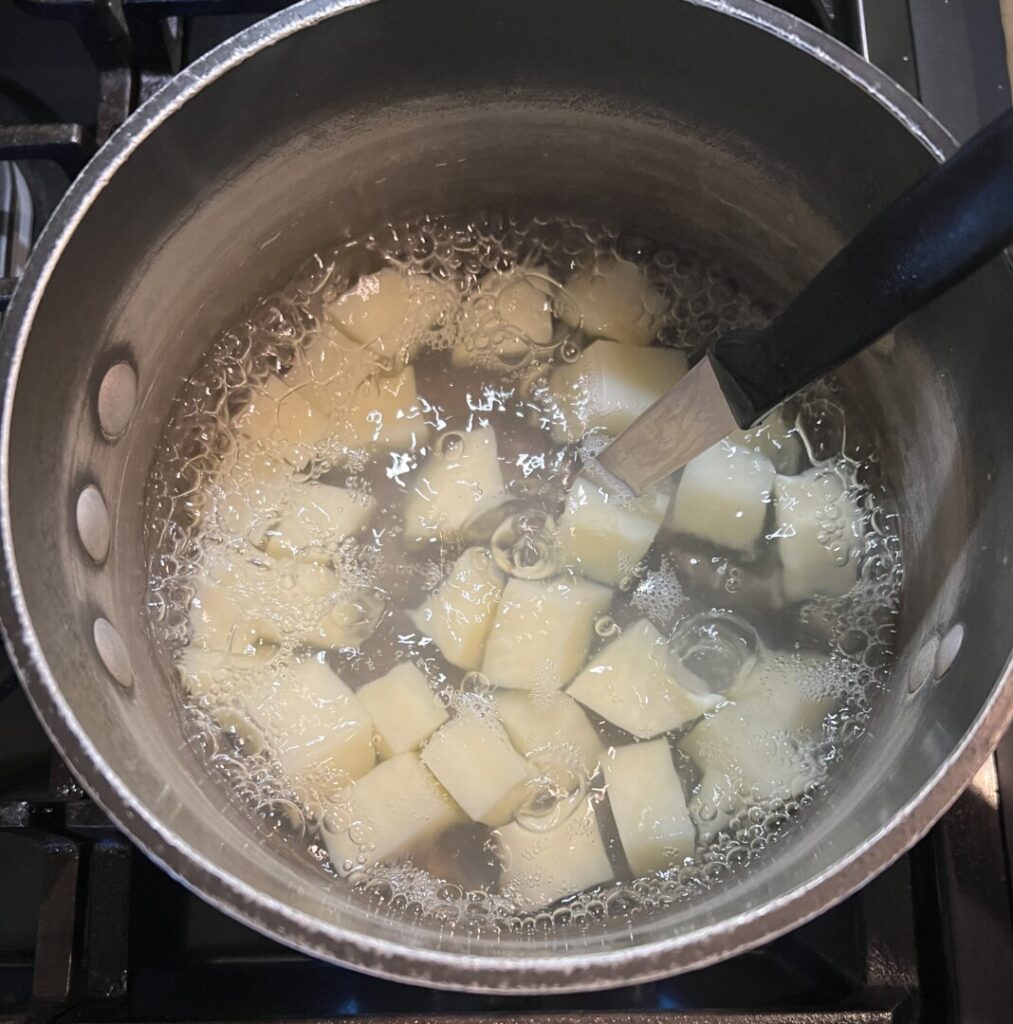
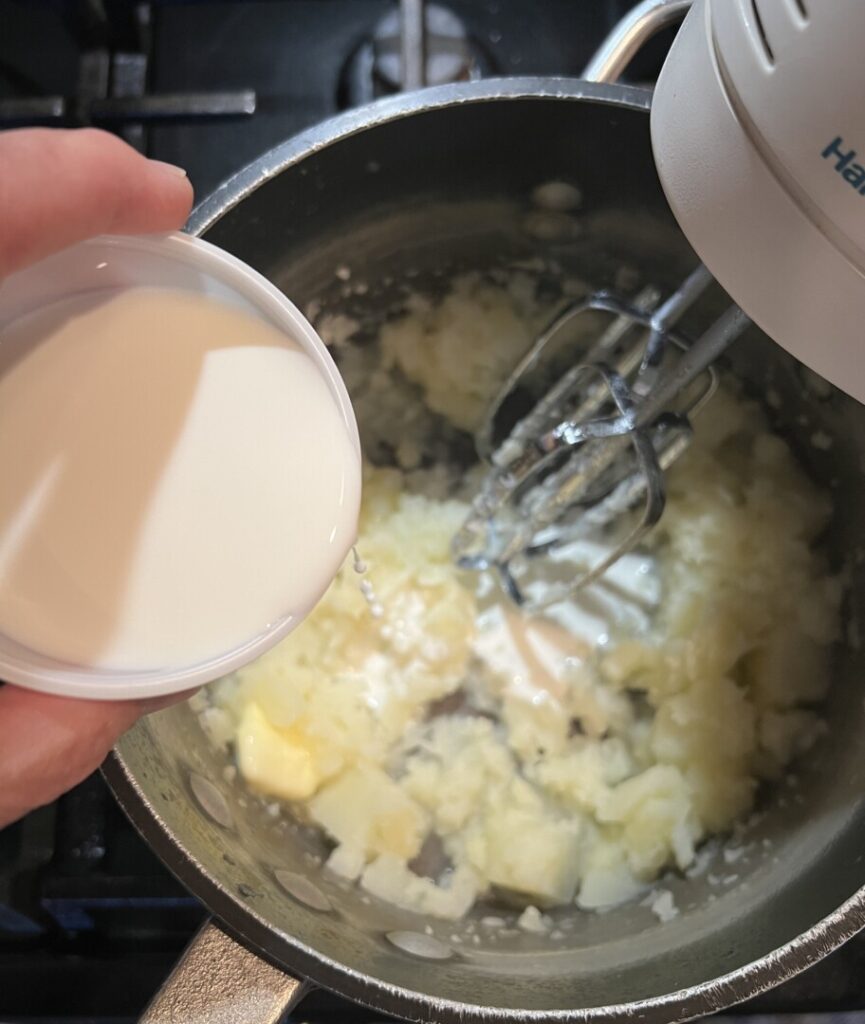
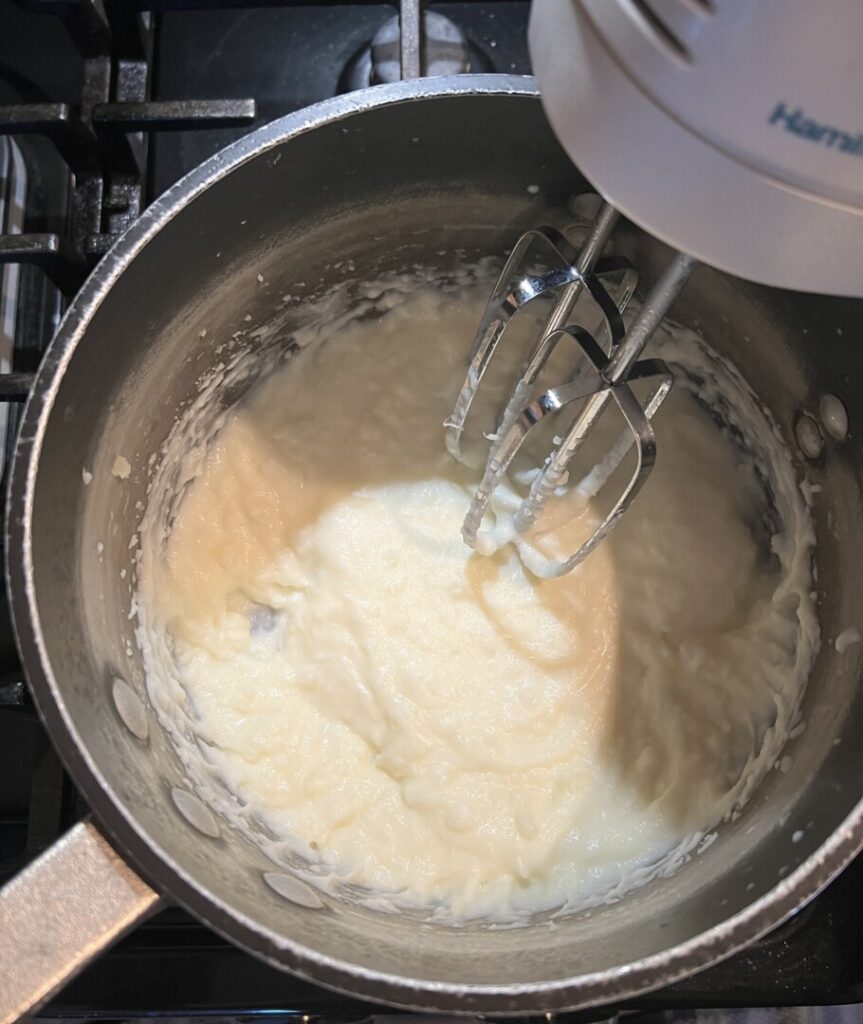
To make the purée potatoes, drain off the soaking water and place the potatoes in a roomy saucepan. Cover with fresh cold water and add a generous amount of salt. (Only a small amount of the salt will penetrate into the potatoes along with the cooking water.) Bring to the boil and simmer briskly just until the potatoes are tender when pierced with a knife. Don’t overcook the potatoes to mush; overcooking potatoes releases too much starch that can give your purée a gluey texture. Drain off most of the cooking water but, for a light and fluffy purée, leave at least 1/4 inch or more in the pan. Whip the potatoes with a hand-held mixer or heavy wire whip, adding the butter and cream. Whip only until the potatoes are puréed. Over whipping also causes a gluey texture. Alternatively, you can use an immersion blender—but take care, as it’s easy to over-whip with such a powerful device. When in doubt, whip less! In my opinion, a few lumps are better than a plateful of gluey potatoes. Evaluate and, if necessary, correct the salt and add the optional white pepper. Cover the pan and hold the potatoes over a very low burner. The purée may thicken as it sits. If so, whisk in a little boiling water to maintain a light, loose, and fluffy texture thinner than most mashed potatoes.

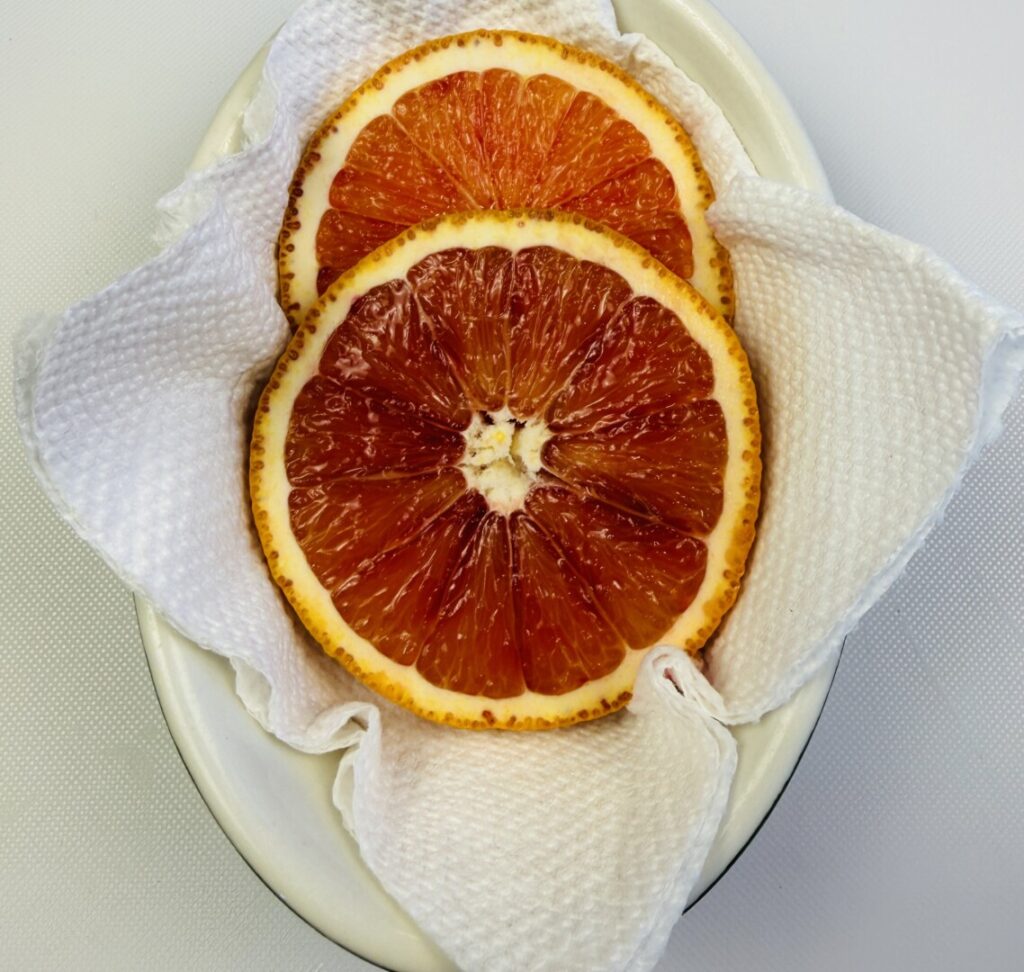
Cut a thick slice of orange for each portion, and place the slices on paper towels to absorb excess moisture.
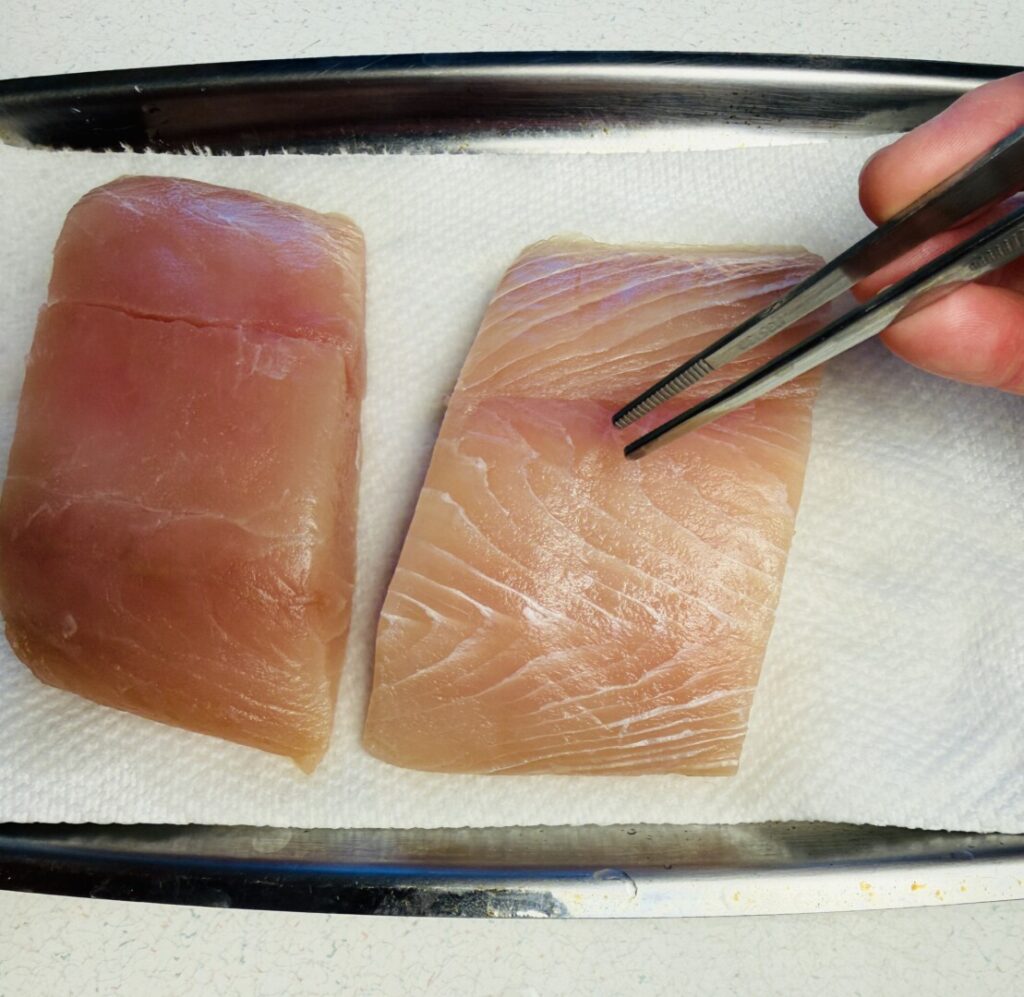
Rinse the fish fillets under cold water and thoroughly blot dry on paper towels. Check the fillets for pin bones by pressing the flesh gently with your fingers, especially along the center line and the edges. If you feel any small bones, use kitchen tweezers to remove them.
The remaining cooking is time-sensitive and requires some multitasking—but by following the recipe directions, you can turn out this dish just like a professional line cook! Before you begin to make the sauce, get ready for the rest of your cooking by placing a nonstick sauté pan on one burner, and (preferably) a carbon steel sauté pan on another. (For speed and efficiency, you can turn the burners on to the lowest setting.) Have a small bowl ready at the stove. Prepare your carrots for heating in the microwave oven.
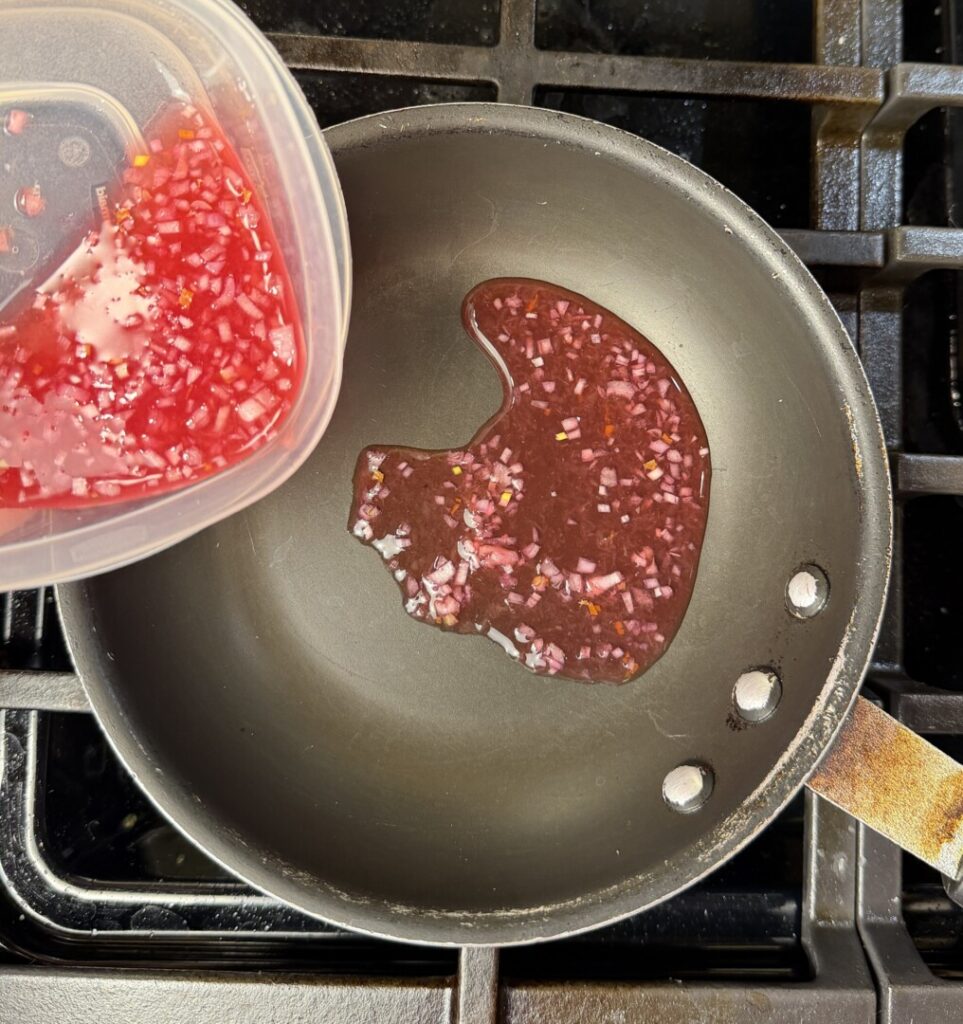
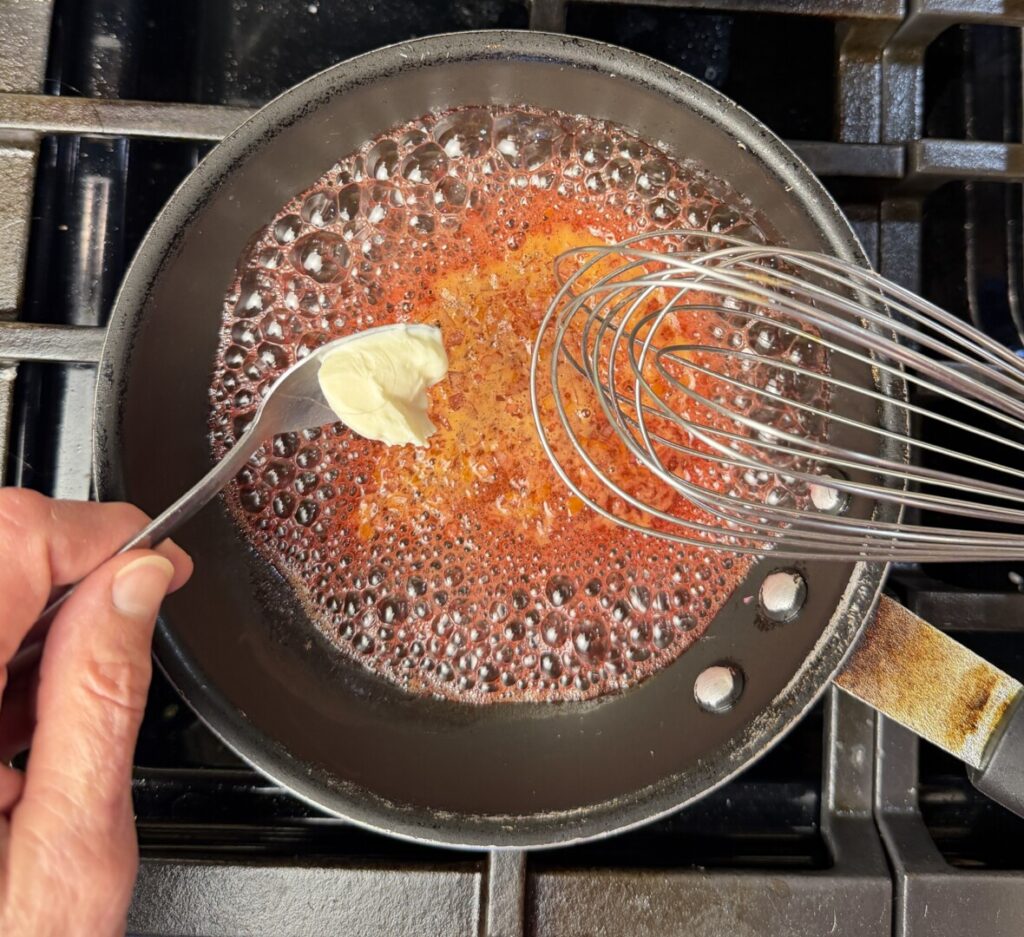
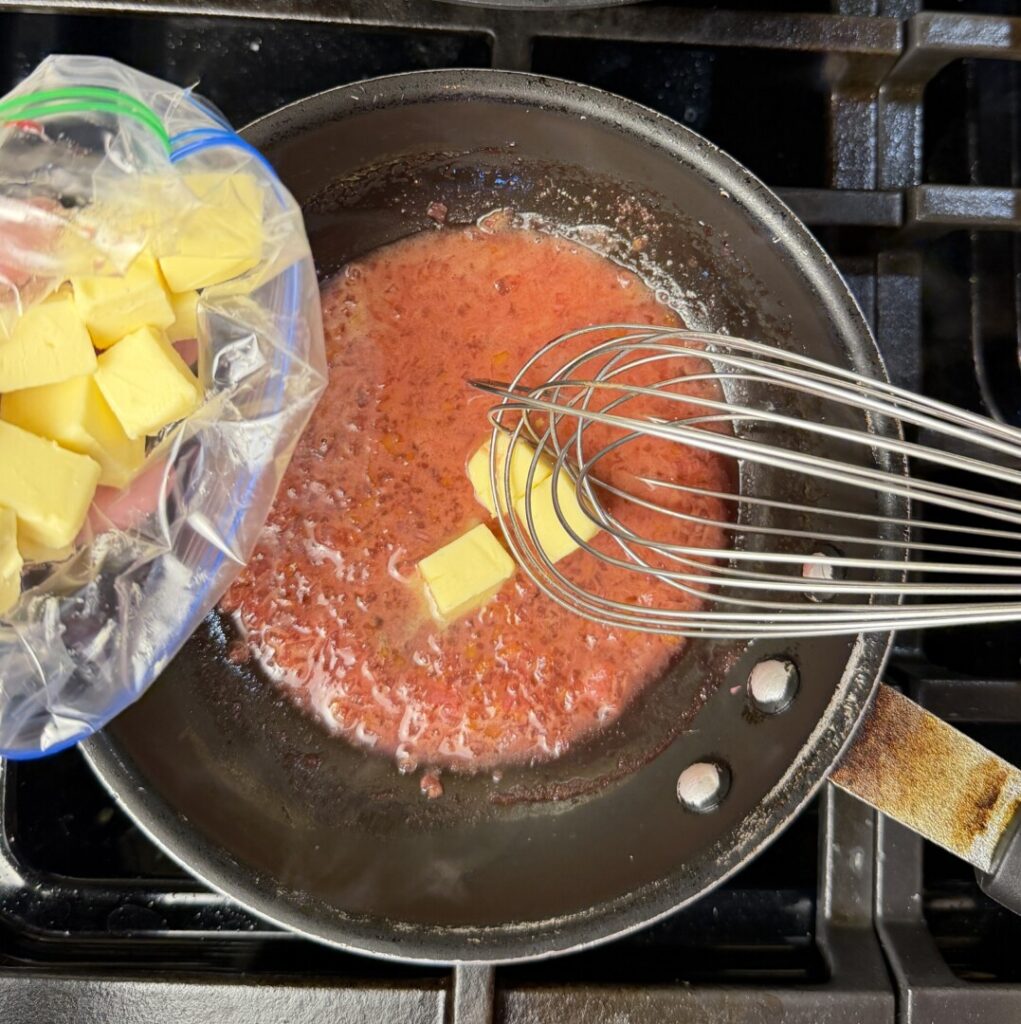
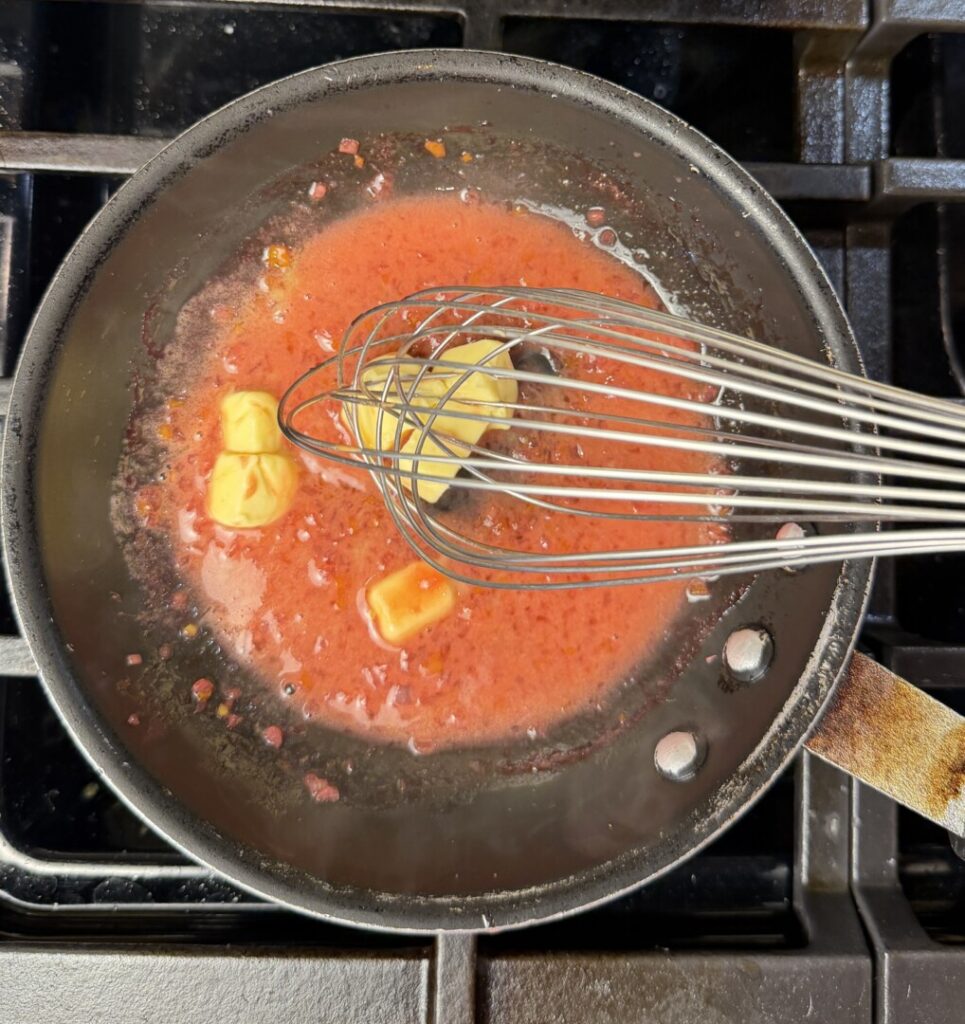
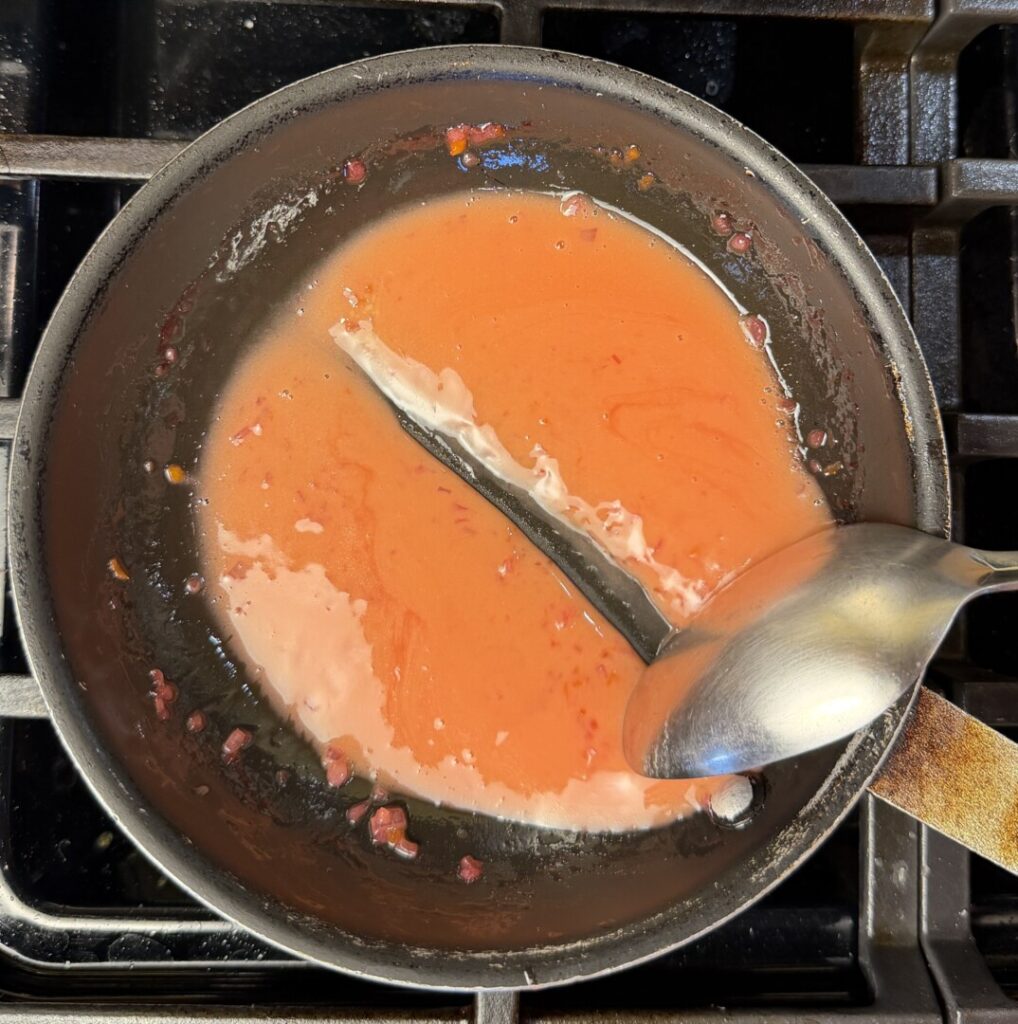
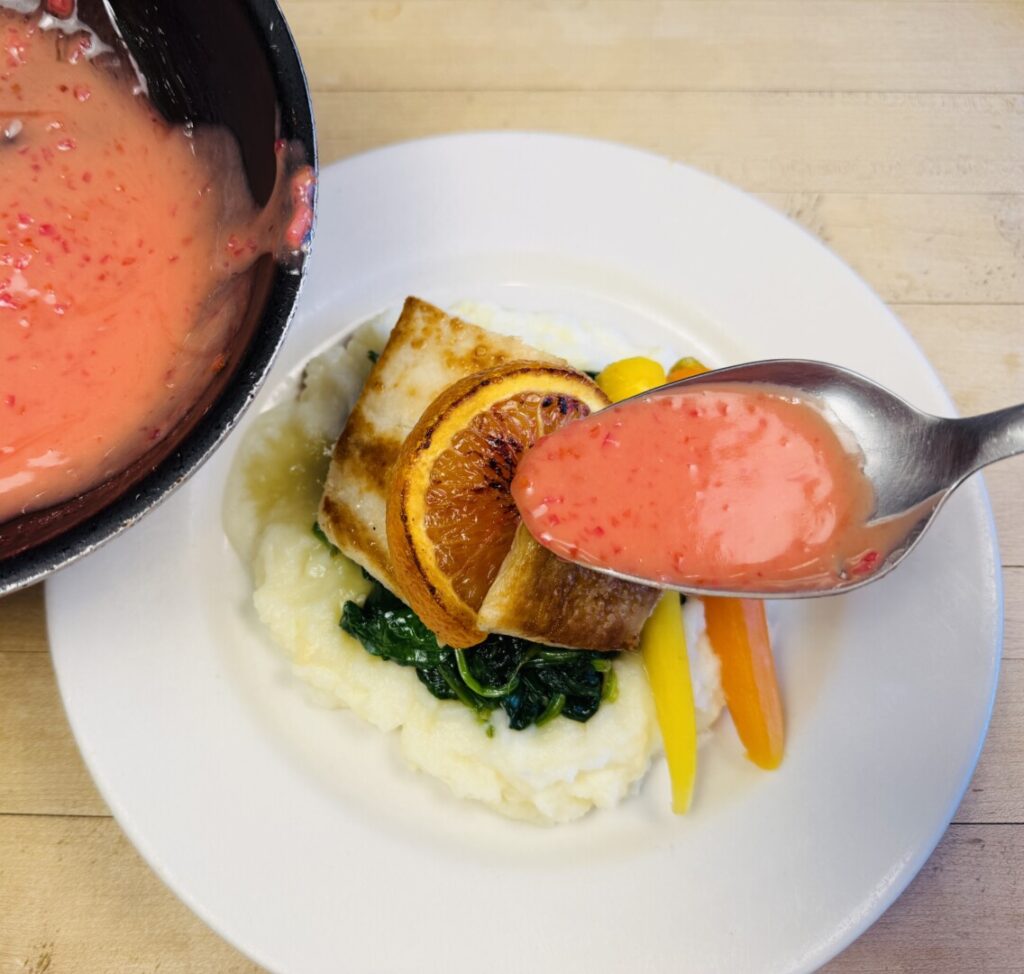
To make the sauce, pour the blood orange sauce base into a small sauté pan and bring it to a lively simmer. Cook over medium heat until the liquid reduces to about 1/3 of its original volume. Turn off the heat and whisk in the crème fraîche or heavy cream. Start whisking in the cold butter, a few chunks at a time. The butter will slowly melt and emulsify with the reduced liquid. It should not melt quickly, and you should not see streaks of oily yellow butterfat. When the first addition of butter is completely emulsified, whisk in a few more chunks. If the temperature drops enough so that the butter stops melting, turn on low heat for a few seconds only, and then continue. As you add butter, the sauce will thicken and turn glossy. When all the butter is in, the sauce will have a nappé consistency (thick enough to coat a spoon but thin enough to flow on a plate) as shown in the photo at the far right. Evaluate the flavor and, if necessary, add a little more salt. Hold the sauce in a warm area on the back of the stove. Monitor it so that is doesn’t get too hot and begin to break, or separate. (If it should get too warm and threaten to break, try whisking in a small ice chip.) If your sauce does break, don’t get upset. Chalk it up to practice and use it anyway—it’ll still taste great.
To view a short video showing how to make a raw butter emulsion sauce, click this link: https://prepholdcook.com/tutorials/how-to-make-a-lemon-butter-sauce-with-chef-lou/
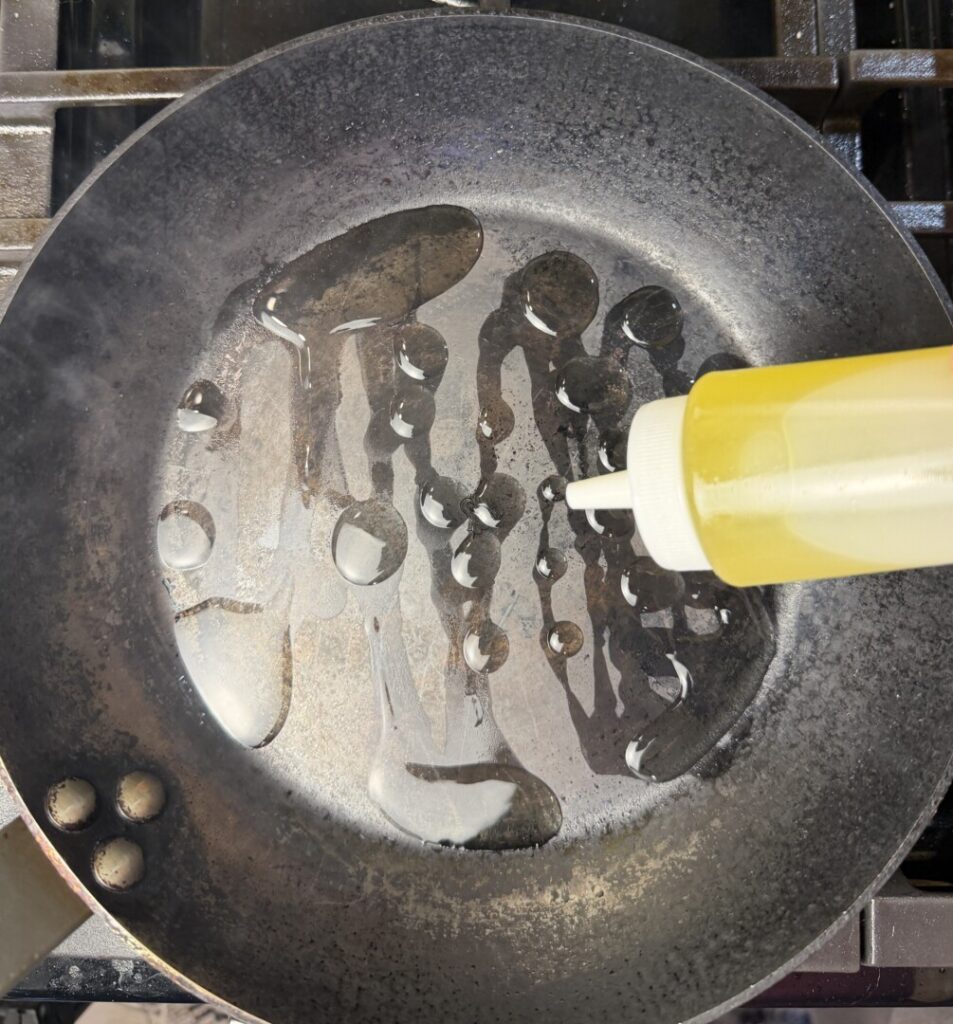
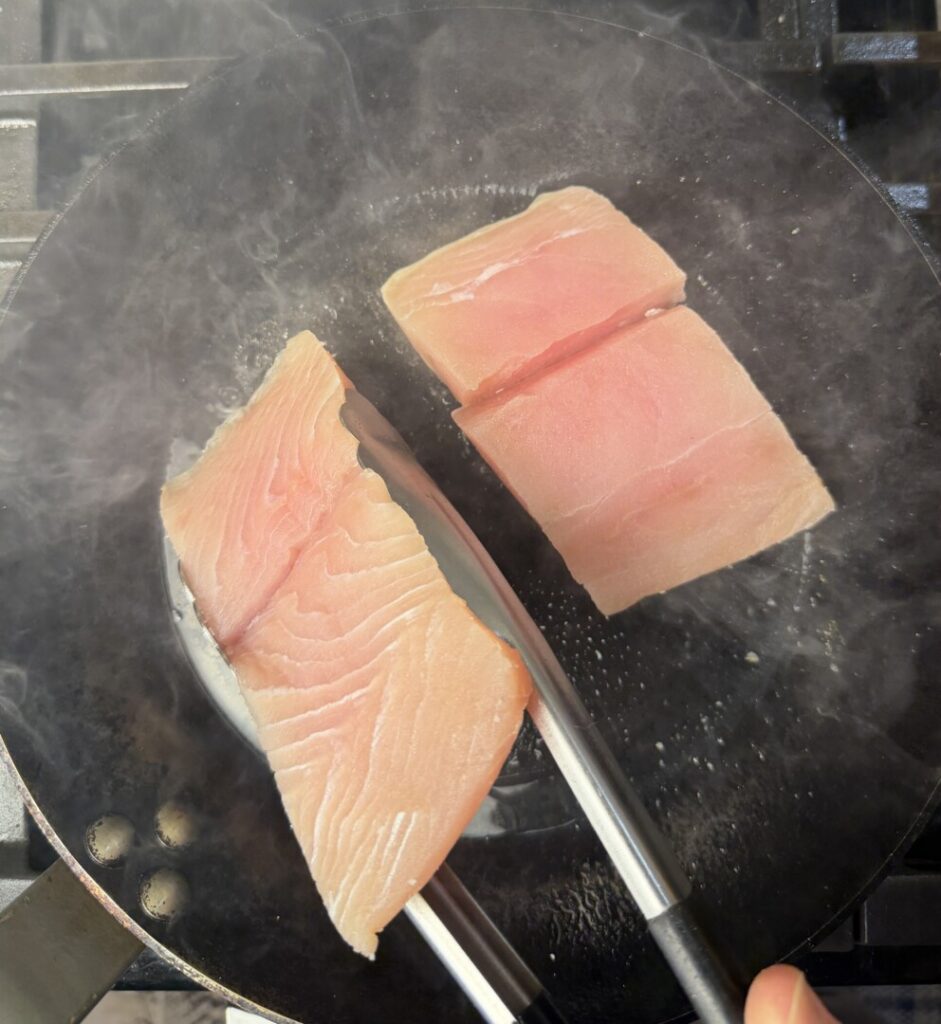
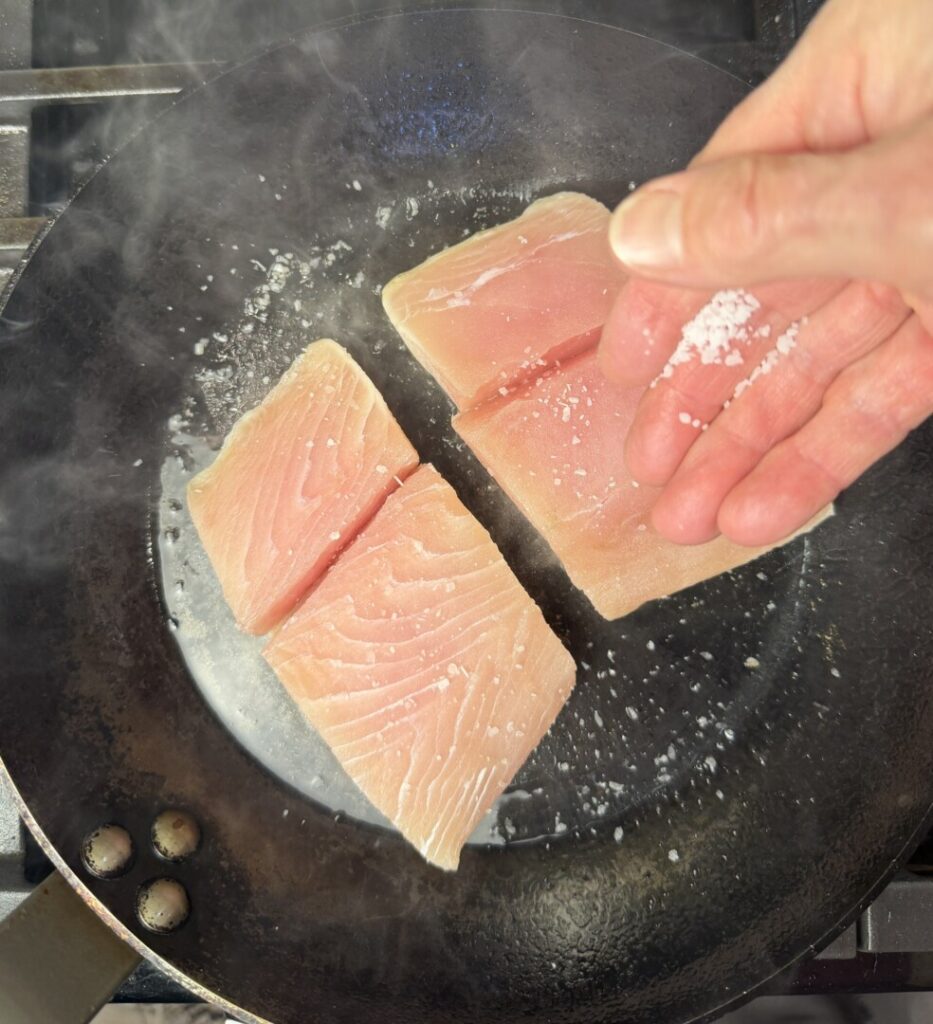
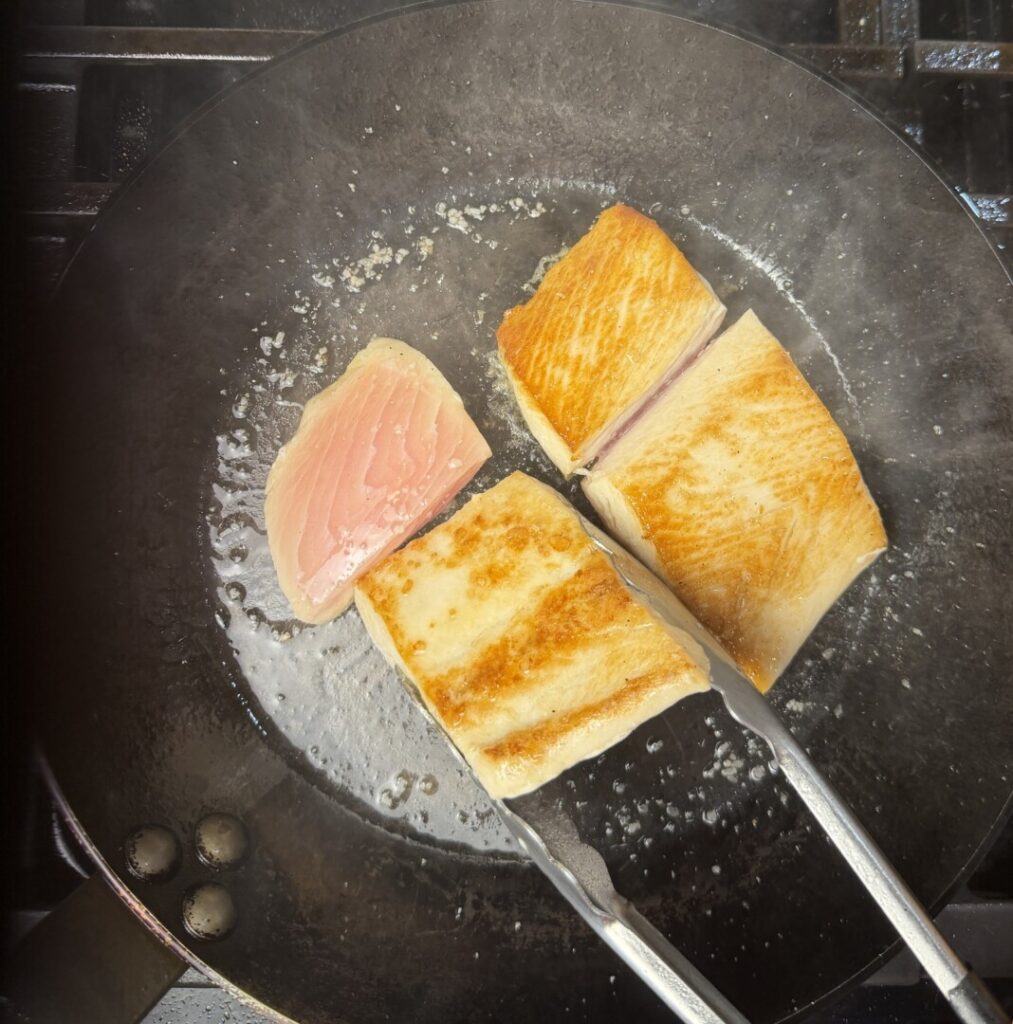
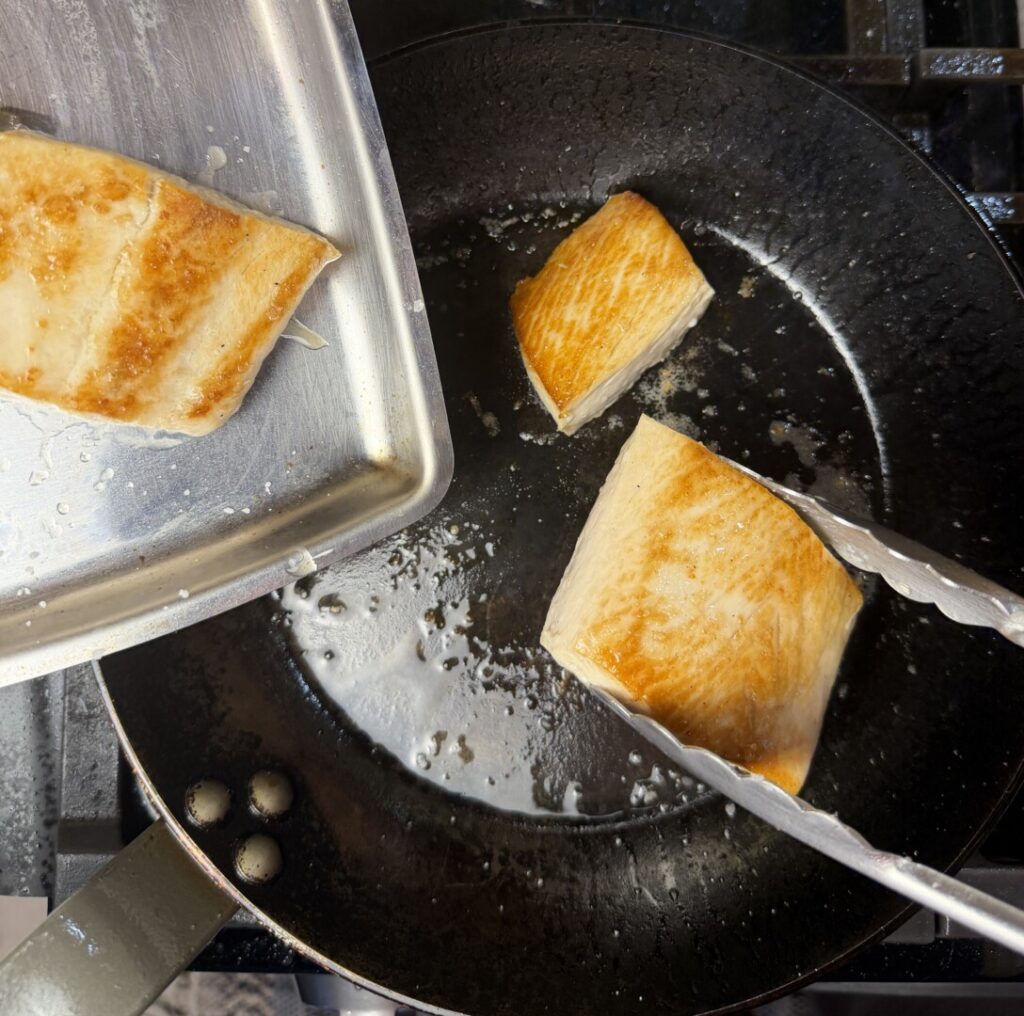
To create the “shingled,” or overlapped, fish presentation shown in the plating photos, cut each fish fillet in half widthwise at the centerline, and then reassemble each fillet. Use the “8-minutes per inch of thickness” rule to determine total cooking time. (Example: If your fillet measures 1/2 inch thick at its widest point, total cooking time is 4 minutes.) Heat the carbon steel pan very hot, and then squeeze in some of the oil. Swirl the pan to coat the bottom surface and partially up the sides. Place the recombined fillets in the pan, rounded-side-down, and season the tops with a little salt. Sauté undisturbed for half the total cooking time, until the bottom of the fillets are golden brown and easily detach from the pan surface. Turn the fillets over, season with salt, and cook for the remaining time. Transfer the fillets to a sizzle pan or small tray and hold them hot.
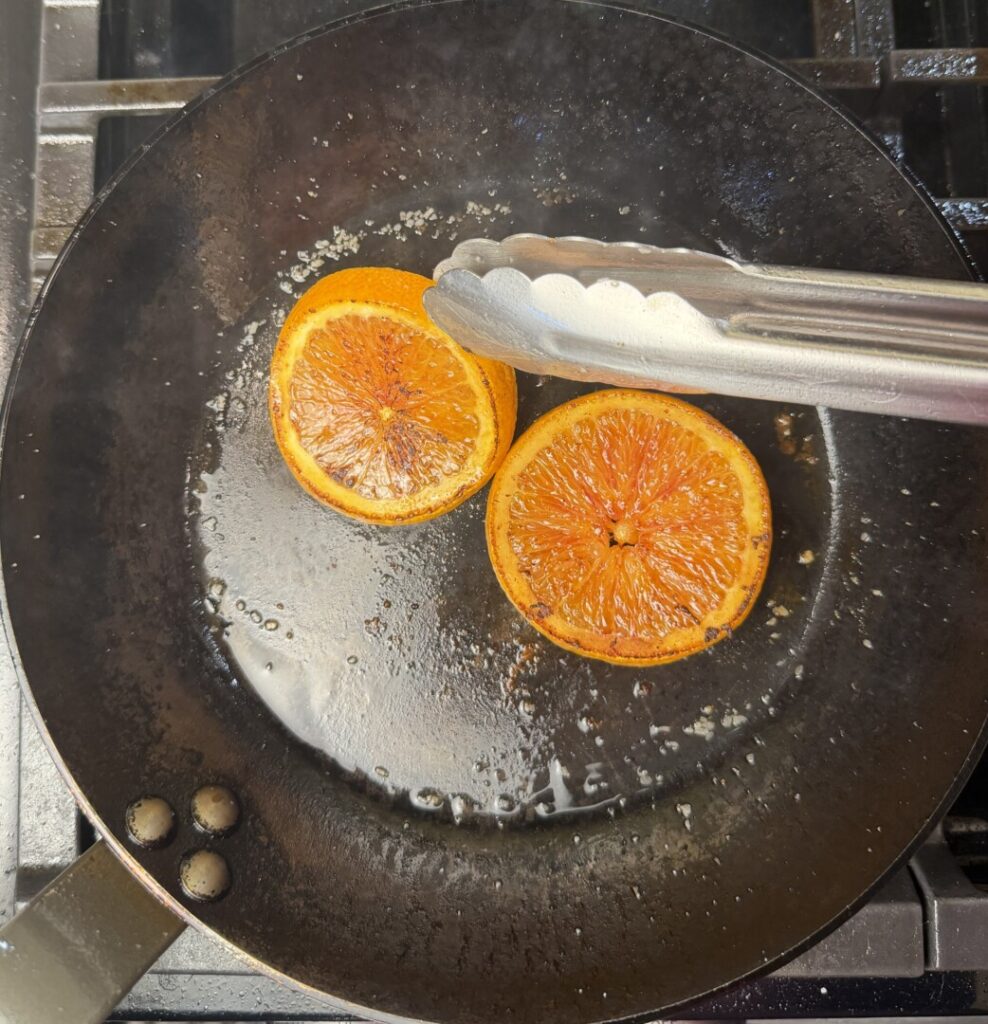
Add a little more oil to the pan and sear the oranges slices for a few seconds on each side. Transfer to the sizzle plate and cut each slice in half.
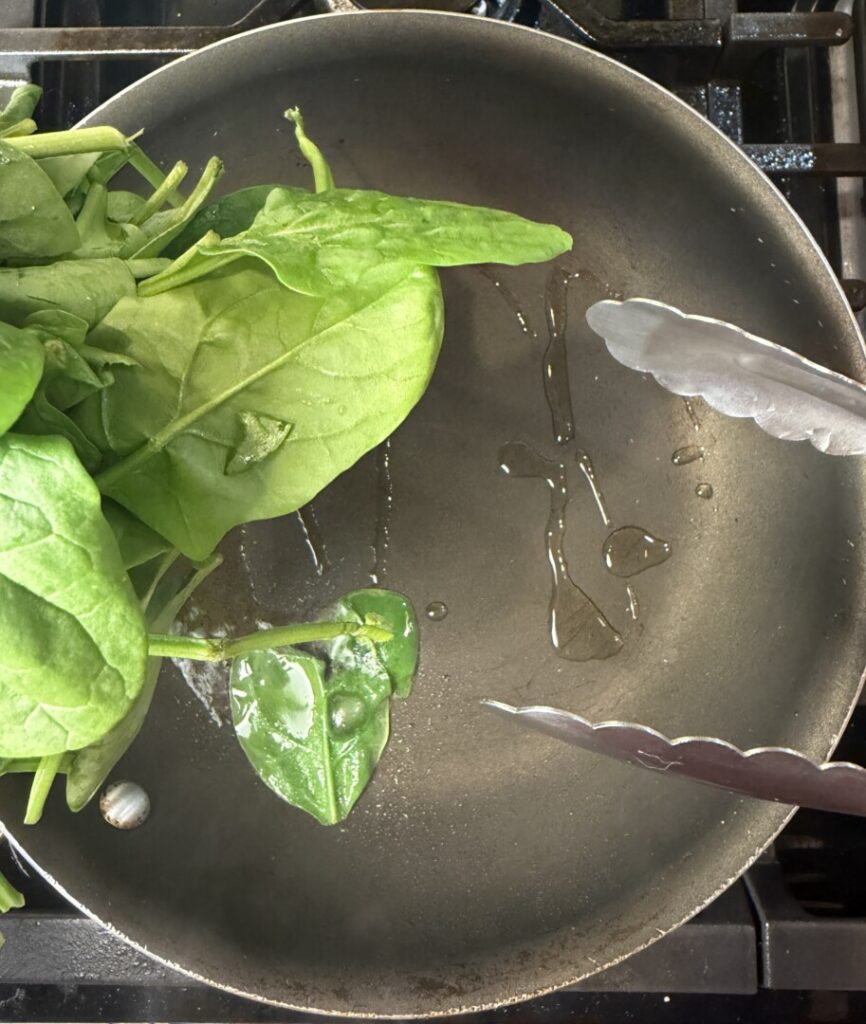
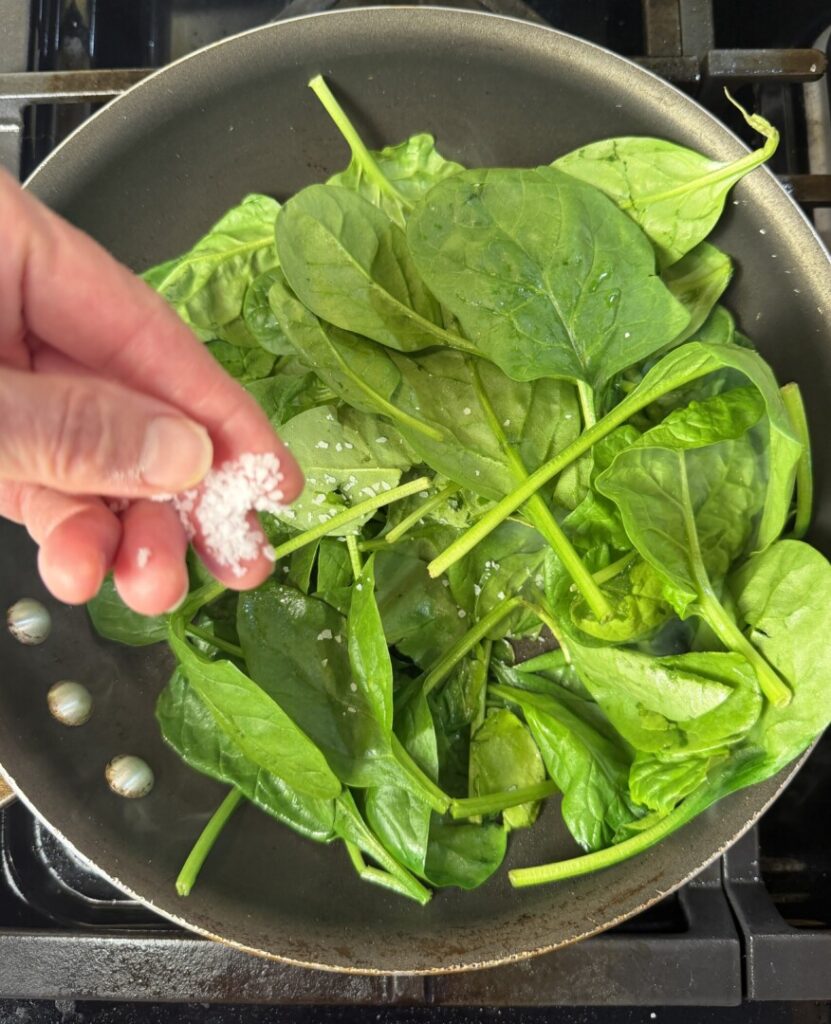
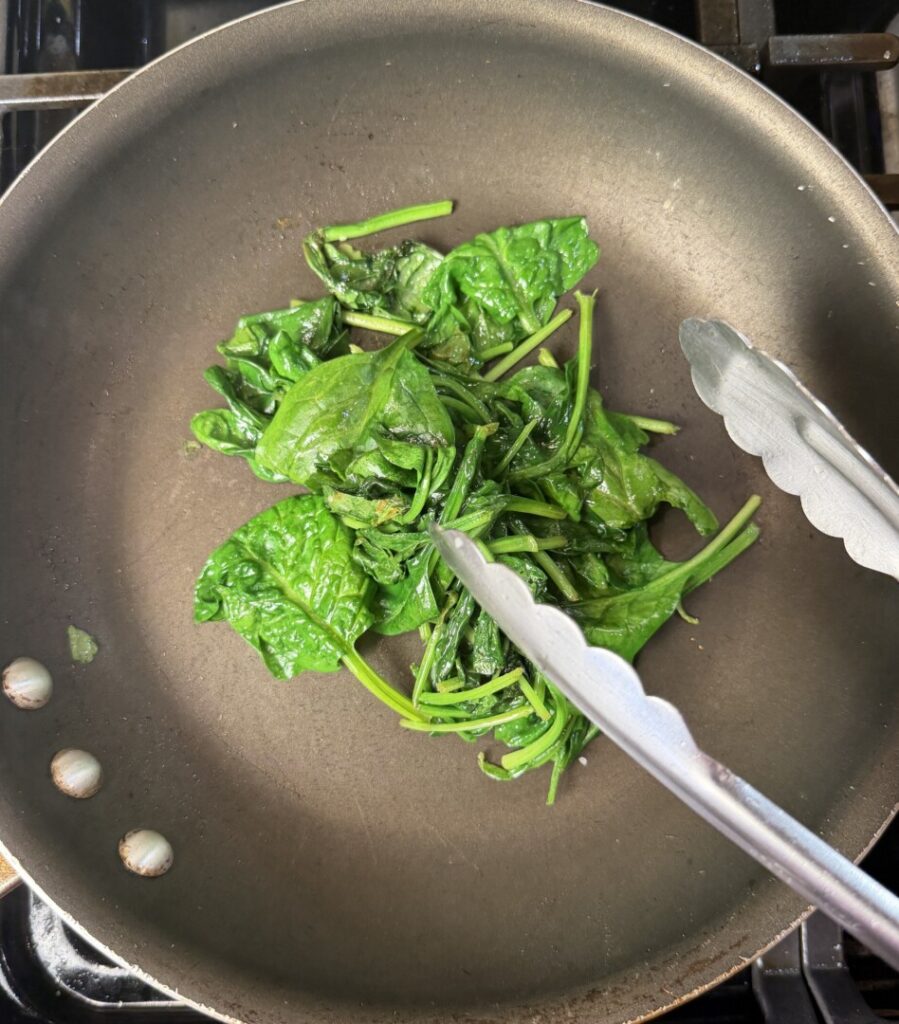
Turn the heat under the nonstick pan to high and wait for it to get very hot. Squeeze in a little oil, and then add half the spinach with a little salt. Turn the spinach with tongs just until it wilts, then remove it to the bowl. Sauté the remaining spinach, then add the previously-cooked spinach back into the pan, leaving behind any liquid in the bottom of the bowl. Toss to combine.
Now you’re ready to plate!
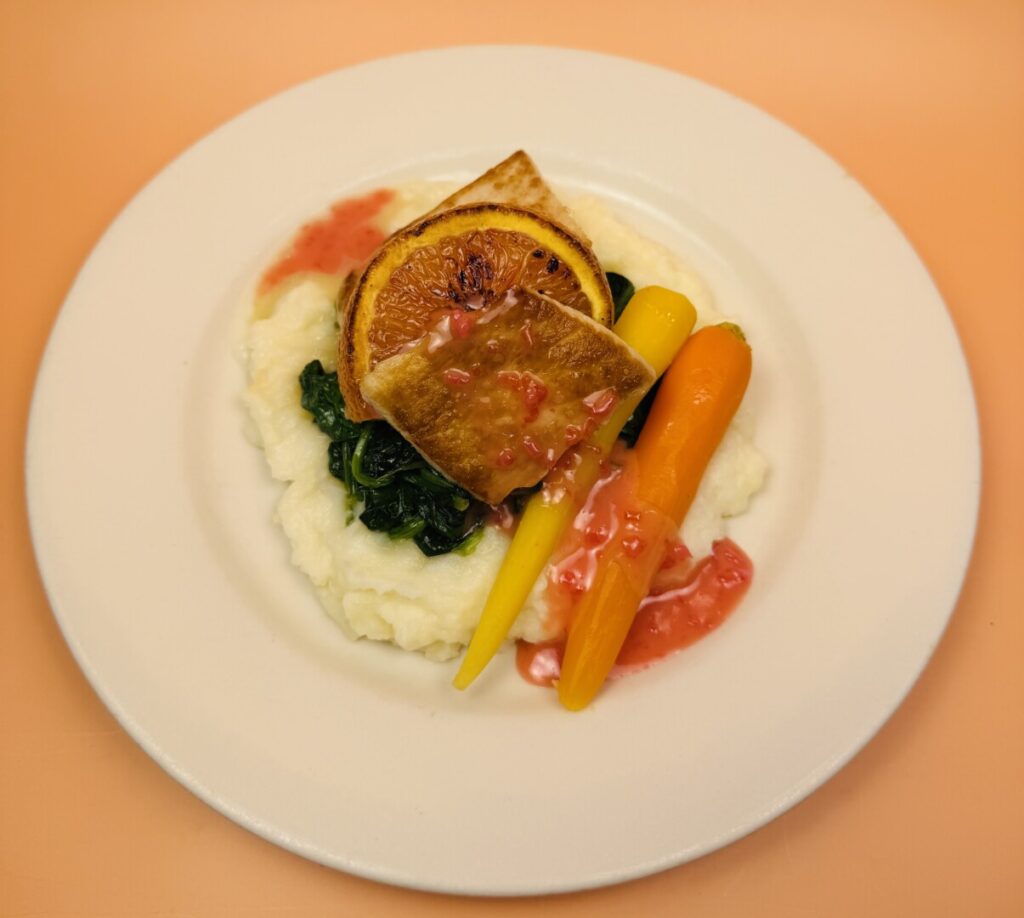
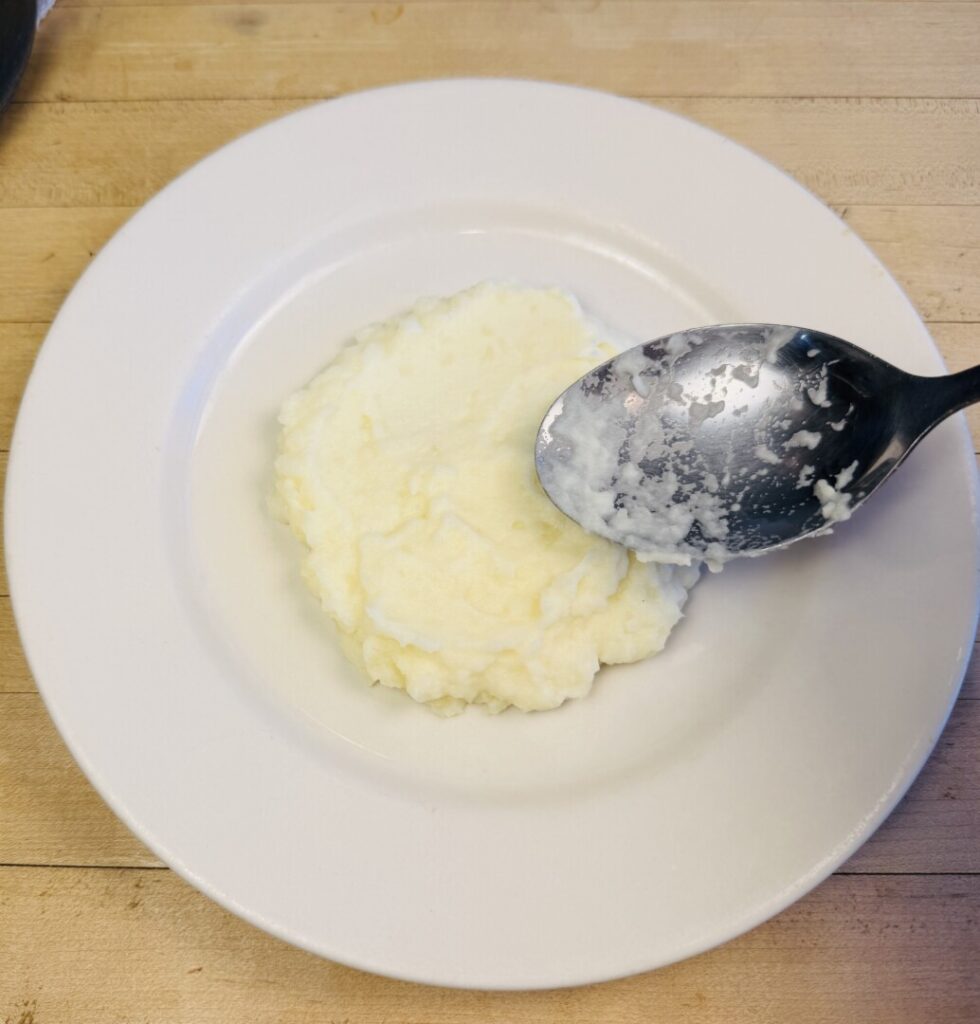
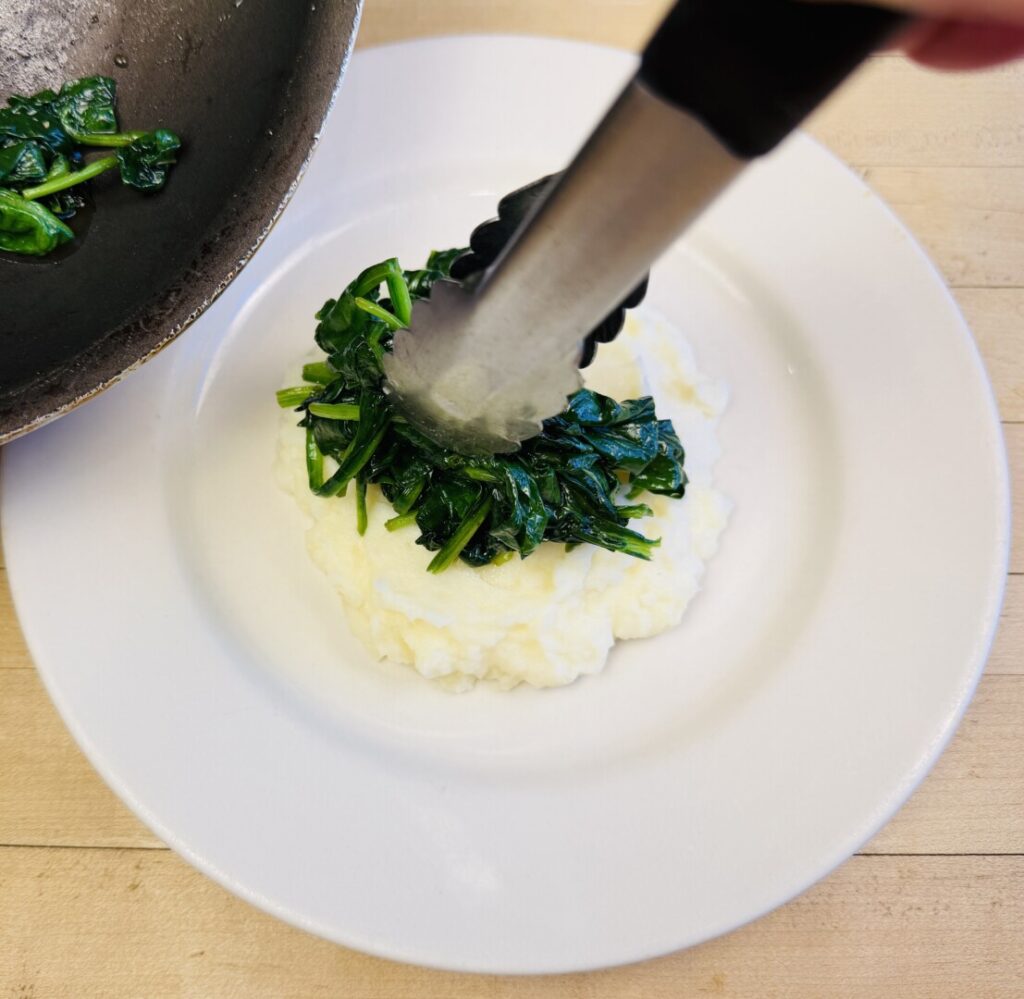
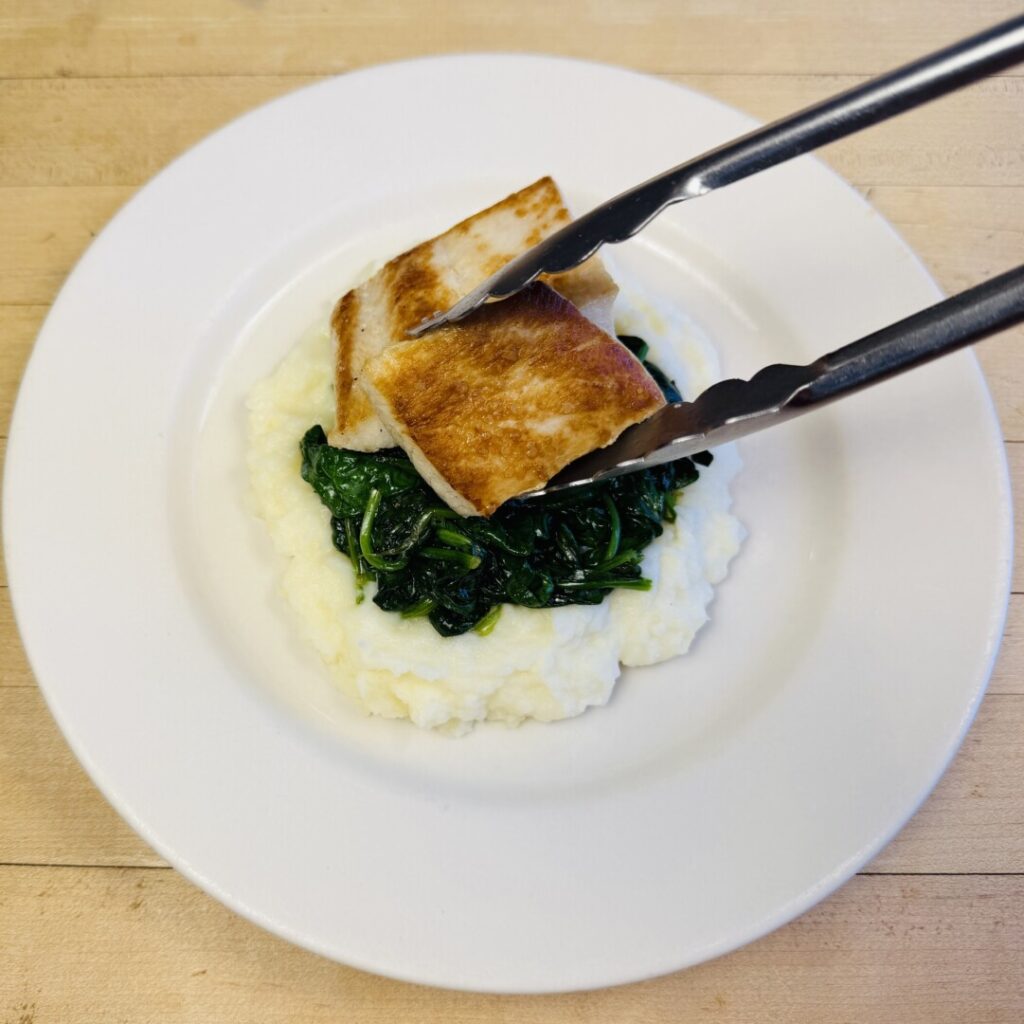
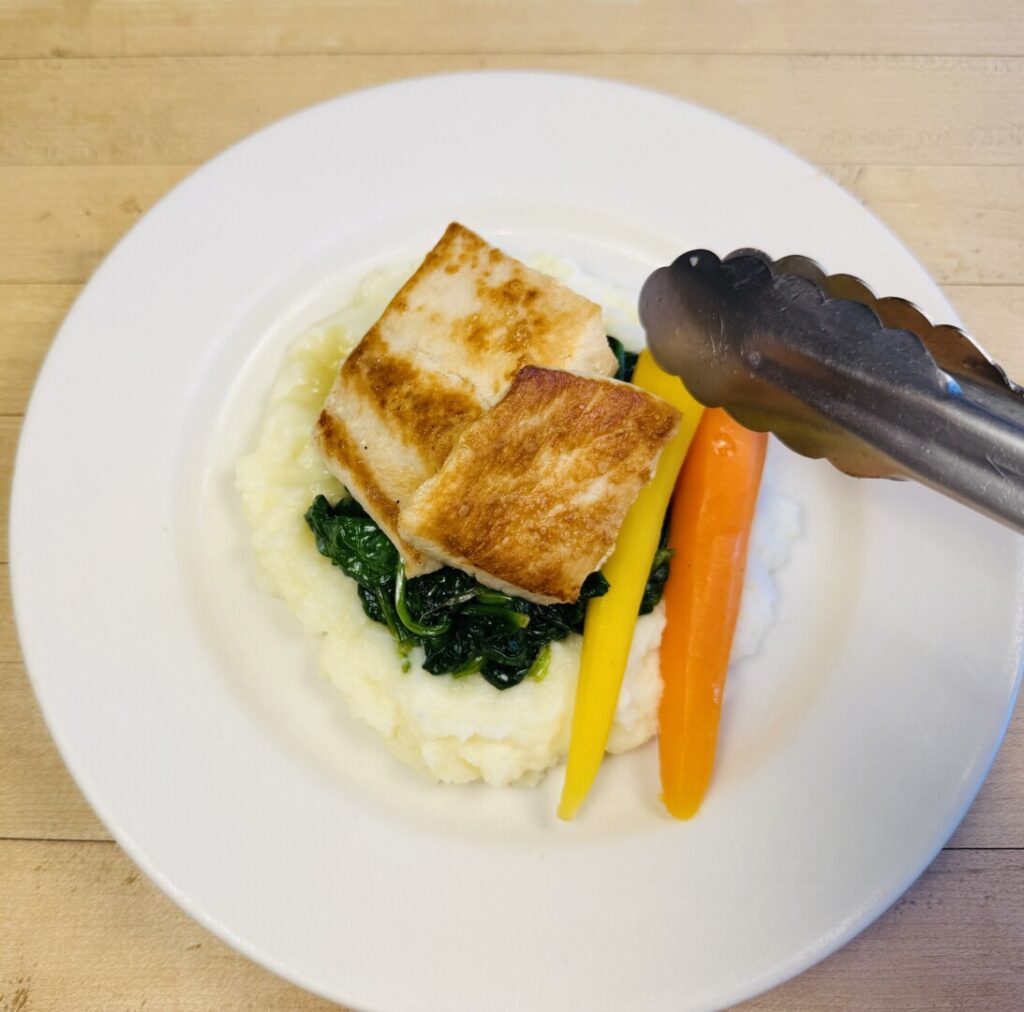
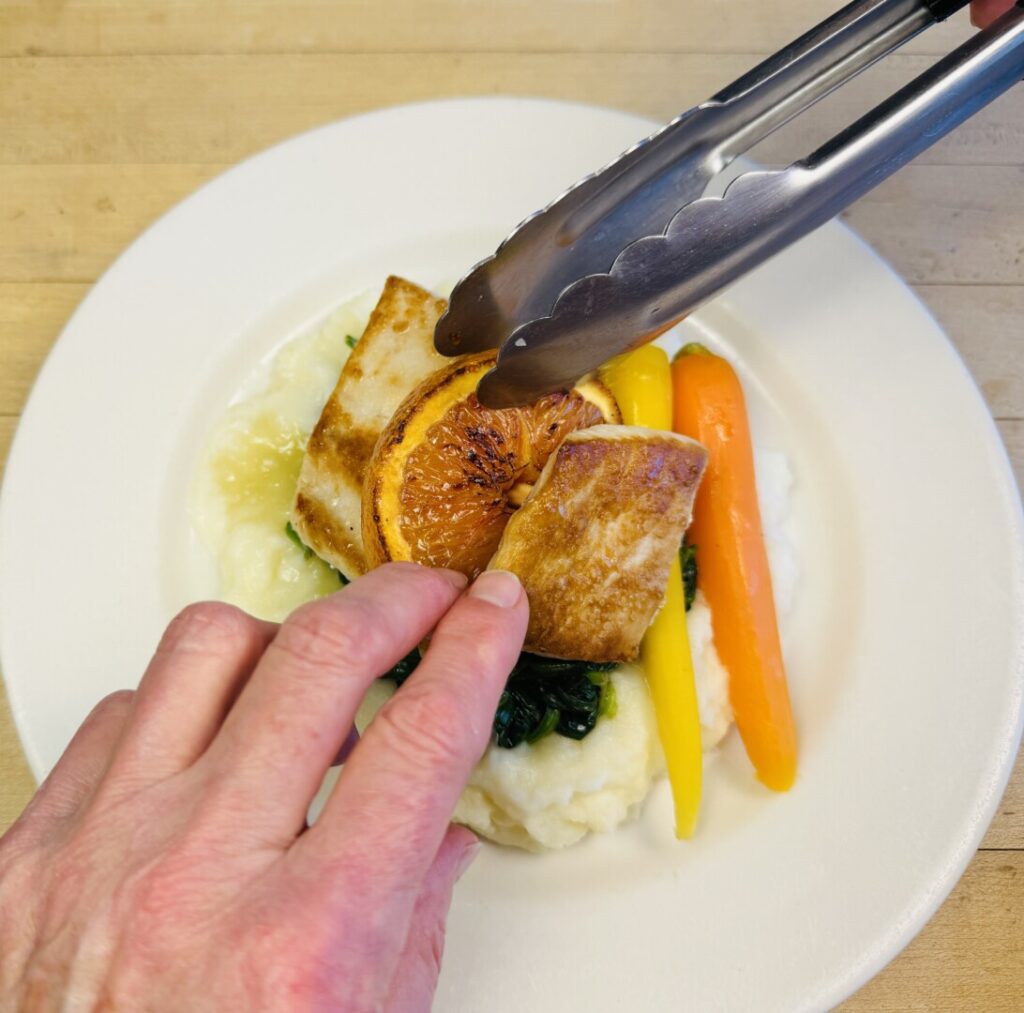
Spoon a portion of potatoes onto the center of each warmed dinner plate, and then use the back of the spoon to gently flatten them into a disk shape. Mound a portion of spinach on top of the potatoes. Place two “matching” fish fillet halves on top of the spinach, overlapping them with the front piece propped against the back piece. Arrange two carrots on the right side of each plate. Insert two orange slice halves between the fish fillet pieces. Spoon a portion of sauce diagonally across the plate, allowing some to pool in the plate well.
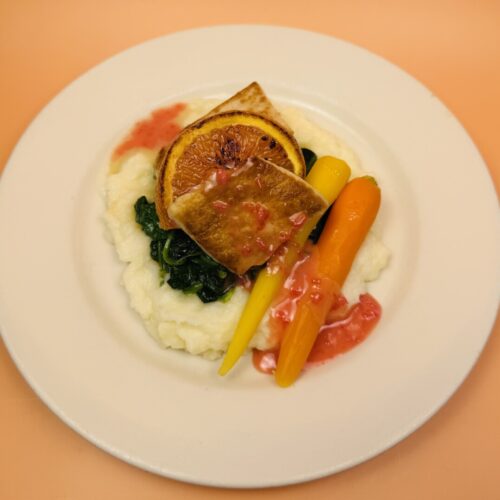
Pan-Seared Fish in Blood Orange Butter Sauce with Purée Potatoes, Baby Spinach, and Carrots
Ingredients
step 1 ingredients
- 4 small carrots, preferably multi-color
step 2 ingredients
- 14 oz russet potatoes
step 3 ingredients
- 2 blood oranges (or navel oranges)
- 1/8 lemon, wedge
- 1/4 shallot
- to taste kosher salt
- 2 oz butter, preferably Irish or French
- 1 Tbsp crème fraîche or heavy cream
step 5 ingredients
- 2 tsp kosher salt
- 1 Tbsp butter
- 3 Tbsp half & half or heavy cream
- pinch fine-ground white pepper, optional
step 7 ingredients
- 14 oz boneless, skinless fish fillets
step 8 ingredients
- to taste kosher salt
step 11 ingredients
- 2 Tbsp pure olive oil (not extra-virgin) in squeeze bottle
- to taste kosher salt
step 13 ingredients
- 2 tsp pure olive oil (not extra-virgin) in squeeze bottle
- 10 oz baby spinach
- to taste kosher salt

Instructions
PREP: Mise the recipe ahead of time.
1. Fabricate and par-cook the carrots:
- Bring about 1 qt water to the boil in a small saucepan. Place a bowl of cold water near the stove.
- Blanch the carrots in the boiling water for about 3 minutes until a knife inserted in the wide ends meets just a little resistance.
- Blanch the carrots in the boiling water for about 3 minutes until a knife inserted in the wide ends meets just a little resistance.
- Transfer the carrots to the bowl of water and then place the bowl in the sink under a stream of cold water. Refresh for about 1 minute until the carrots are cold.
- Drain the carrots and blot dry on paper towels.
- If prepping ahead, place the carrots in a plastic bag with a folded paper towel in the bottom.
2. Mise the purée potatoes:
- Peel the potatoes and cut them into rough 1-inch cubes. Place the potatoes in a container and cover with cold water.
3. Mise the butter sauce:
- Wash the blood oranges thoroughly and pat them dry.
- Use a swivel peeler to shave off a large, very thin strip of zest from one of the oranges. (Take care not to include any of the underlying white pith, which has a bitter flavor.) Mince the zest and place it in a container.
- Halve the partially-zested orange and squeeze the juice into the container, taking care to remove any seeds. You should have about ⅓ c juice per serving.
- Reserve the other orange for garnish.
- Squeeze the lemon juice into the container, again removing any seeds.
- Mince the shallot and add it to the container.
- Add a pinch of salt to the container.
- Cut the butter into ½-inch cubes; if prepping ahead, store the cubes in a plastic bag.
- If using the optional crème fraîche or heavy cream, measure it into a separate small container.
4. Assemble the remaining ingredients.
HOLD: Refrigerate the fish up to 1 day or freeze it for longer holding; refrigerate all other ingredients up to 4 days.
5. Make the purée potatoes:
- Drain the potatoes, place them in a saucepot, add cold water to cover by ½ inch, and add the step 5 salt.
- Bring to a brisk simmer and cook, uncovered, for about 8 minutes until a knife pierces a potato chunk with a little resistance. Be careful not to overcook the potatoes to a mushy texture.
- Pour most of the cooking water off of the potatoes, using a slotted spoon to hold them back and leaving about ½ inch water in the bottom of the pan.
- Add the butter to the potatoes. Use a handheld electric mixer to whip the potatoes into a purée. Take care not to over-mix. When the potatoes are smooth, whip in the half-and-half. The consistency should be soft, light, and fluffy, and substantially looser than mashed potatoes. (The potatoes will thicken a bit as they hold.)
- Evaluate the flavor and, if necessary, season with additional salt and optional white pepper.
- Cover the pan and hold on the back of the stove.
6. Fabricate the orange garnish:
- Cut one round orange slice per serving, making the slices about 3/16-inch thick.
- Use the tip of a paring knife to remove any seeds.
7. Mise the fish:
- Rinse the fish fillet and pat it dry with paper towels.
- Feel carefully for tiny pin bones and, if necessary, use kitchen tweezers to remove them.
- Cut the fillet crosswise into two pieces. Then cut each piece crosswise, keeping the two pieces together.
- Note the thickness in inches of the fillets at their widest parts.
8. Set up the carrots for reheating:
- Place the carrots in a microwave-safe dish, season with a little salt, and cover with plastic wrap.
- Place the carrots in the microwave oven until ready to reheat.
9. Make the sauce:
- Pour the sauce mixture into a small sauté pan, ensuring that all of the zest and shallots go into the pan. Place the pan over low heat and simmer about 1 minute until the sauce reduces to about 2 Tbsp per serving. Watch carefully to avoid scorching.
- Add the optional créme fraîche or heavy cream and reduce for a few seconds longer.
- Turn off the heat and whisk in the cold butter, one or two cubes at a time, so that they emulsify into a creamy, homogenous sauce. Turn on low heat only if necessary to continue softening the butter, then turn it off. Don’t allow the sauce to become hot or it will “break” and the butterfat separate out of the liquid component.
- Evaluate the flavor and, if necessary, add more salt and/or lemon juice.
- Hold the sauce warm on the back of the stove; watch carefully so that it doesn’t overheat and “break,” or separate.
10. Place a large nonstick pan over low heat.
11. Pan-sear the fish and orange garnish:
- Choose a heavy, preferably carbon steel sauté pan slightly larger than needed to accommodate the fish fillets. Place the pan over high heat until hot.
- Squeeze in most of the step 11 oil and swirl to coat the pan bottom and slightly up the sides.
- Season the convex, non-shiny side of the split fish fillets with salt and place them, salted-side-down, in the pan. Use the “8 minutes per inch of thickness” guidelines in the lesson section of this post to determine total cooking time. Sauté undisturbed for the appropriate time and then turn over the fillets. Season the top of the fillets with salt and continue sautéing until the fillets are lightly cooked through.
- Transfer the fillets to a sizzle pan or small tray and hold hot.
- Squeeze a bit more oil into the pan and then place the orange slices in it. Sauté them for about 30 seconds on each side until then flesh is browned in some places and the rinds are slightly charred. Transfer to the sizzle pan, and then cut each orange slice in half.
12. Heat the carrots in the microwave oven for about 2 minutes until hot.
13. Wilt the spinach:
- Turn the heat under the nonstick pan to high and wait for it to get hot. Place a small bowl near the stove.
- Squeeze in a little of the step 13 oil and add half the spinach with a pinch of salt. Use tongs to constantly turn over and push down on the spinach just until it wilts. Transfer the spinach to the bowl.
- Repeat with the remaining spinach.
- When the second batch of spinach is wilted, return the first batch to the pan, leaving any liquid behind.
- Toss the batches together and drain off any liquid in the sauté pan.
14. Plate:
- Spoon a portion of potato purée in the center of each warmed dinner plate, and flatten it slightly.
- Mound a portion of spinach in the center of the potatoes on each plate.
- Place 2 pieces of fish fillet on top of the spinach, overlapping them.
- Arrange 2 carrots against the fish fillets on each plate, leaning against the potatoes with points toward the front of the plate.
- Place an orange slice upright between the fish pieces on each plate.
- Stir the sauce, and then spoon a portion across the fish pieces, allowing sauce to pool in the plate wells.