

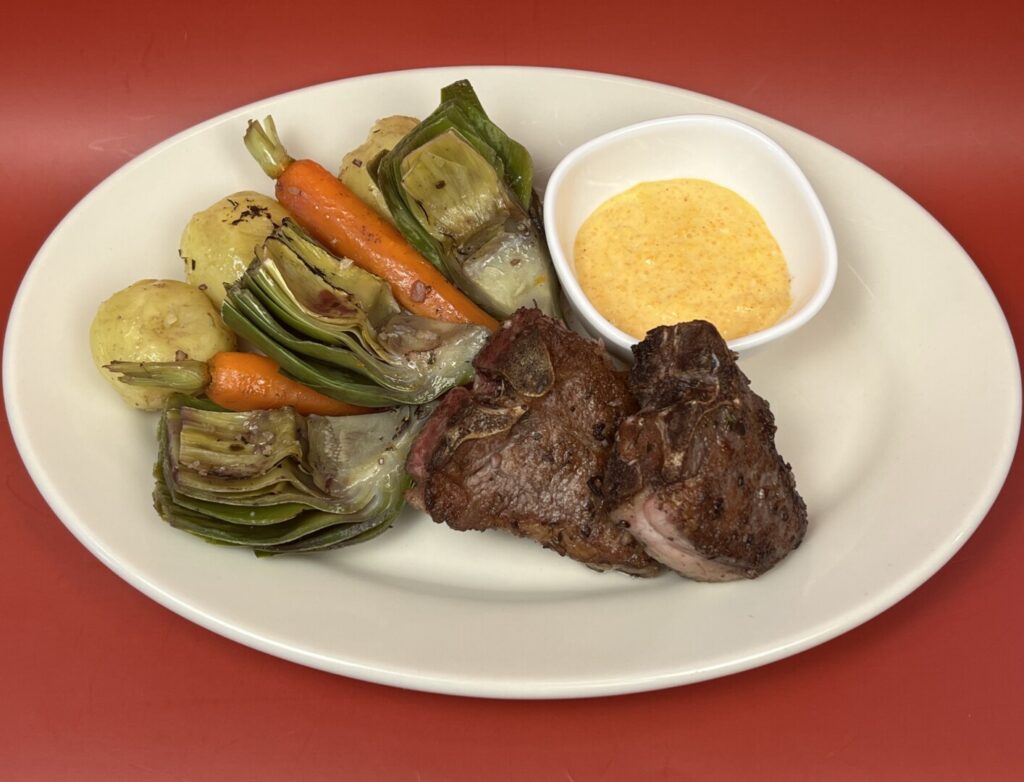
Your Cooking Lesson
Advice, explanation, and in-depth information to help you achieve recipe success.
This recipe teams two foods that have a lot in common. Both lamb chops and artichokes are seasonal to spring. Just as important, they both qualify as foods you just have to eat with your fingers!
Sure, you can be all proper, and daintily cut the meat off your chops with knife and fork—but everyone knows that the best-tasting and most tender meat is in those nooks and crannies next to the bones. Serious eaters, in the comfort of their own homes, are sure to just pick ’em up and nibble on ’em. And it’s impossible to eat those tempting nuggets of goodness off of artichoke petals without using your fingers. So this entrée really is “finger-lickin’ good.”

Before the era of modern industrial meat production and frozen food technology, lamb—like the meat of other young animals—was available only in the spring season. So, even though today we can purchase lamb year-round, it’s still a traditional springtime treat.
In the North American market we have two primary sources of lamb: domestic or New Zealand. Domestic lamb typically is larger, harvested at a maximum of 14 months of age. It has a milder flavor due to both diet and breed. Some domestic lamb is grain-finished and, as a result, may have more marbleization causing richer mouthfeel. New Zealand lamb is smaller, at a maximum of 12 months. Free-range and totally grass fed, it has a more pronounced lamb flavor, is leaner, and may be slightly less tender.
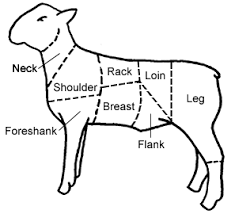
A chop is a cut of meat fabricated by sawing crosswise through the spine of a lamb, sheep or hog half-carcass. Because an animal’s back muscles get little exercise, meat cuts from this area are tender. Rib chops are cut from the rack section and comprise only an “eye” of meat attached to the bone. Loin chops include both the eye and a round section of tenderloin. Either type of chops can be used in this recipe.
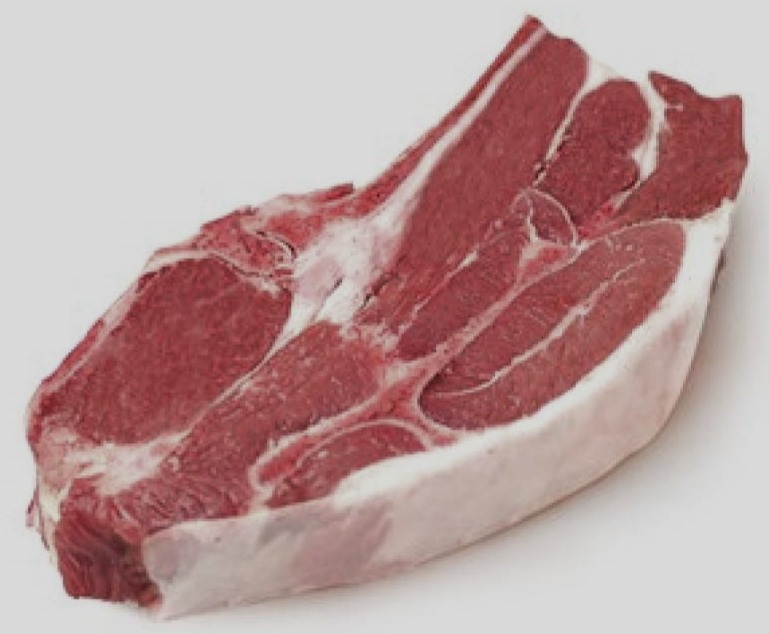
Per the name, shoulder chops are cut crosswise through the bones of the shoulder. These are larger and somewhat tougher than true chops, although when harvested from younger New Zealand lambs they can be surprisingly tender. Shoulder chops are a good bargain but, for this recipe, won’t fit nicely on the plate.
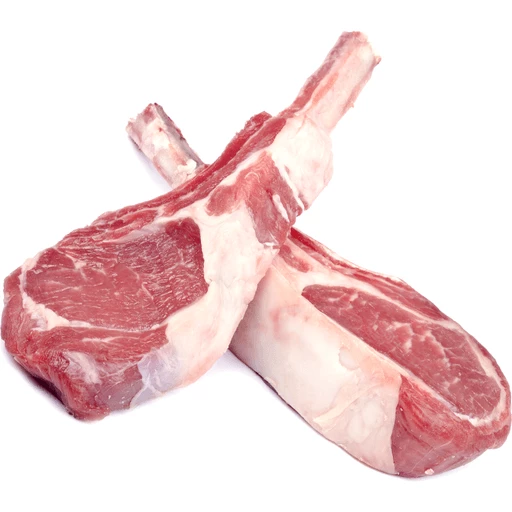
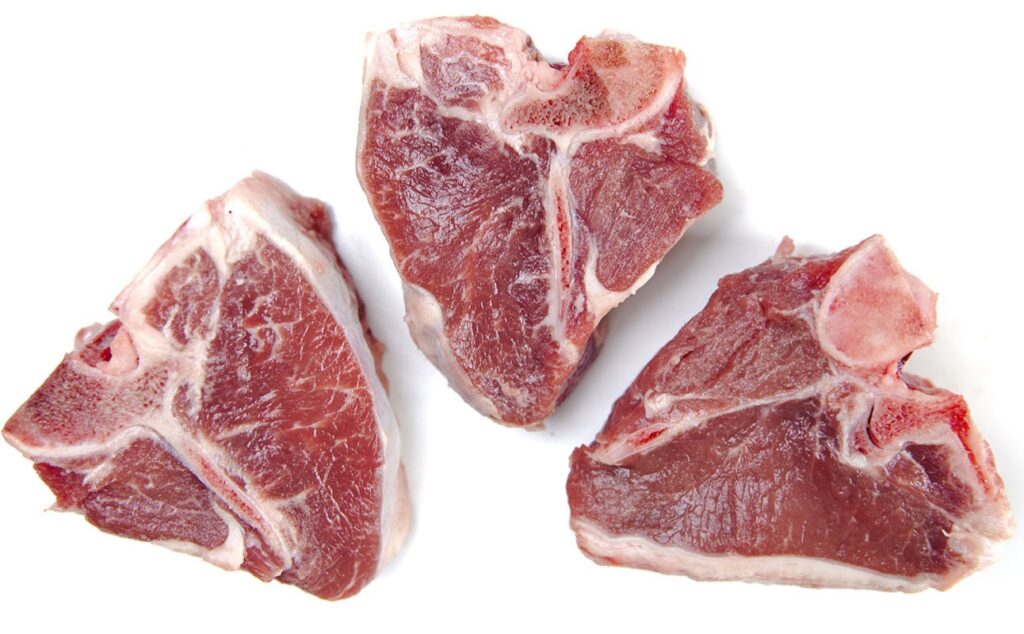
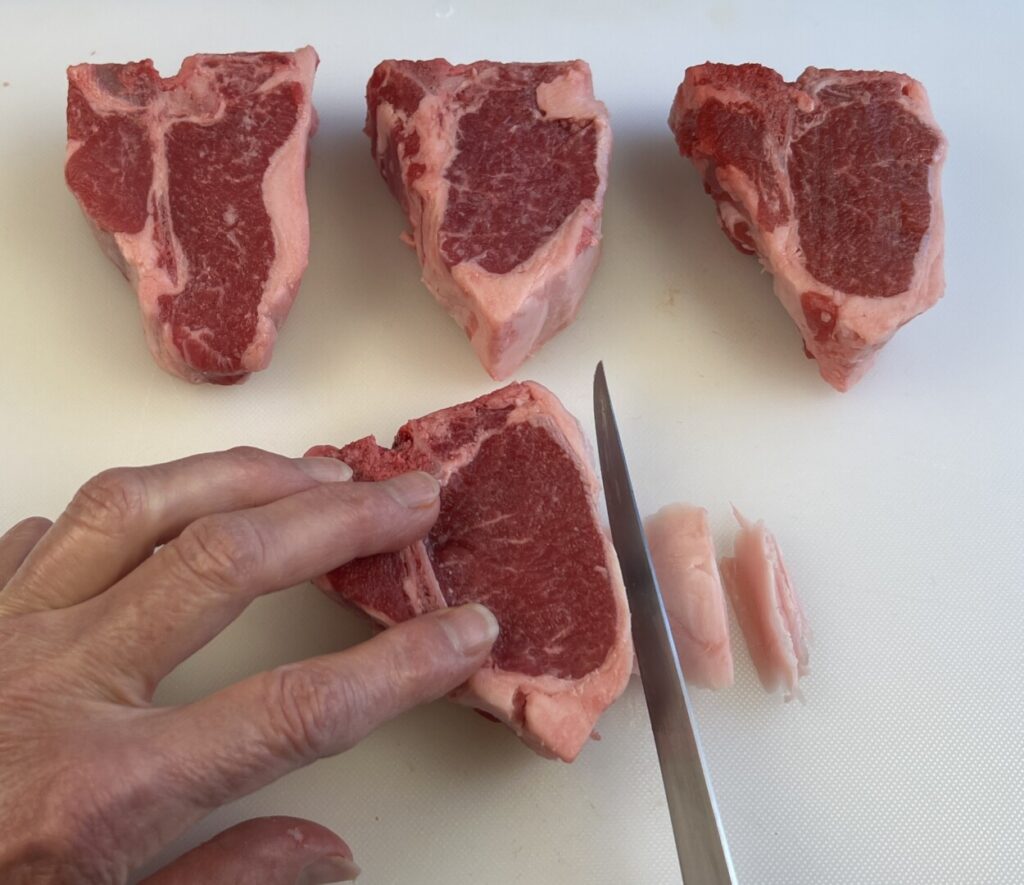
Whether grilling or pan-searing chops, it’s advisable to leave a narrow border of fat around the eye section to protect the meat and provide a delicious, crispy, browned rim. About 1/8 inch of fat is enough; if necessary, trim off excess.
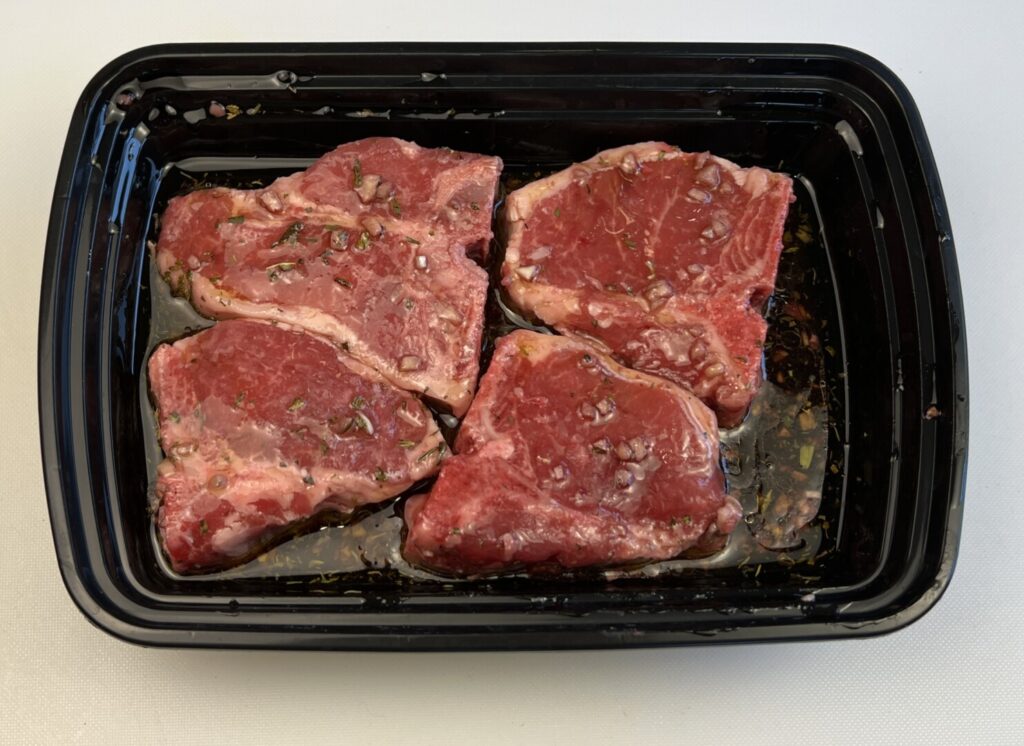
Loin and rib lamb chops don’t require marination for tenderness, but it’s great for enhancing flavor and mouthfeel. Our marinade features red wine, olive oil, Provençal herbs, and lots of garlic. For 4-oz loin chops, 2 days is the maximum recommended marination time. Longer marination risks fiber breakdown resulting in a dry, cottony mouthfeel. If you plan on prepping further ahead, remove the chops from the marinade and reserve both chops and marinde separately.
Spring is also prime season for artichokes, in North America beginning in March and running through May. The artichoke plant is a member of the thistle family, and the artichoke vegetable is its flower. True to its thistle heritage, the flower petals grow protective spines that can inflict painful jabs if they’re mishandled. The delicious inner part of the artichoke is a prize you have to work for; the flower’s thick skin and many thorny-tipped petals serve as a protective armor. But, to artichoke lovers, they’re worth the effort.
Virtually all US commercially-produced artichokes are grown in California, where the mild climate allows for perennial growth. Only the most dedicated home gardeners grow artichokes.
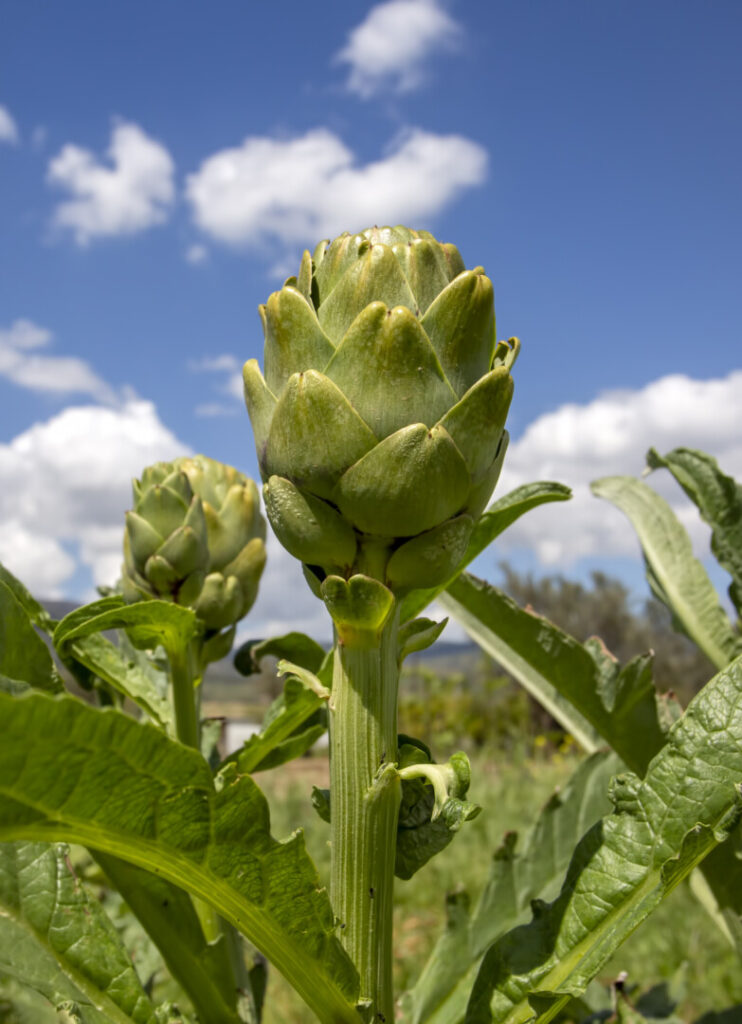
Because of the formidable appearance of fresh artichokes, many people choose to use canned and jarred artichoke hearts. But, however useful they may be in dips and spreads, for a side vegetable these just don’t offer the flavor and texture of the fresh product. Frozen artichoke hearts and bottoms are better; but they’re largely available only to foodservice operations and rarely found in supermarkets. If you’re an avid cook and an adventurous eater, you really should give fresh artichokes a try.
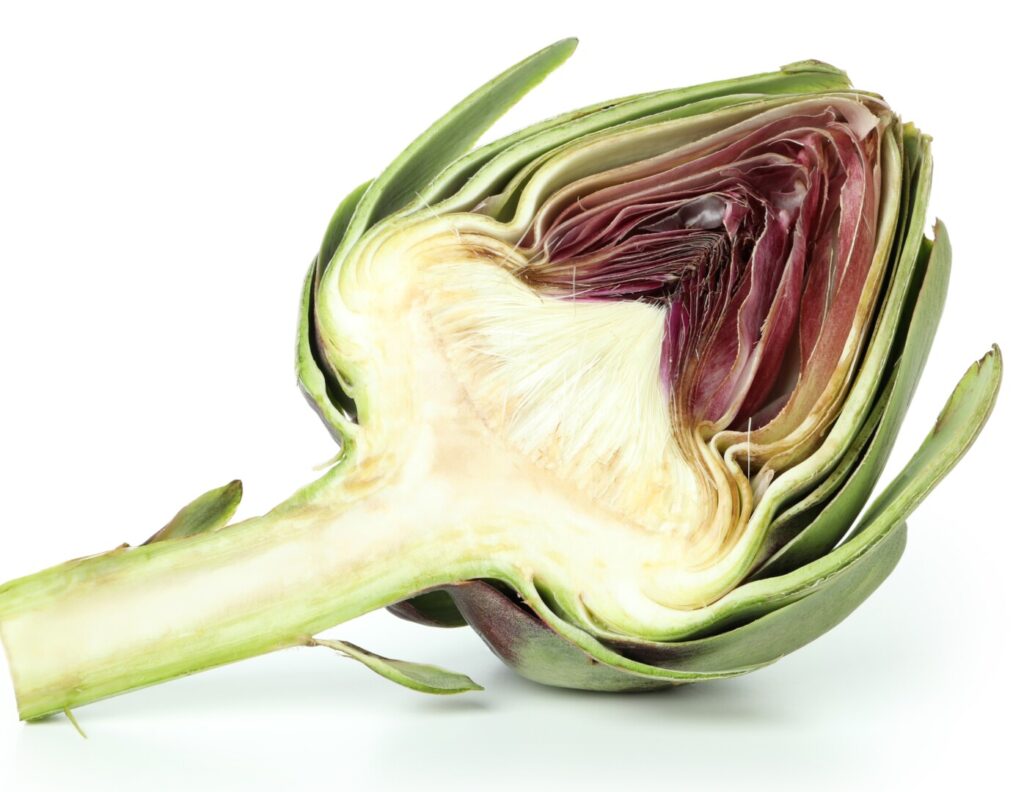
But wait a second…. While I’m trying to convince you to fabricate and cook fresh artichokes, I realize that not everyone may know how to eat one! The “meat” of an artichoke—it’s tender and flavorful flesh—is at the inside bottom of the flower. You start with the petals. The artichoke’s petals are attached to the meaty bottom and, when you pull one off, it harbors a nugget of “meat” at its rounded base. To eat this part, place the base of the petal upside-down in your mouth, against your bottom teeth, and then pull it out. As you do, you’ll scrape off the edible part to enjoy. Add to the pleasure by dipping the petal base in a savory sauce before eating it. If the artichoke has been properly cleaned before cooking, after pulling off all the petals you’ll arrive at the artichoke’s tender heart and bottom; if the stem has been left intact, there’s also tasty meat in its center. If the artichoke has been cooked “in the rough,” without cleaning it (as in the video), you’ll need to remove and discard the fibrous, reddish-colored inner petals and the hairy “choke.” Here’s a demo: https://www.youtube.com/watch?v=mL4RaoSaHu4
I’m not going to downplay how much work it is to fabricate fresh artichokes. It’s a hard-earned skill! Working with fresh artichokes is further complicated by the fact that there are quite a few different ways to fabricate them, yielding different results for different purposes. In this recipe, we’re using what I think is the easiest method: sectioning before cleaning.
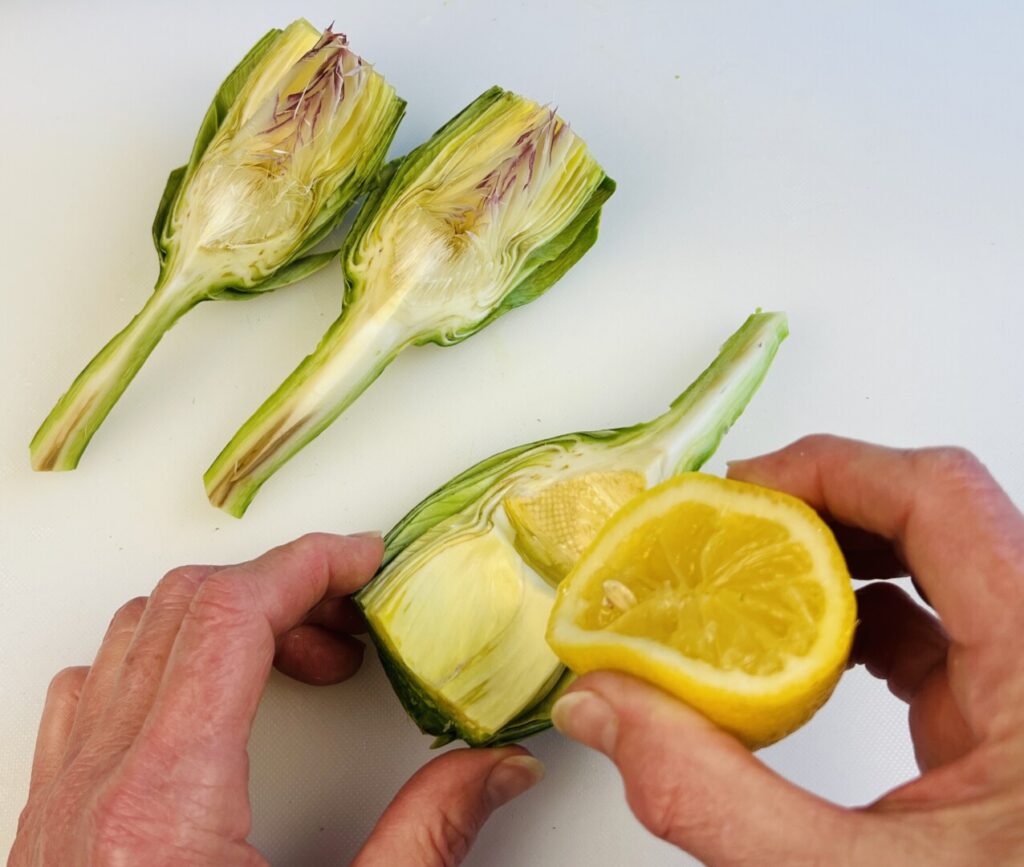
You’ll need three different knives to complete this task: a serrated knife, a chef knife, and a paring knife. There’s virtually no meat in the top third of the artichoke flower, so we use the serrated knife to remove it along with the dried-out end of the stem. Artichokes are particularly vulnerable to enzymatic browning; to help retain an attractive color, rub each cut surface with lemon. We also remove any loose petals at the bottom.
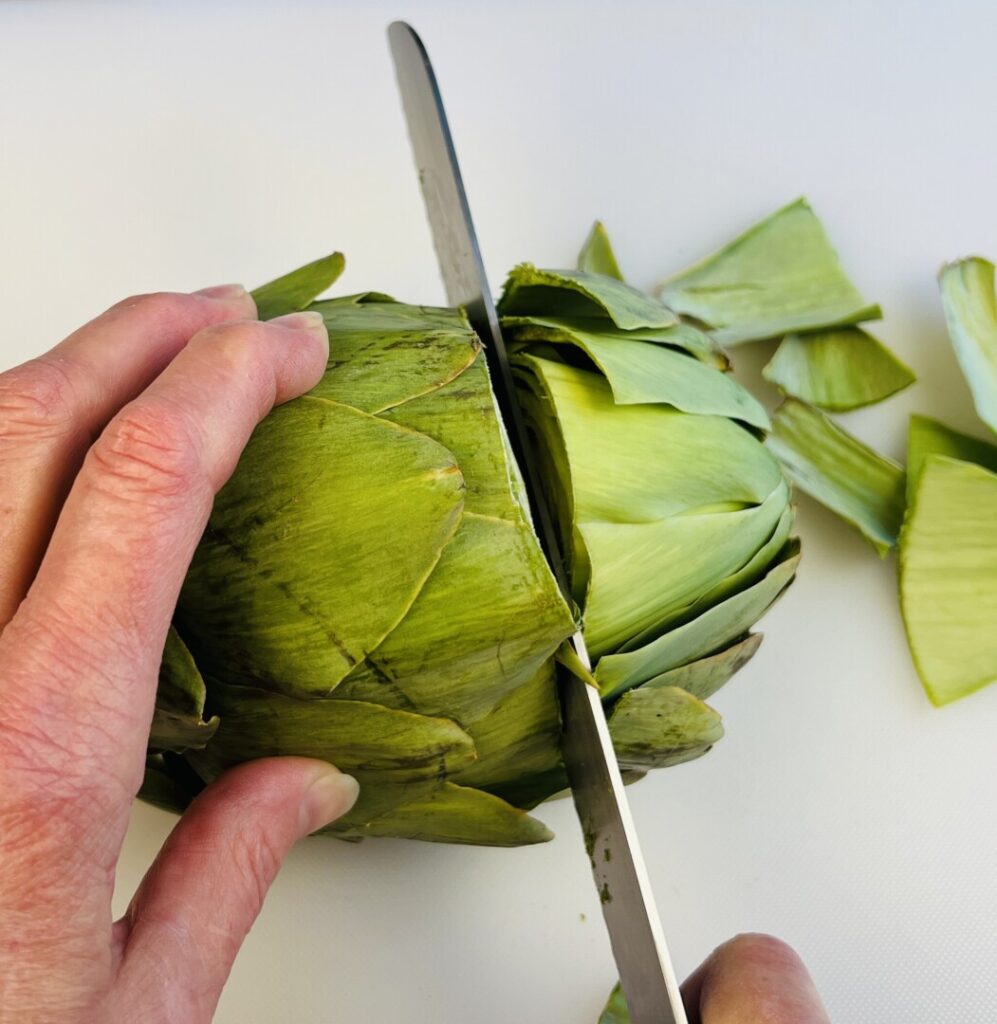
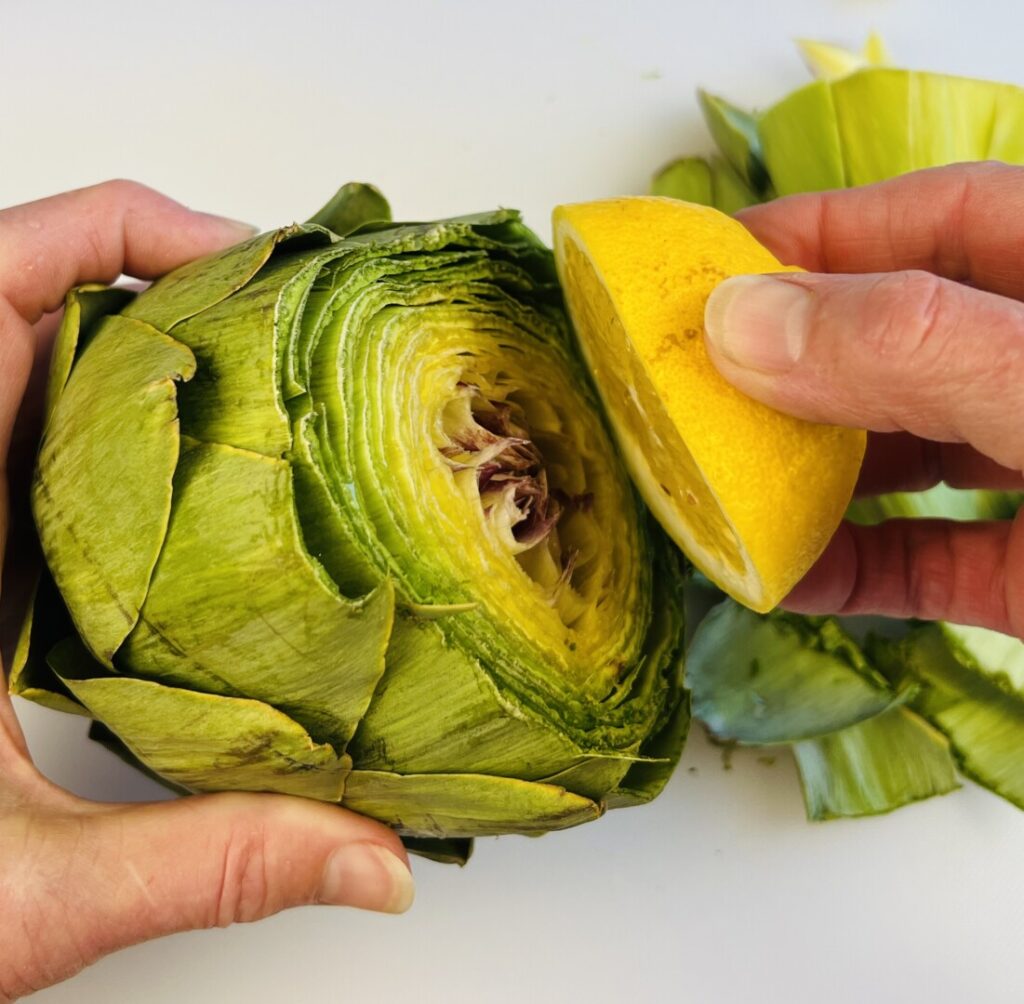
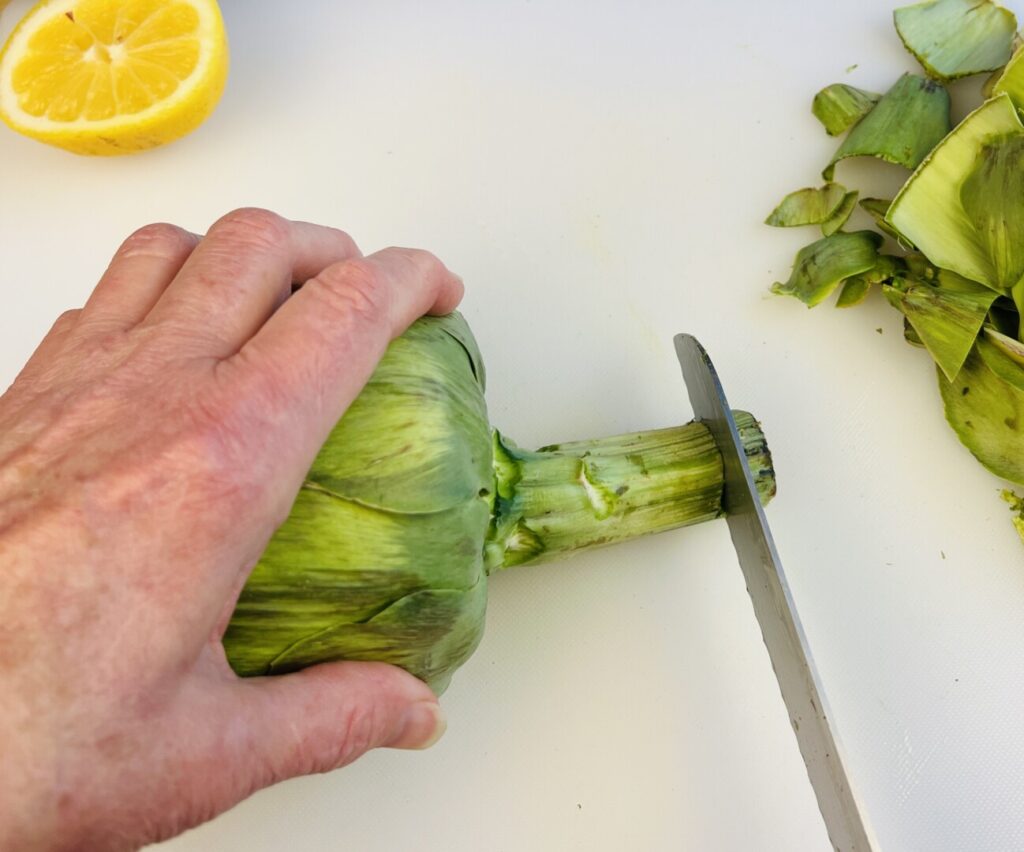
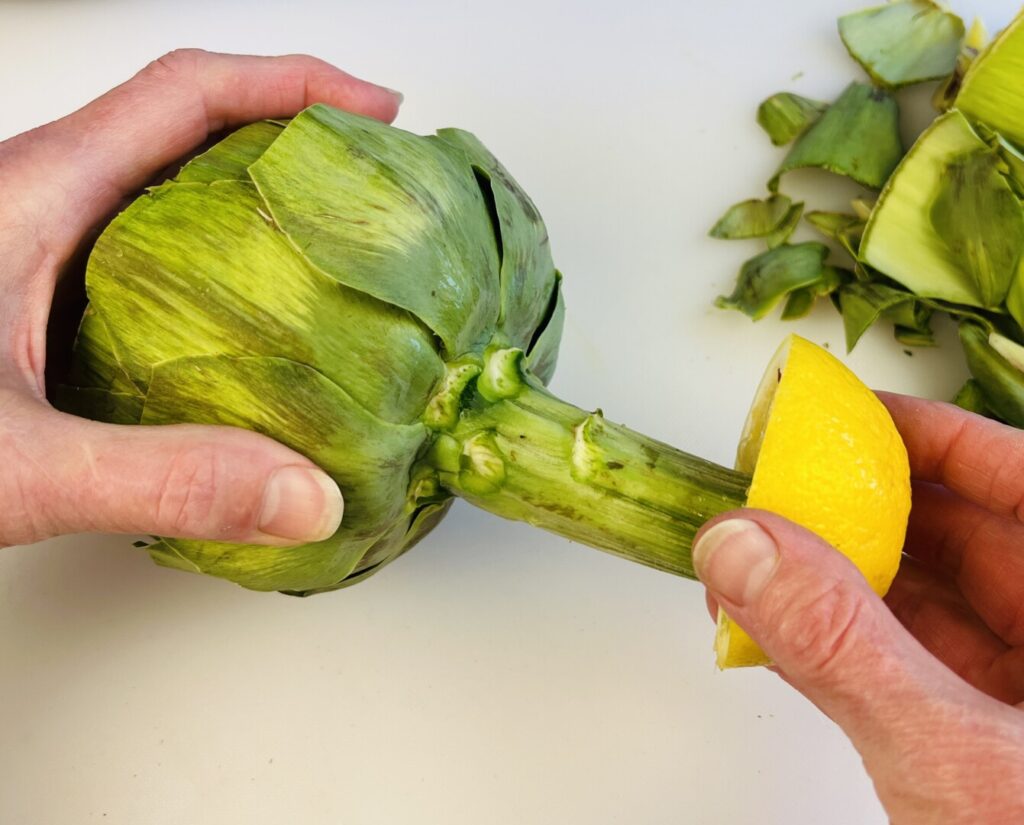
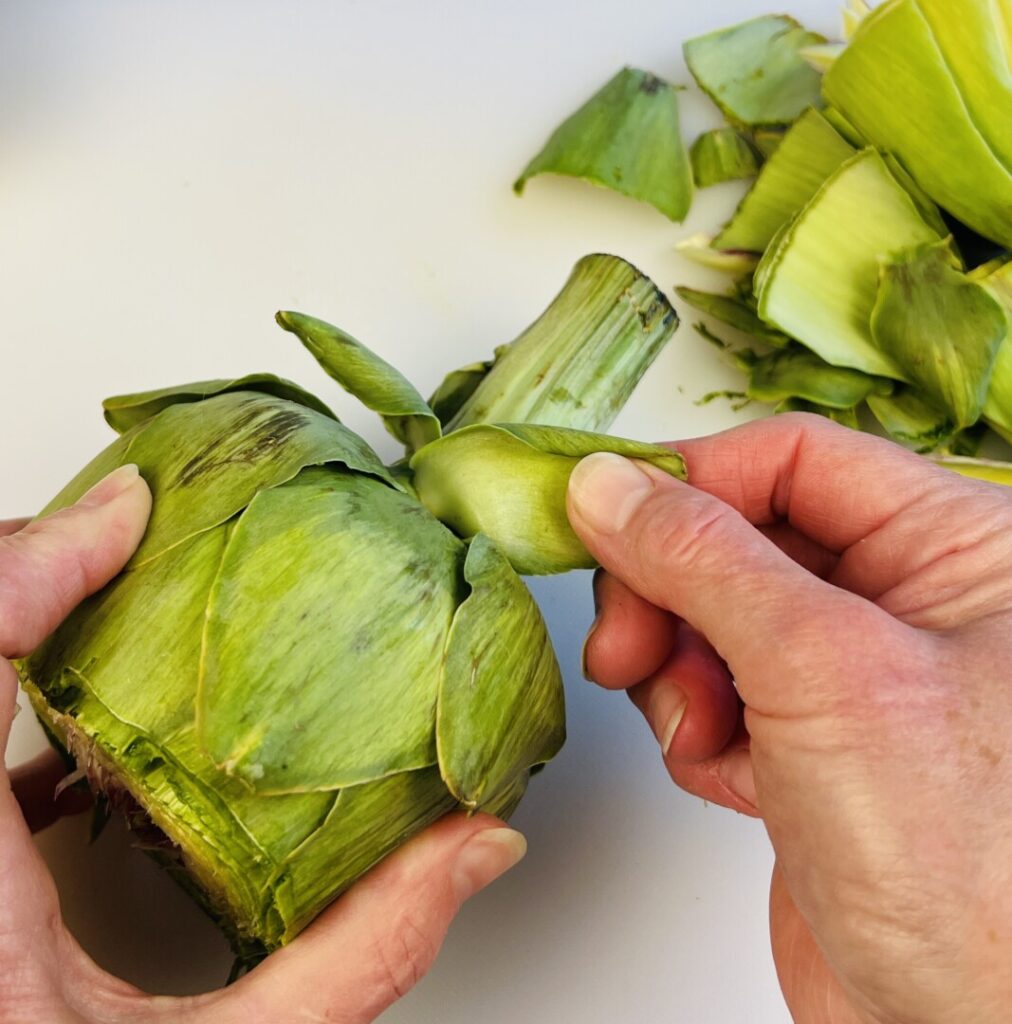
If the artichoke is large, section it into sixths. Smaller artichokes can be quartered. Use the chef knife and start with the stem. As before, rub cut surfaces with lemon to prevent browning.
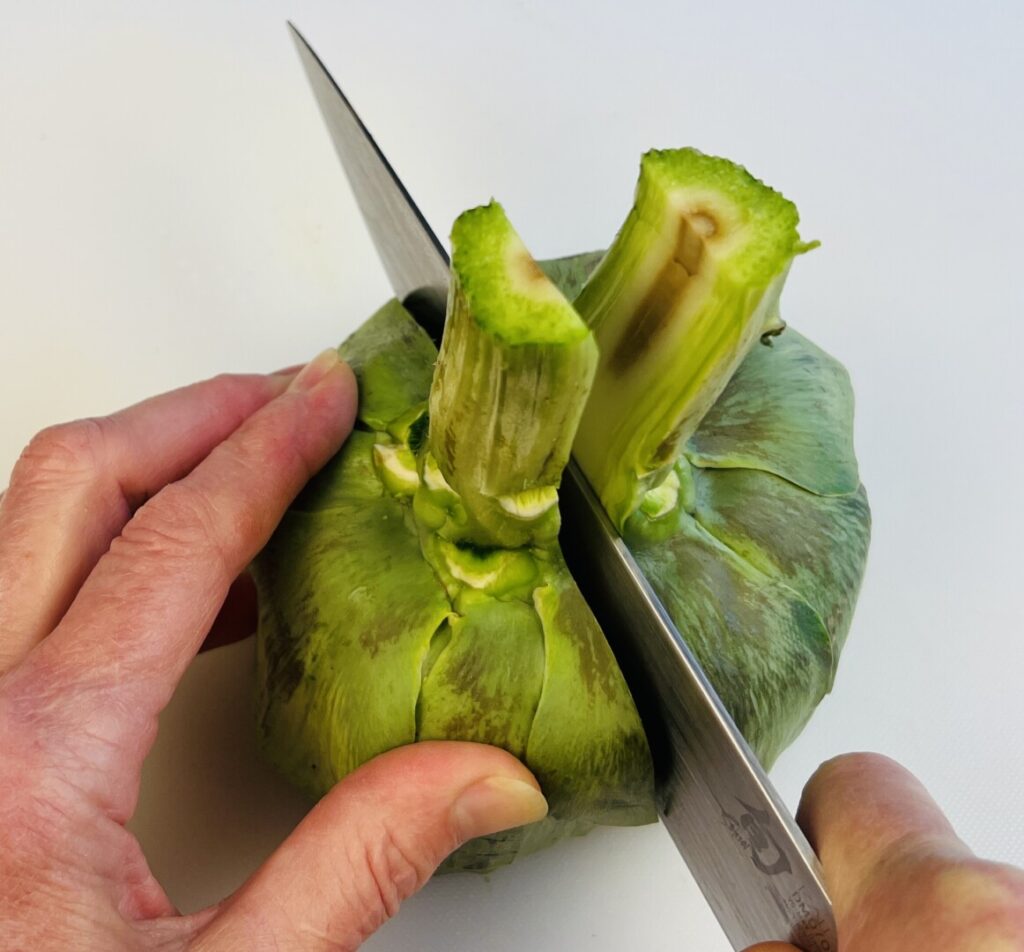
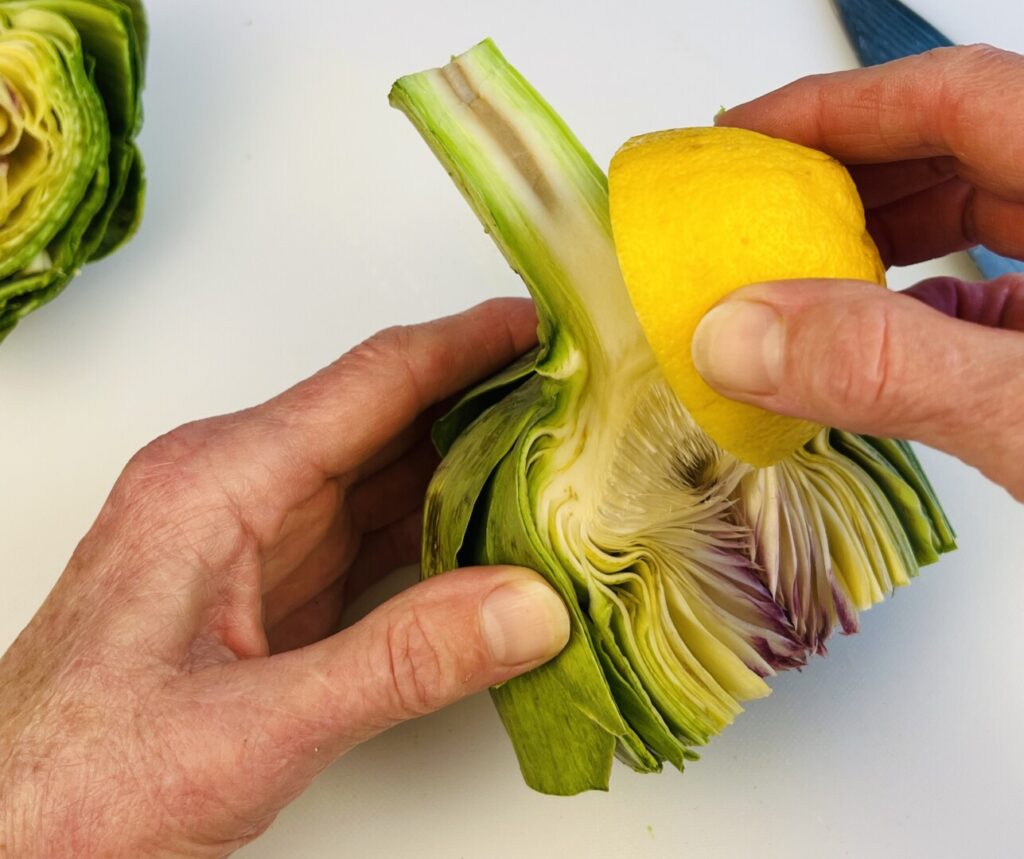
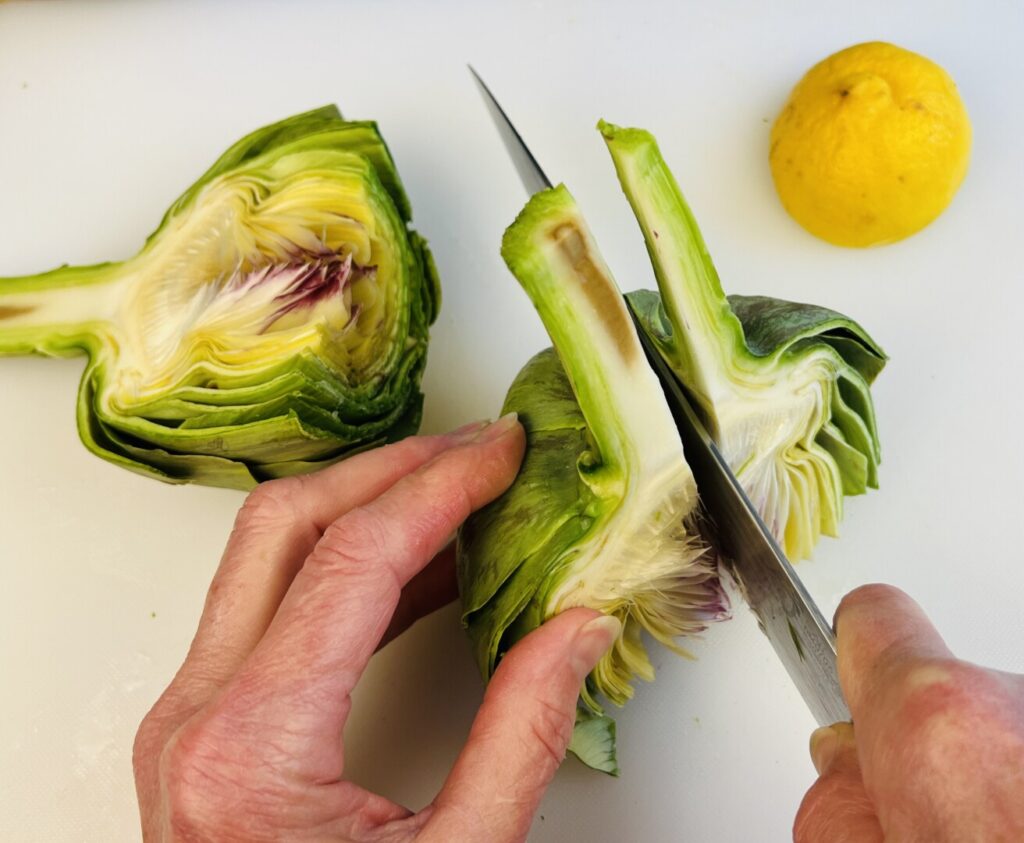
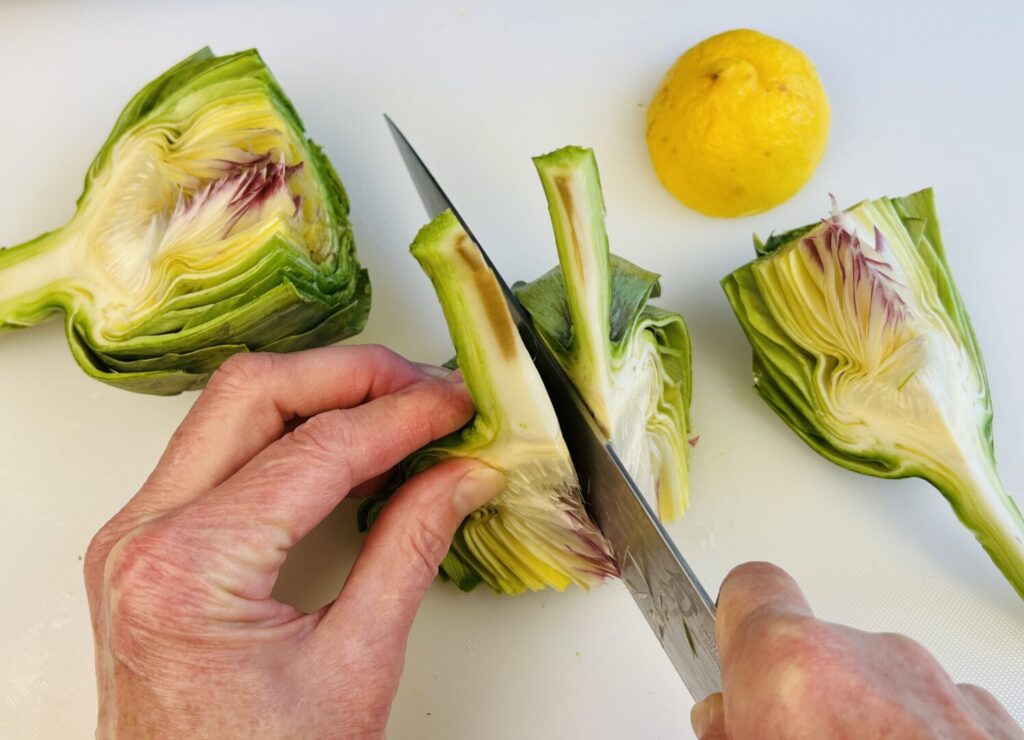
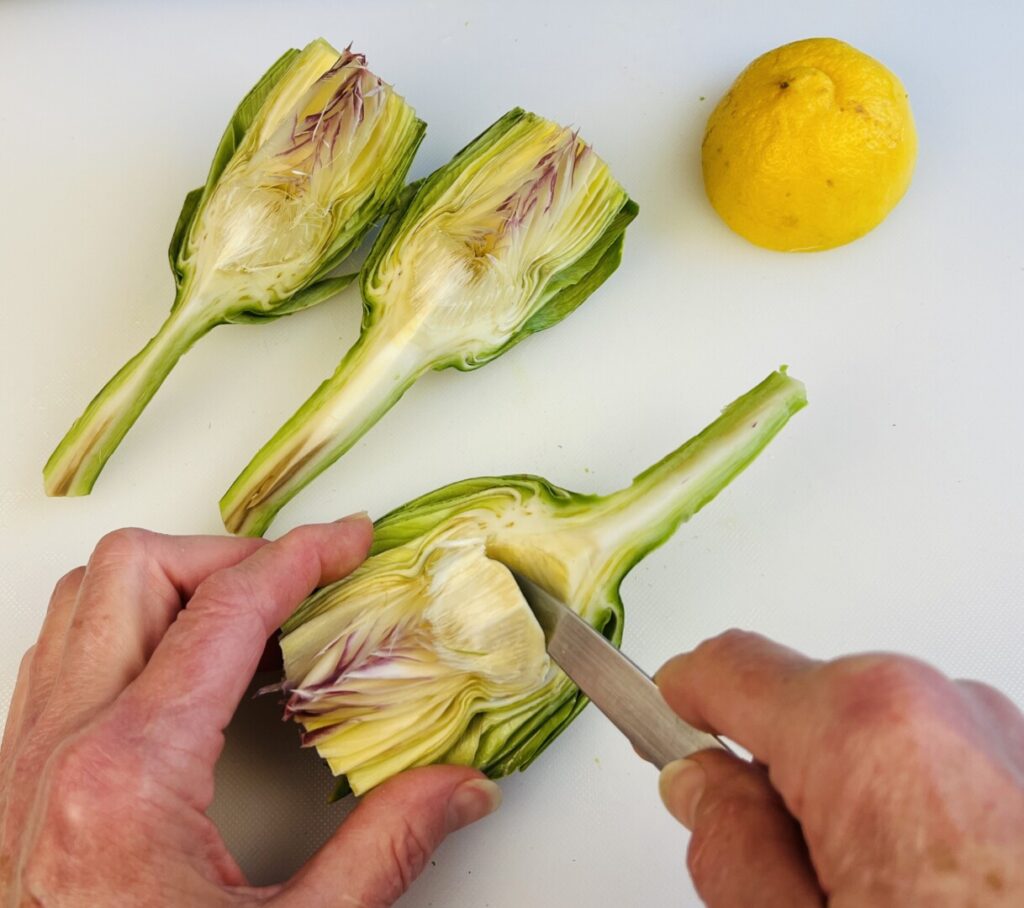
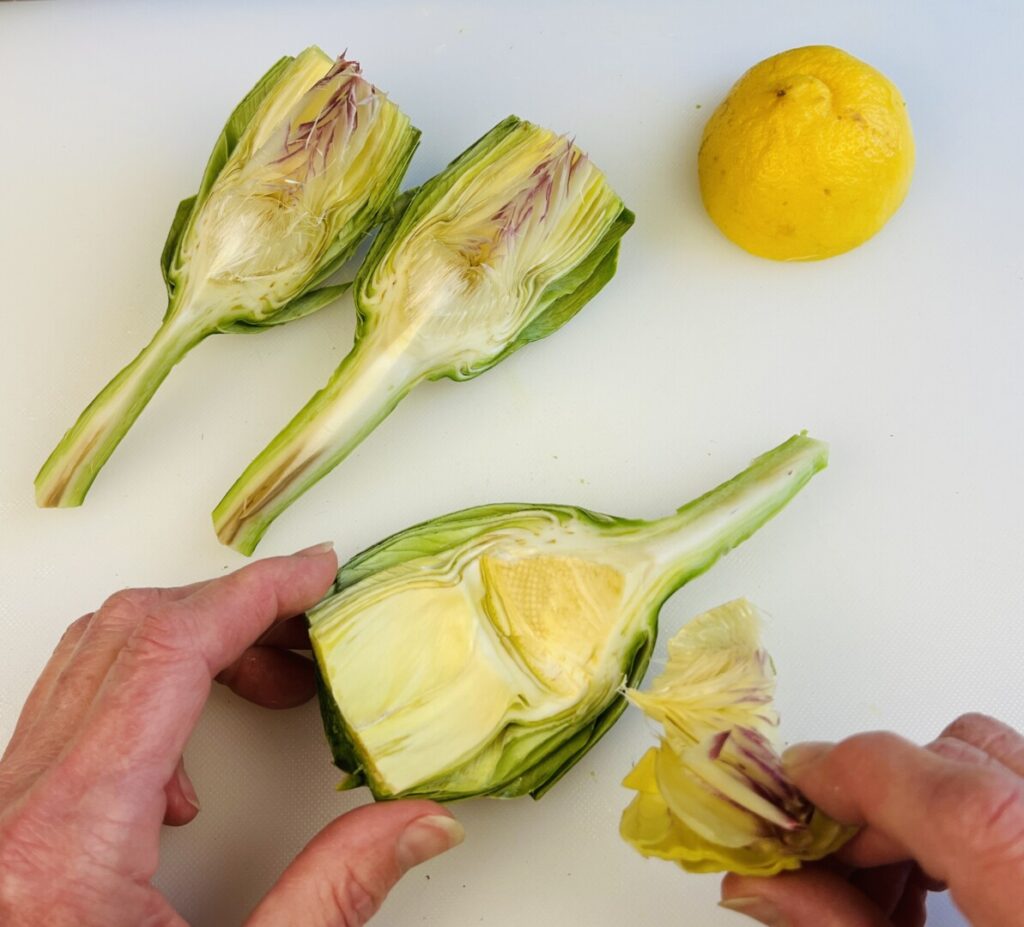
Once the artichoke is sectioned, it’s easy to remove the choke and inedible central petals. The interface between the artichoke’s hairy choke and its edible bottom is bowl-shaped; use the tip of the paring knife to make a curved slice between the two parts. Then grasp the reddish-color petals and pull out and down toward the stem. As you proceed, rub the cut surfaces with lemon and immediately drop the artichoke sections into cold water to prevent browning.
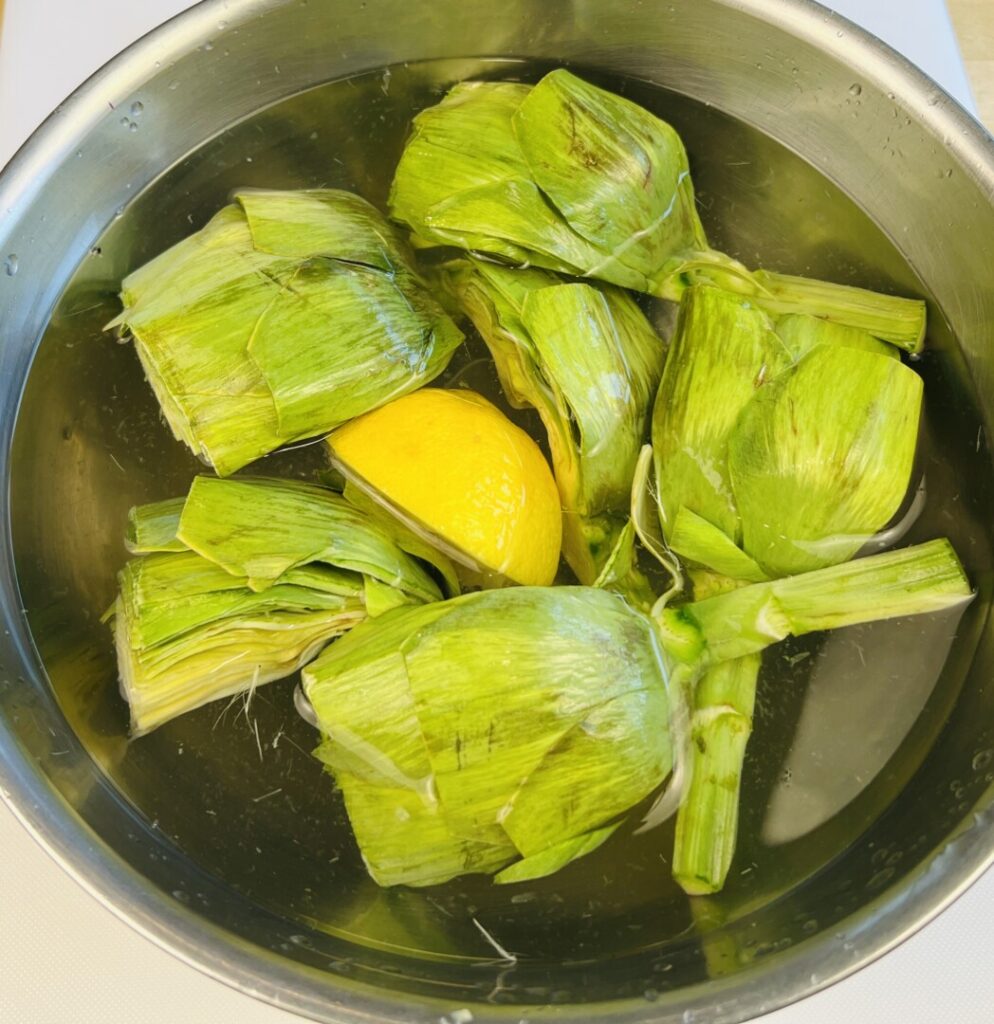
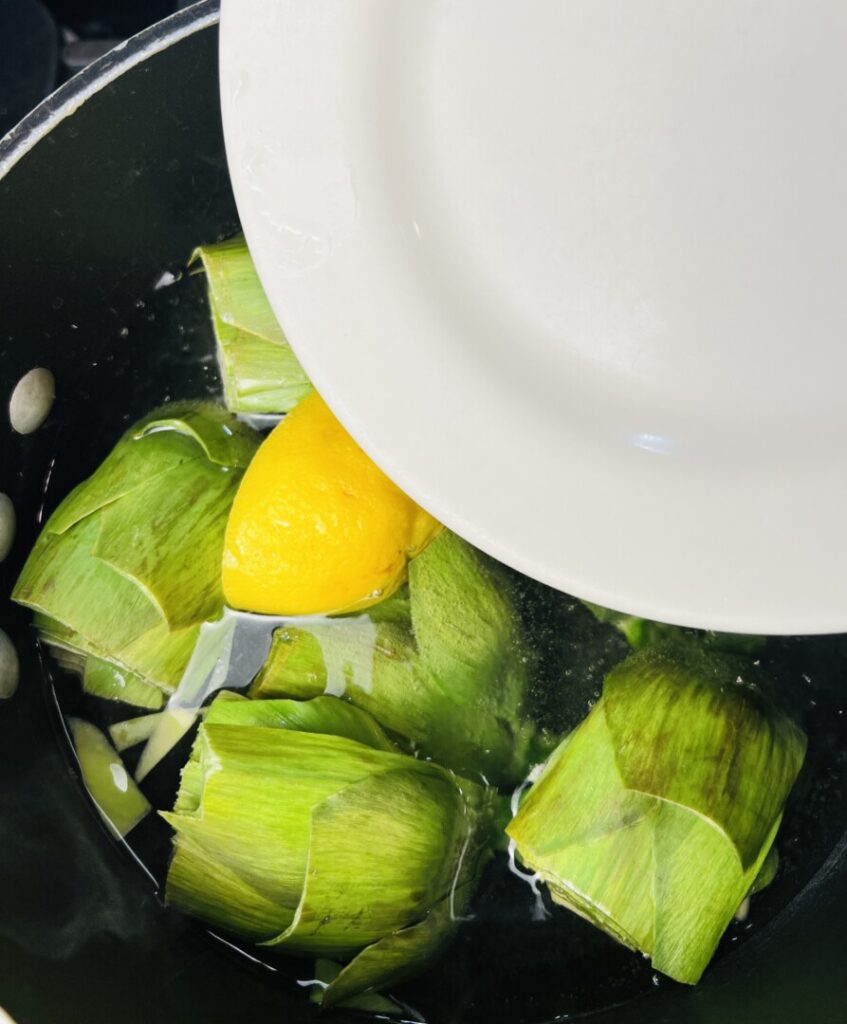
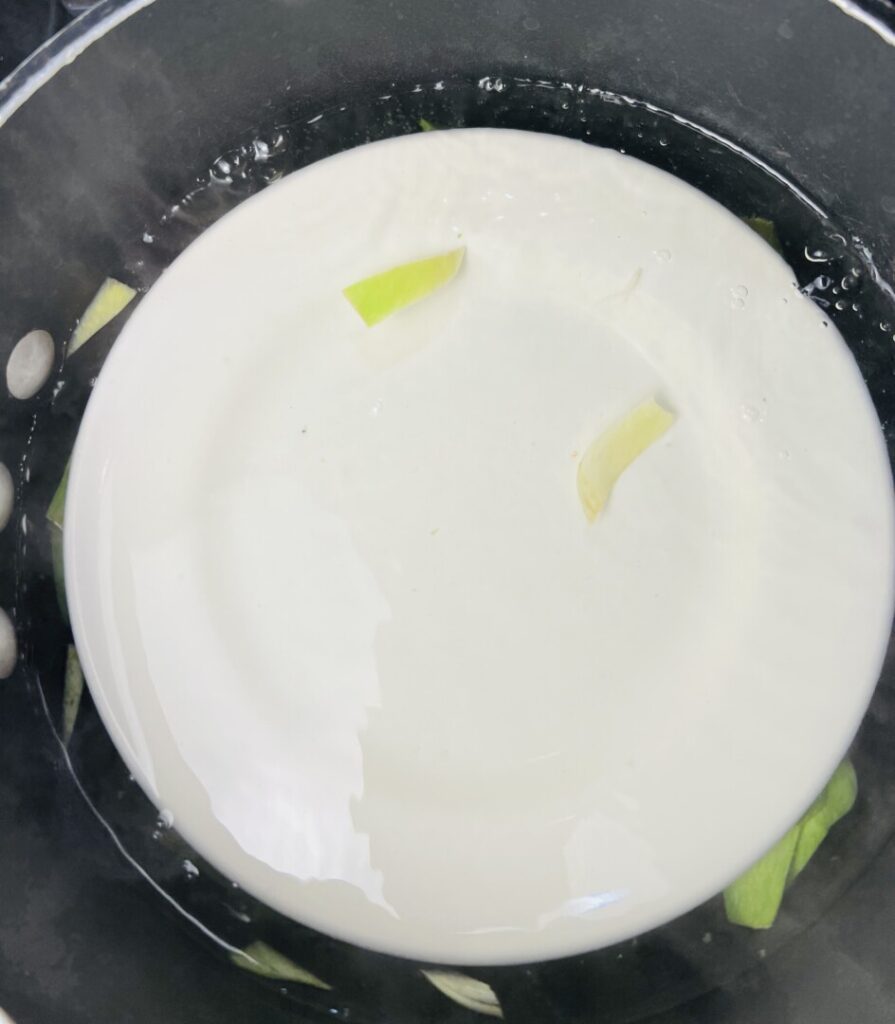
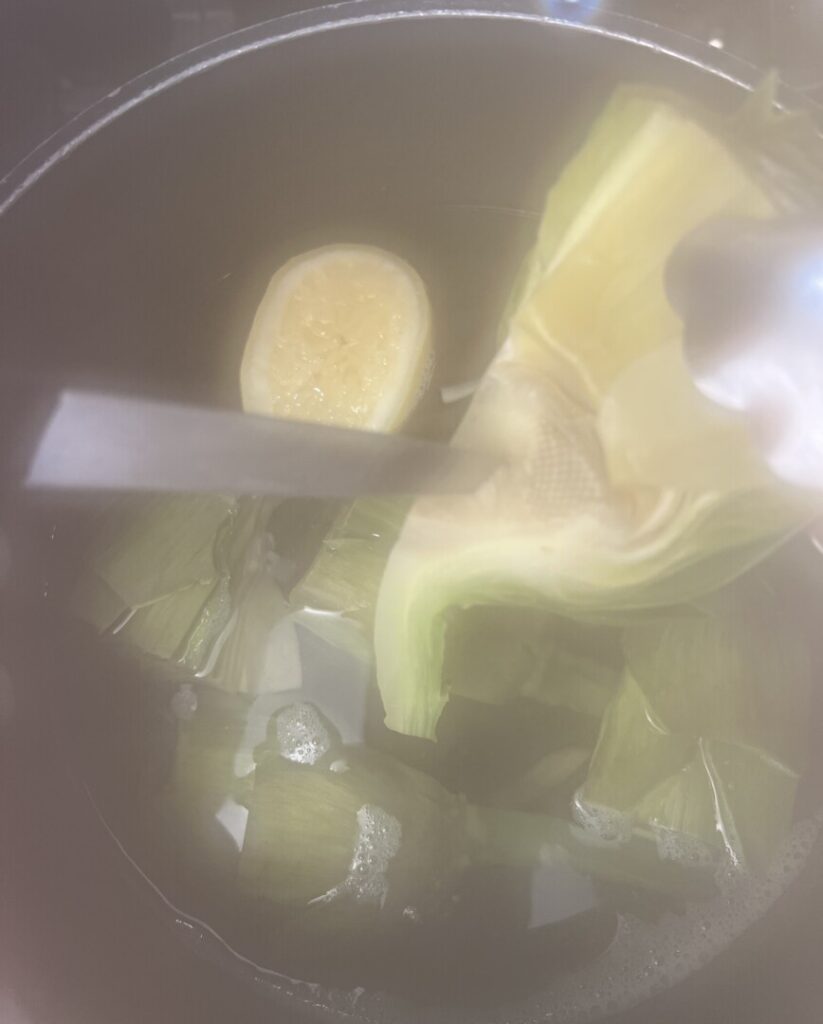
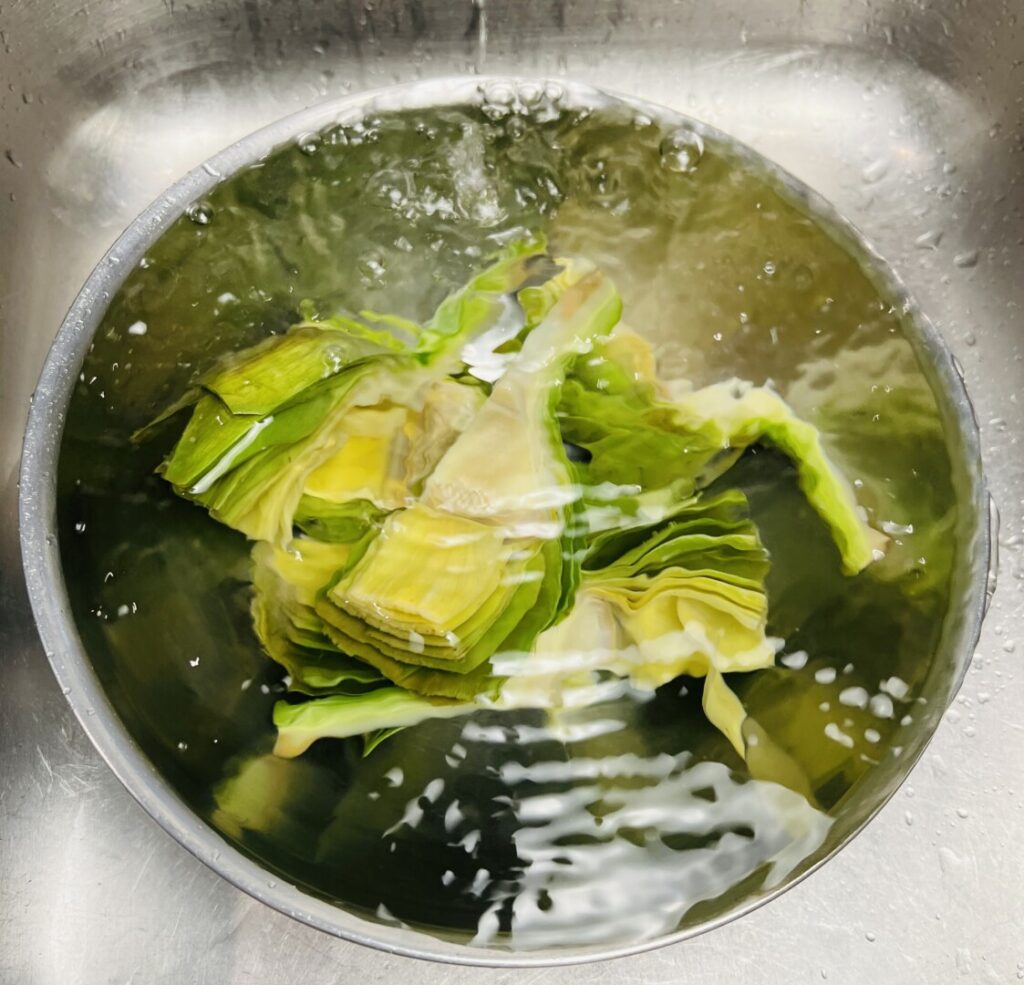
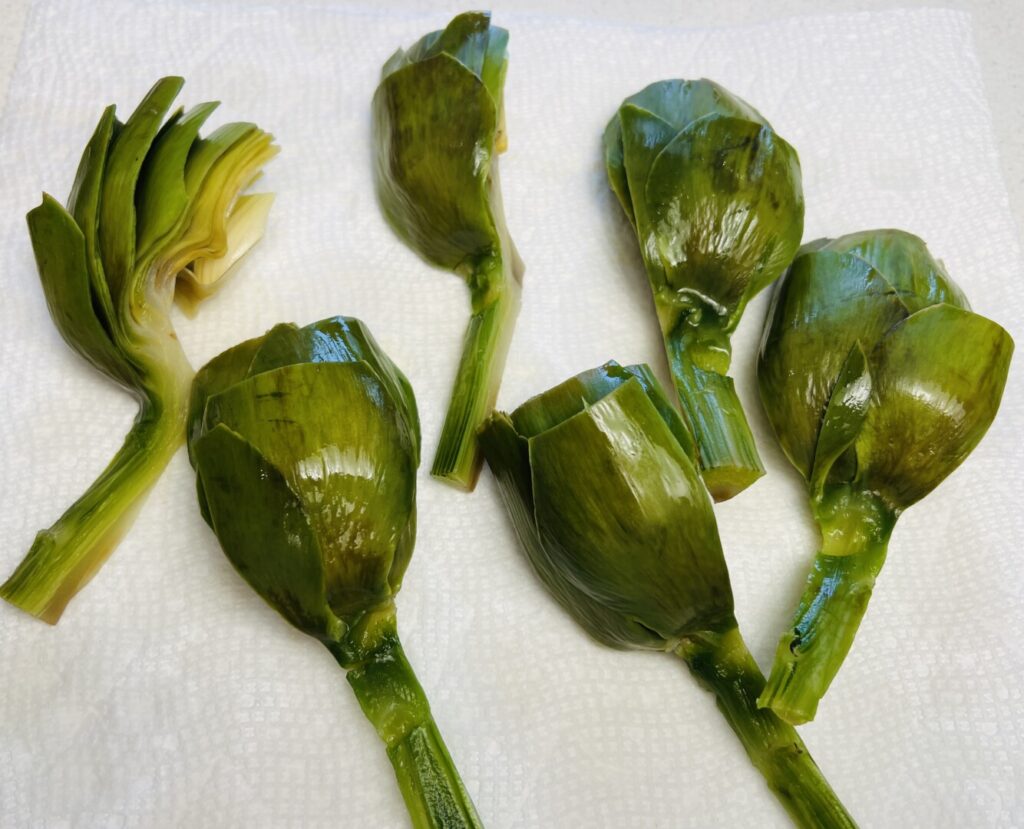
The next step is to par-cook the artichoke sections by blanching and refreshing. Put them in the boiling water cut-side-down. Because artichokes tend to float, keep them submerged by weighting them with a plate. Because the artichokes in this recipe are destined to be roasted, the cooking time will be less than if we were eating them cold or simply reheated in a microwave oven. Test for doneness by inserting a paring knife in the center of the artichoke bottom. For this recipe the blade should penetrate with moderate resistance. Refresh under cold running water, and then blot dry on paper towels.
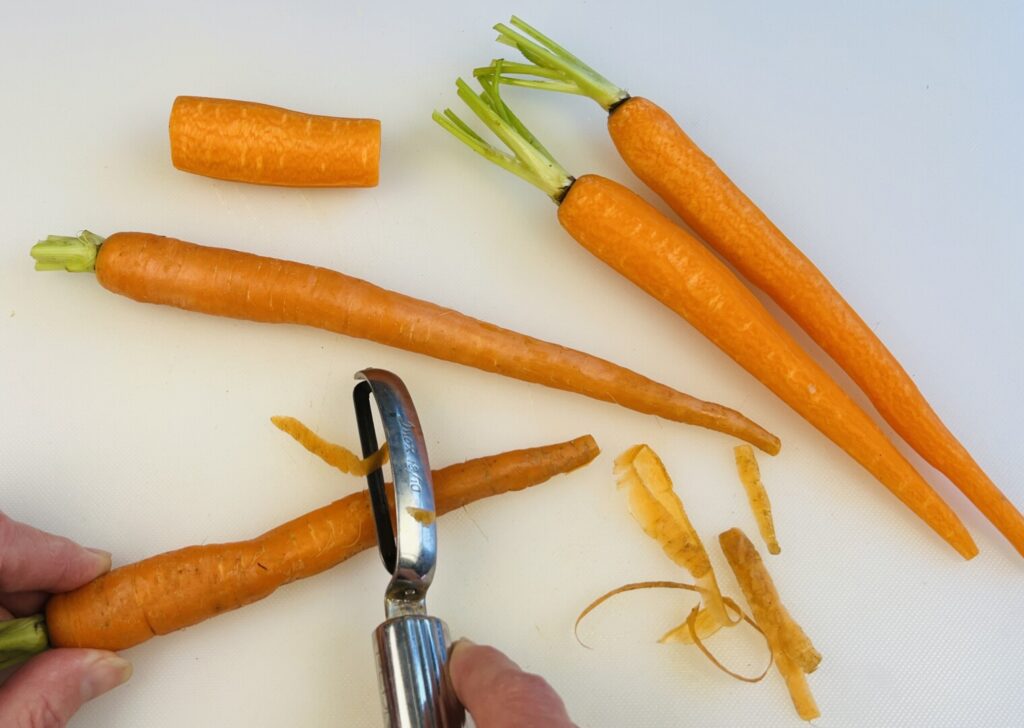
Carrots have two functions in this recipe: as a seasonal side vegetable and to enhance the dipping sauce. For this dish, choose fresh young carrots, the type with tops or at least stems attached. If the ones you purchase are extra-long, whittle down the pointed ends so they’ll fit nicely on your plates. Trim off any discolored areas where the carrot meets its stem. You’ll need some extra diced carrot to make carrot purée for the springtime rouille sauce. The whole carrots will be roasted, so keep them on the al dente side of doneness. Cook the diced carrot soft. Refreshing in cold water stops the cooking.
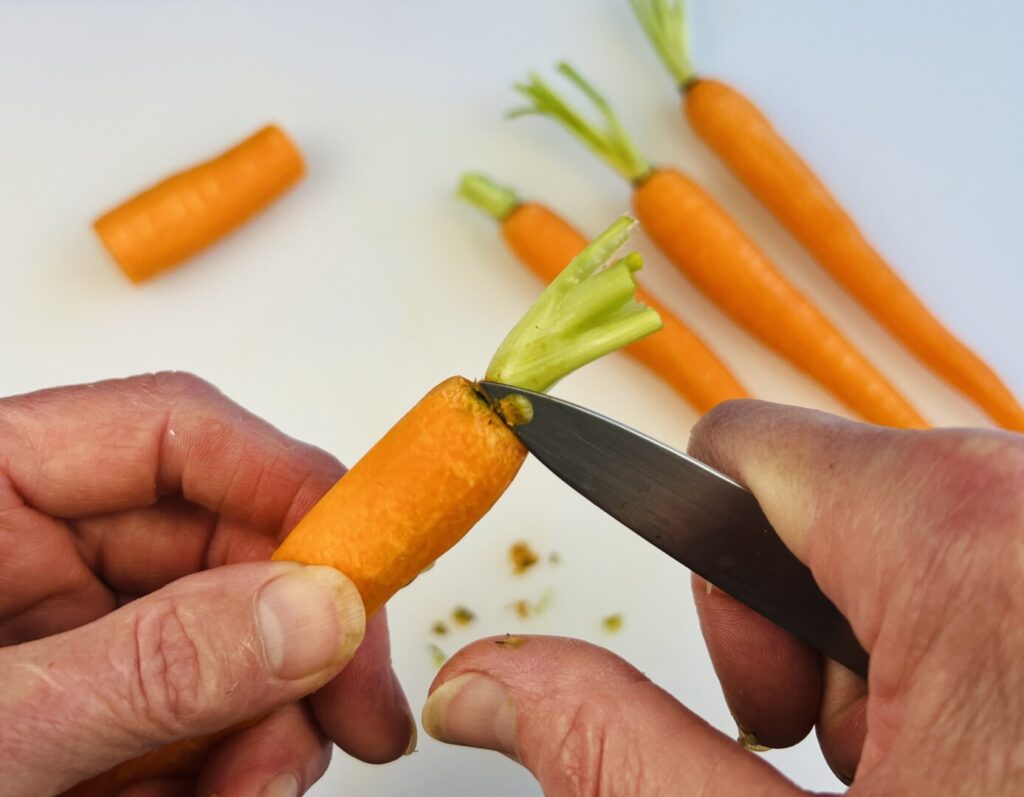
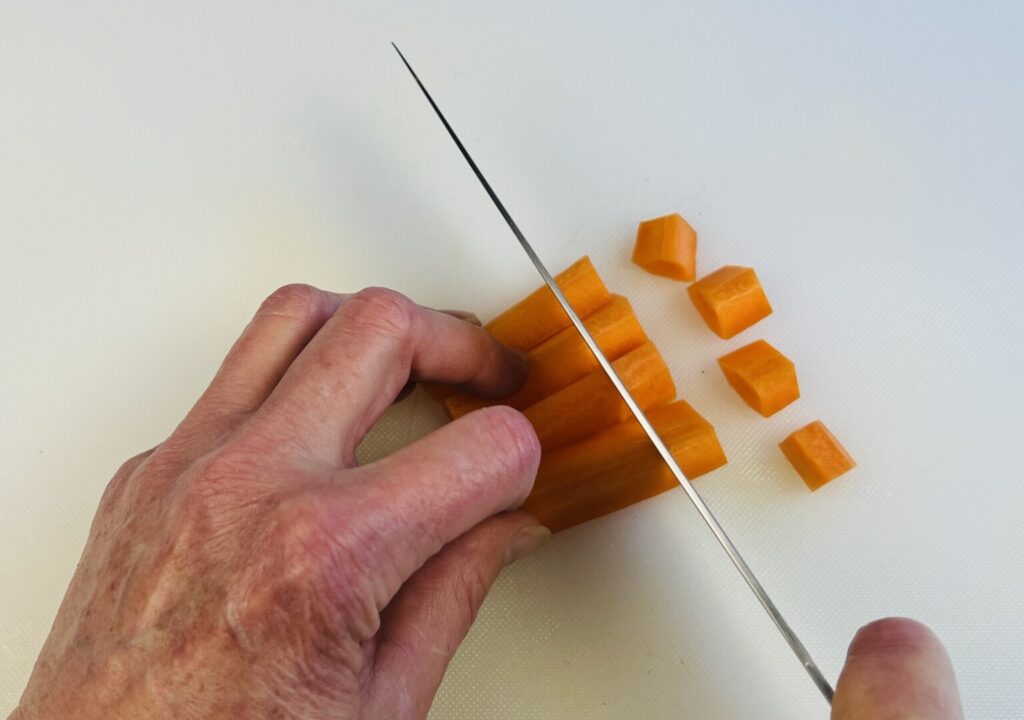
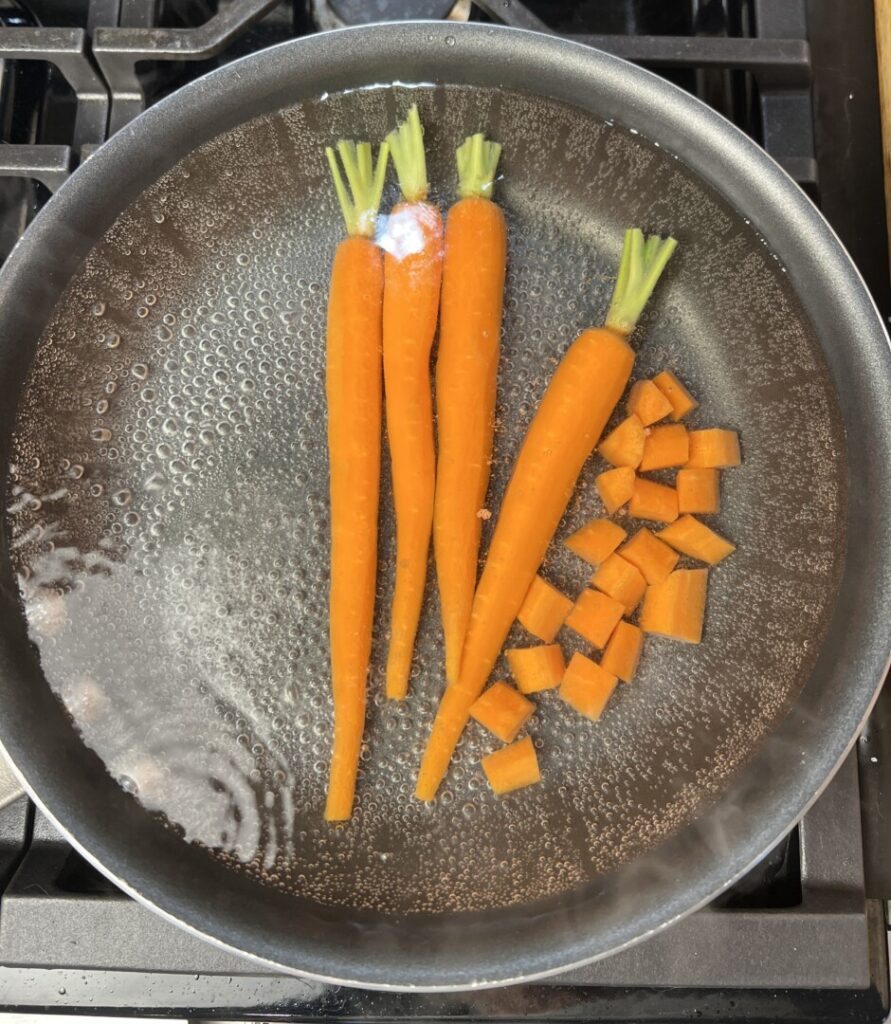
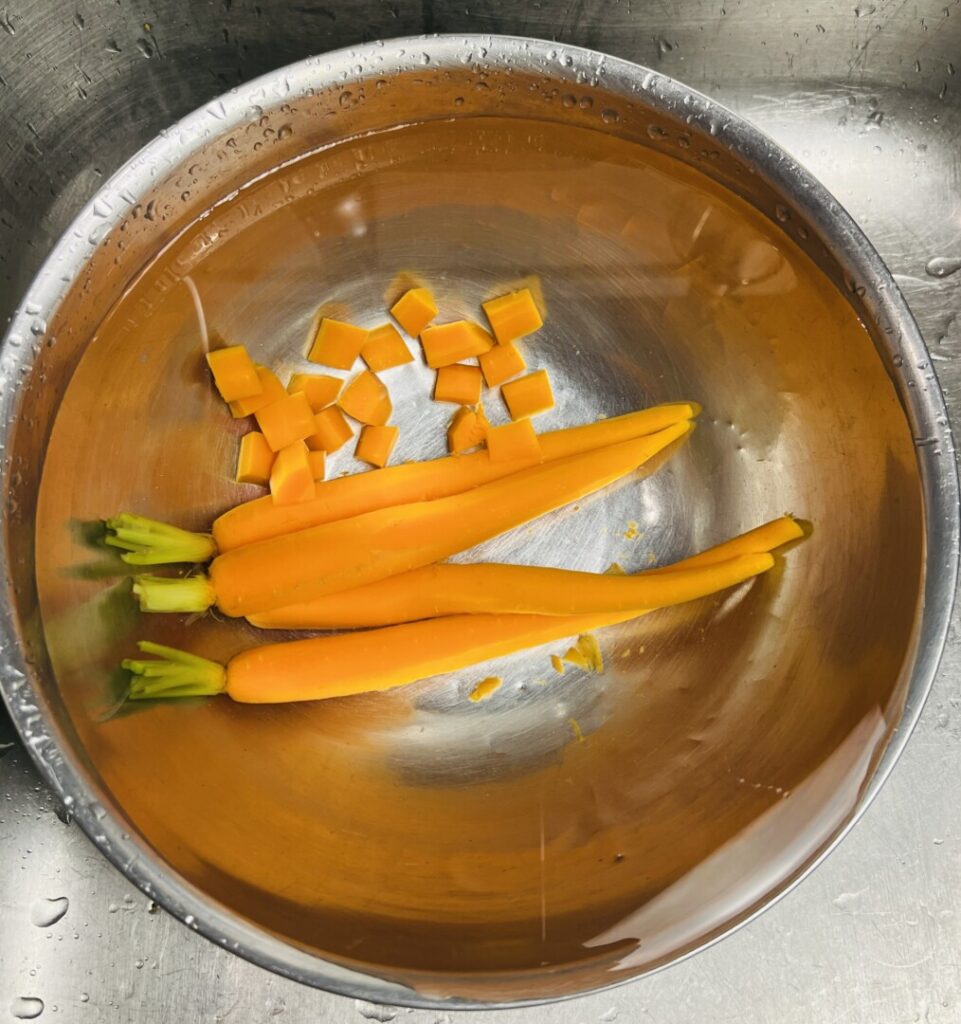
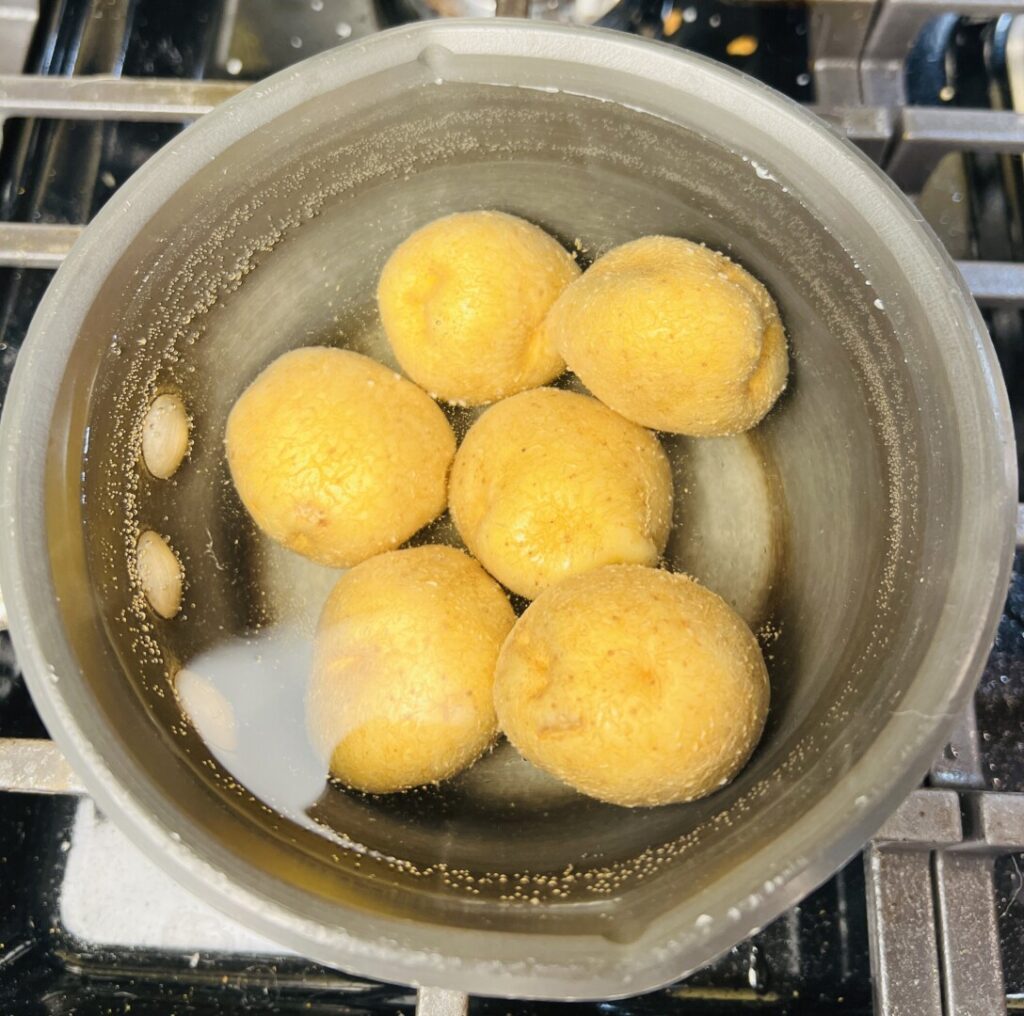
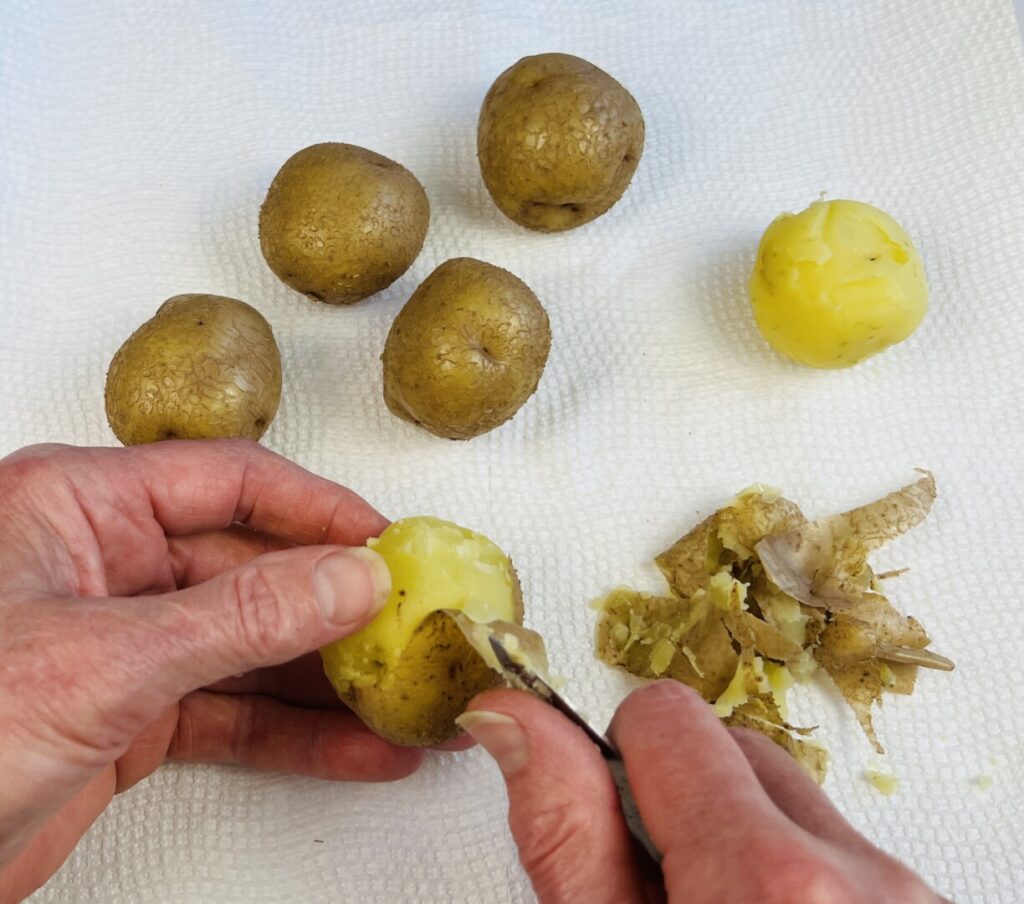
Springtime new potatoes roast alongside the artichokes and carrots. For even cooking, these also are par-cooked al dente before going into the roasting pan. Although the skins of new potatoes are edible, peeling them allow the olive oil and seasonings to penetrate the flesh for enhanced flavor.
Rouille is a spicy, garlicky, mayonnaise-like sauce originally created in Provençe to accompany bouillabaisse, the region’s famous fish stew. The French word rouille literally translates as “rust,” in reference to the sauce’s rusty-red color acquired from saffron and red chiles. Our springtime version of rouille acquires both color and flavor from puréed carrots and uses quality commercial mayonnaise to save time.
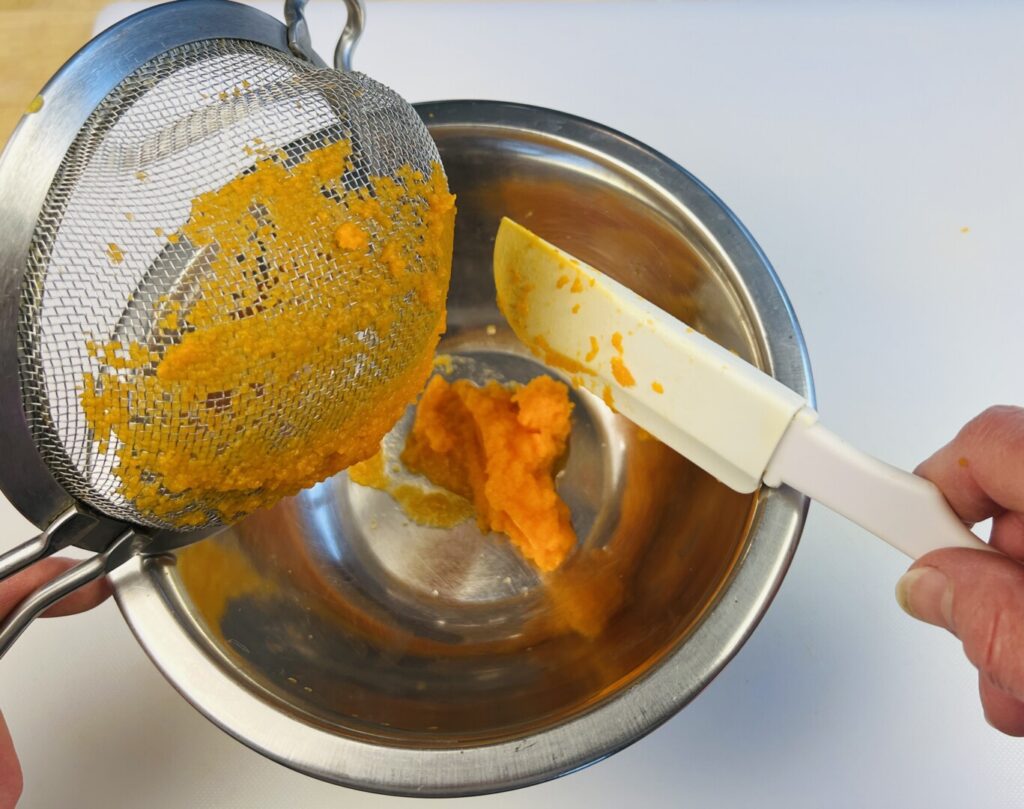
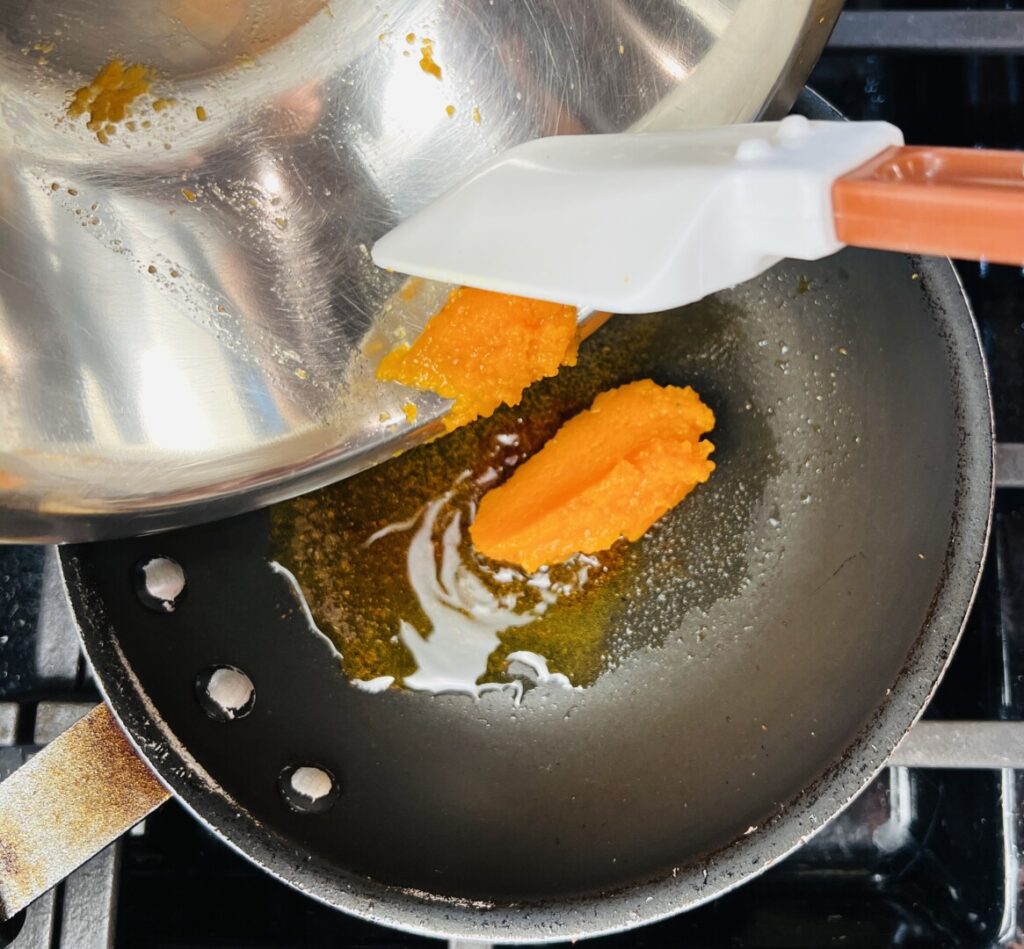
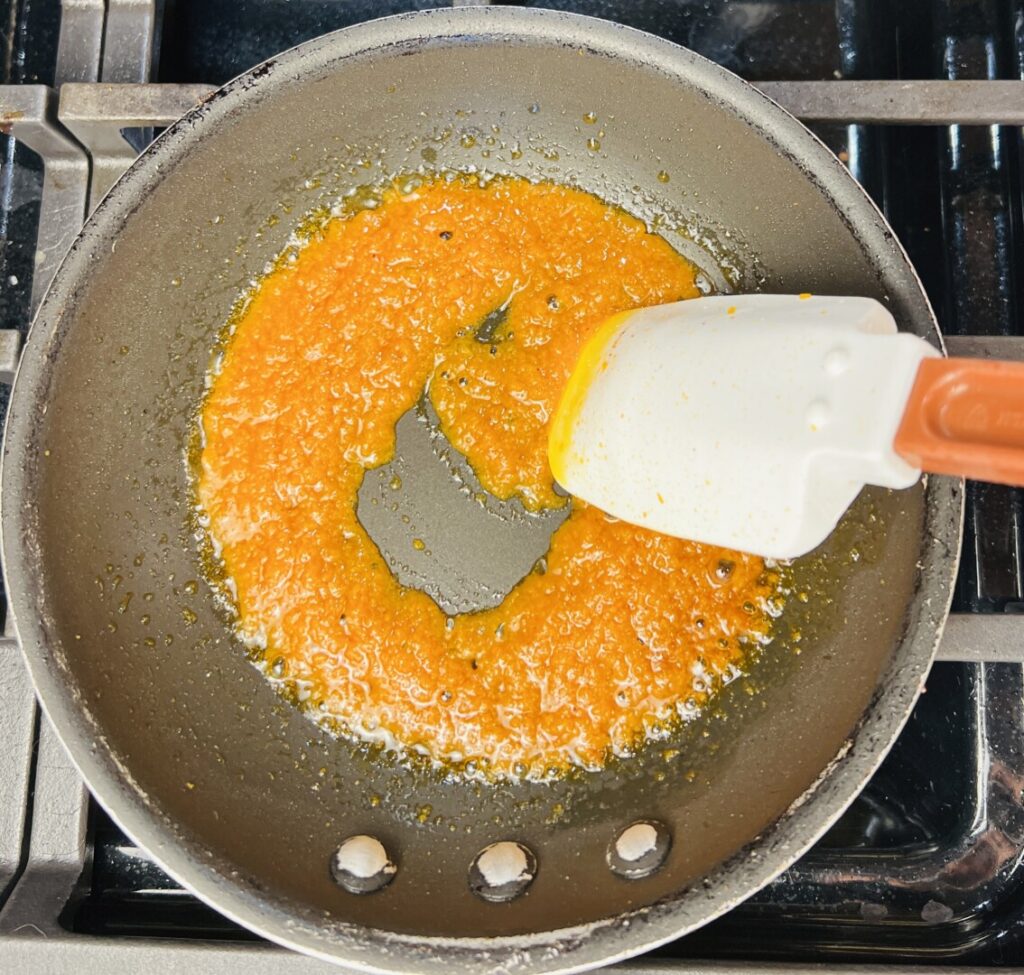
Purée the soft, cooked carrots by forcing them through a sieve. Then sweat smoked paprika and cayenne powder in olive oil to release their flavors before adding the purée. Cook down the purée until excess liquid evaporates and a little oil separates out of the mixture. Then cool and mix with the mayo and other seasonings.
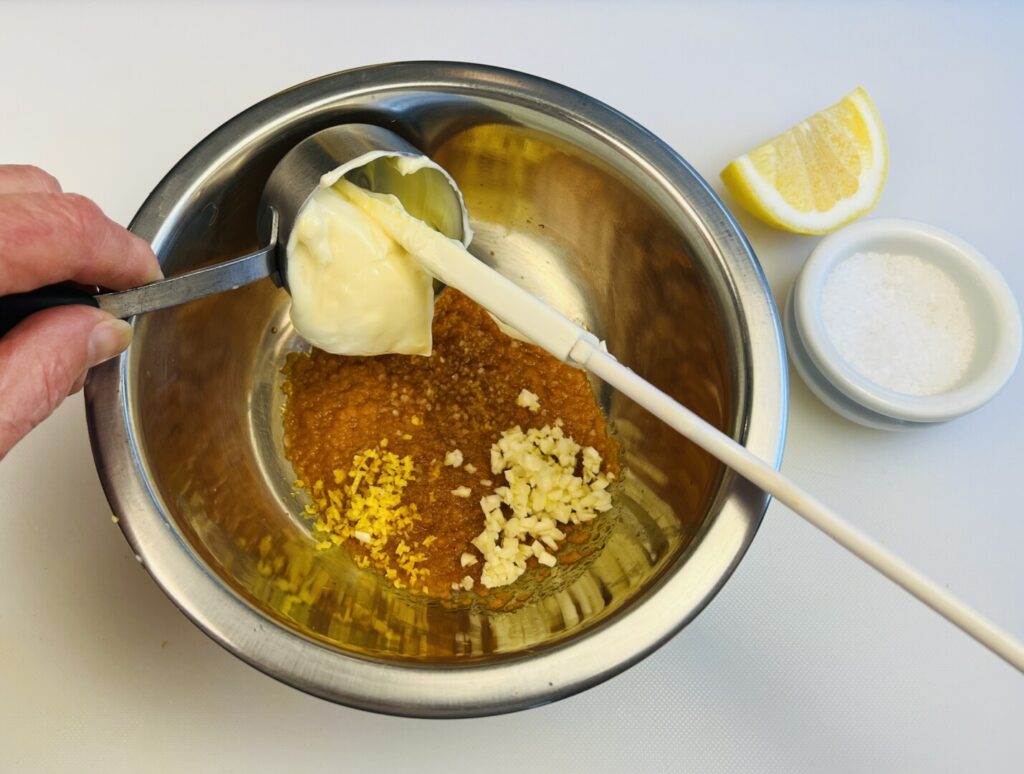
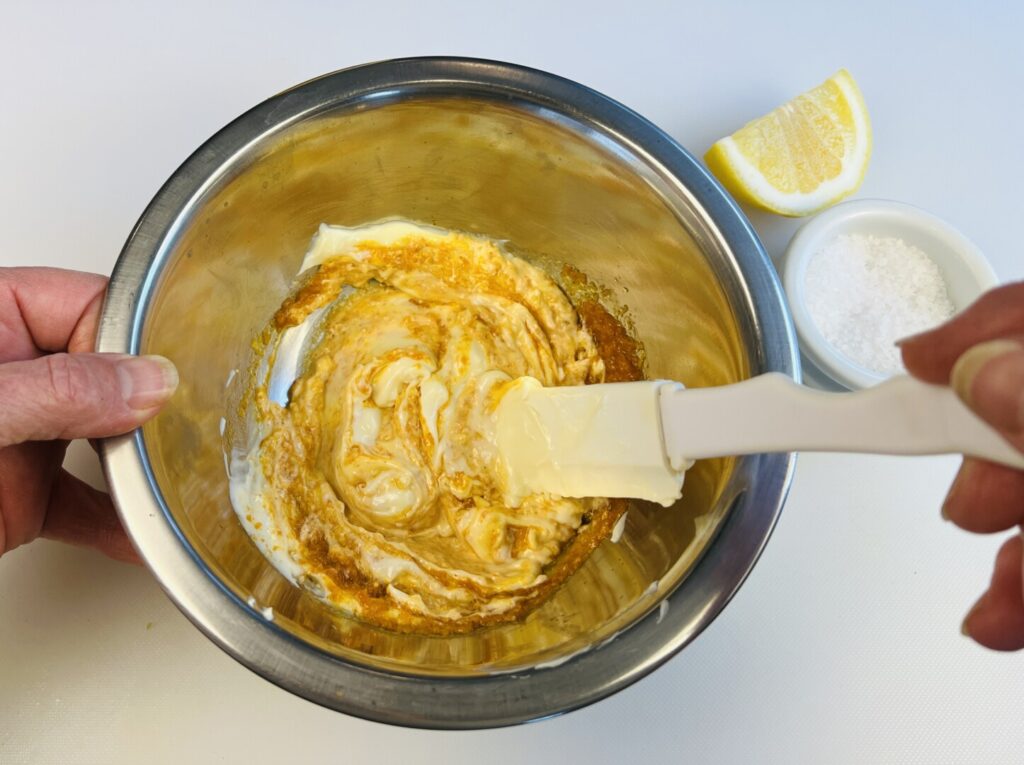
Assemble the remaining ingredients and your prep work is done. Here’s your mise tray:
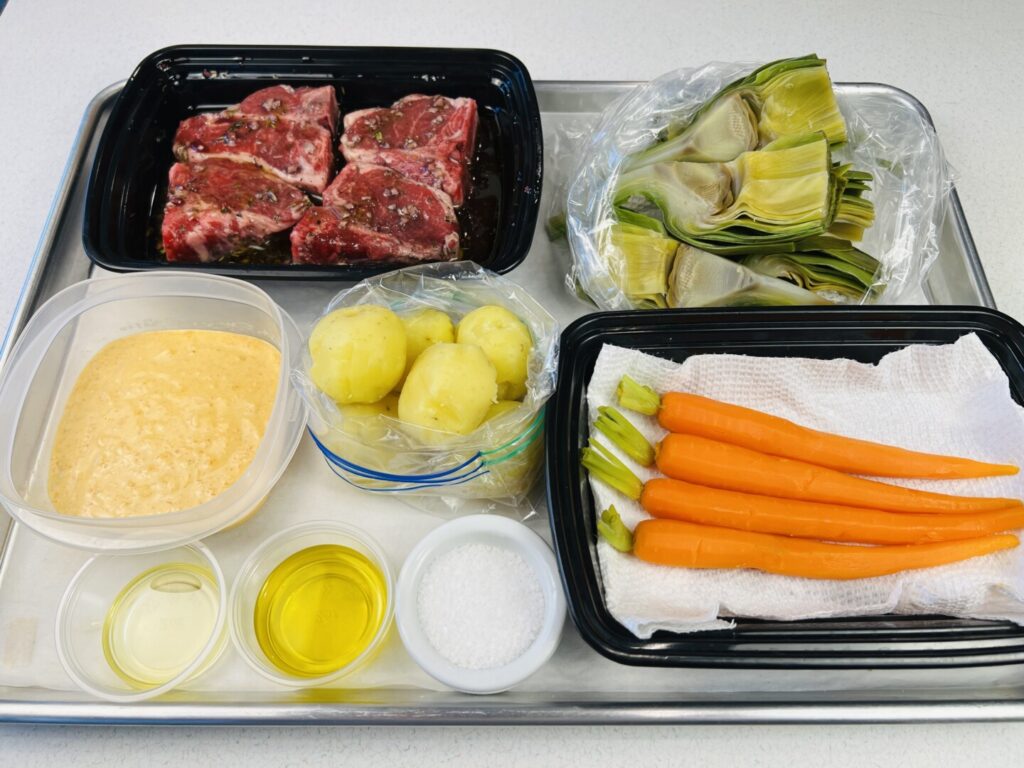
It’s dinner time—let’s COOK!
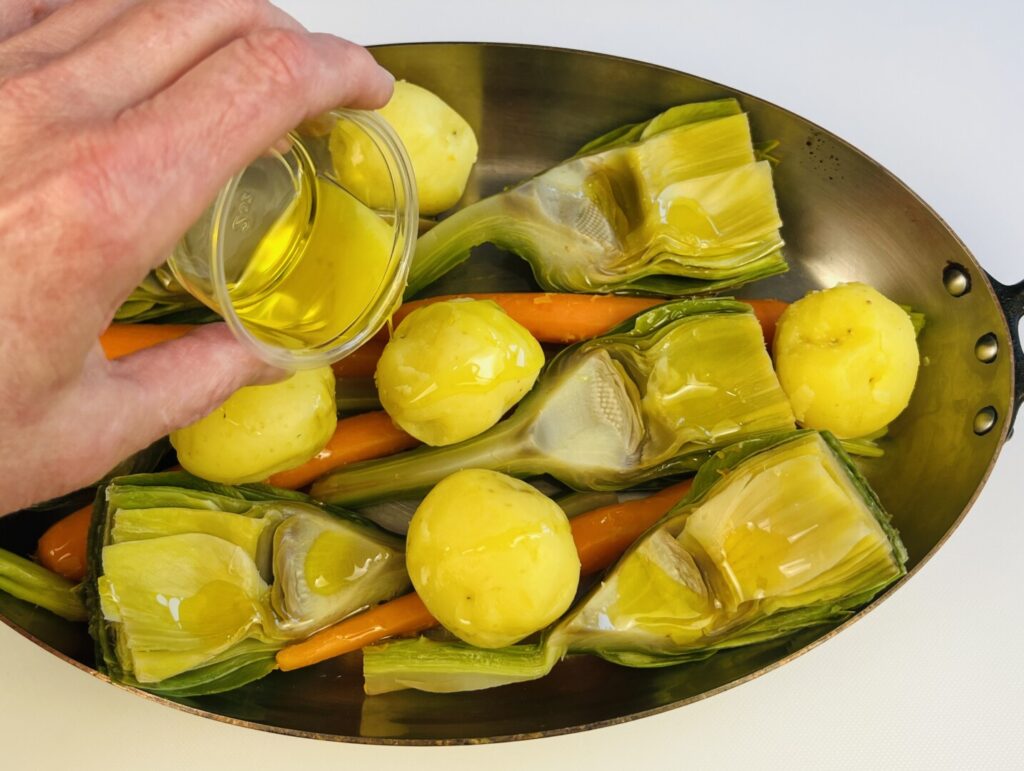
Your first task is to start roasting the vegetables. Arrange the par-cooked vegetables in a gratin dish or baking dish with the hollow insides of the artichokes facing upward. Drizzle with olive oil and some of the lamb marinade, then season with a little salt. A high-heat oven turns excess liquid into steam and concentrates the flavors.
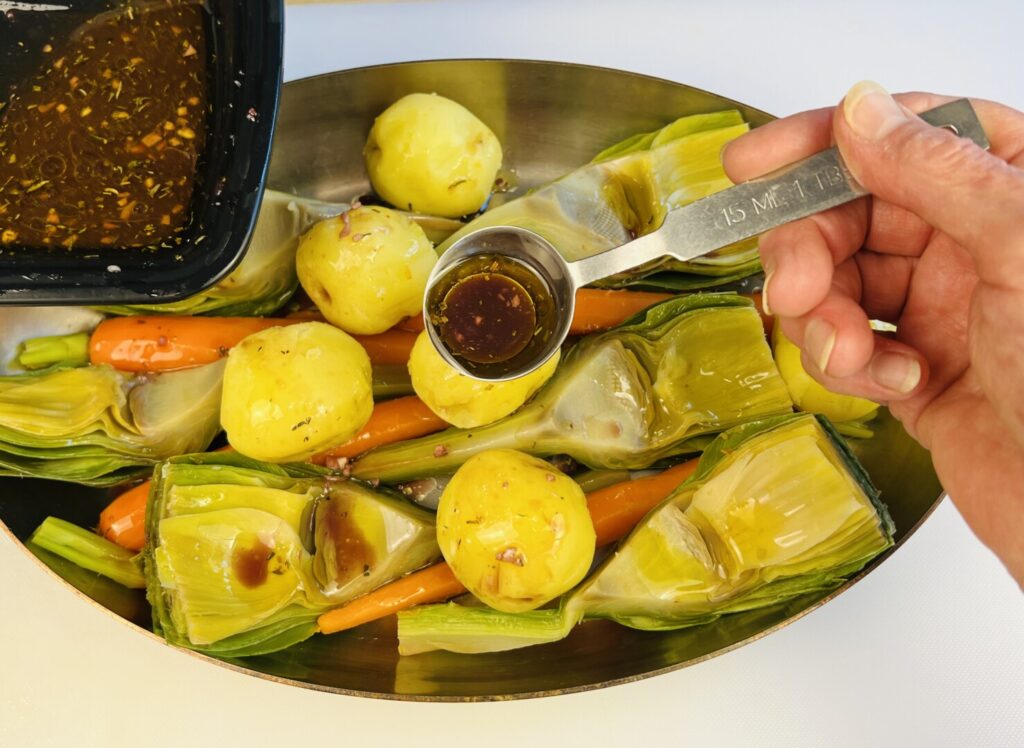
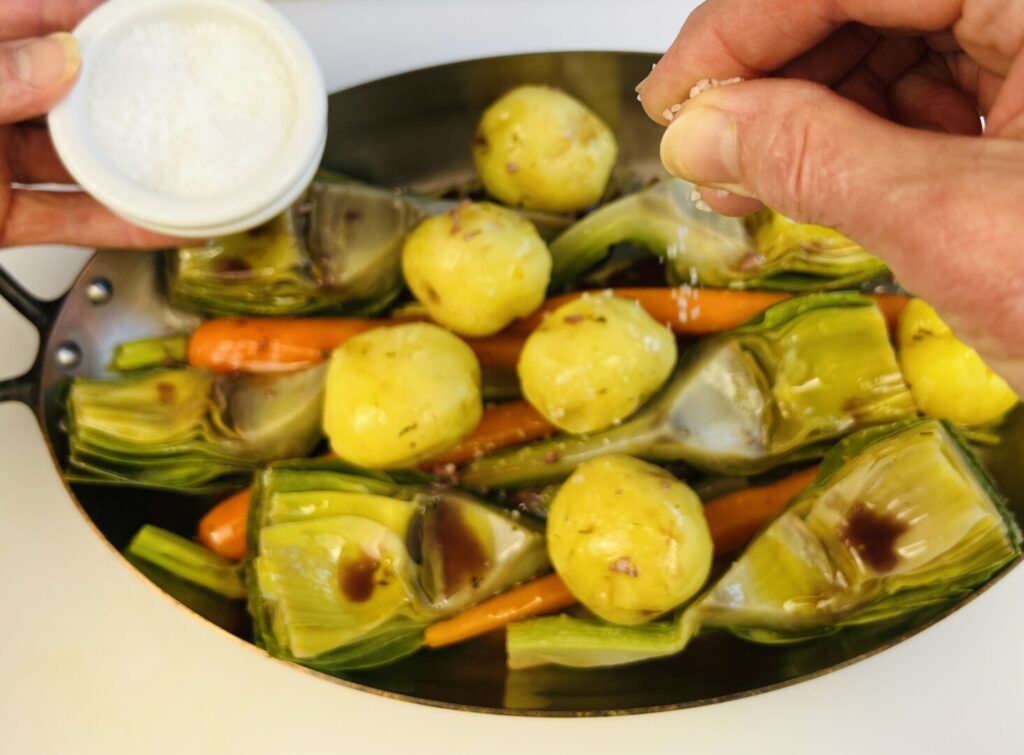
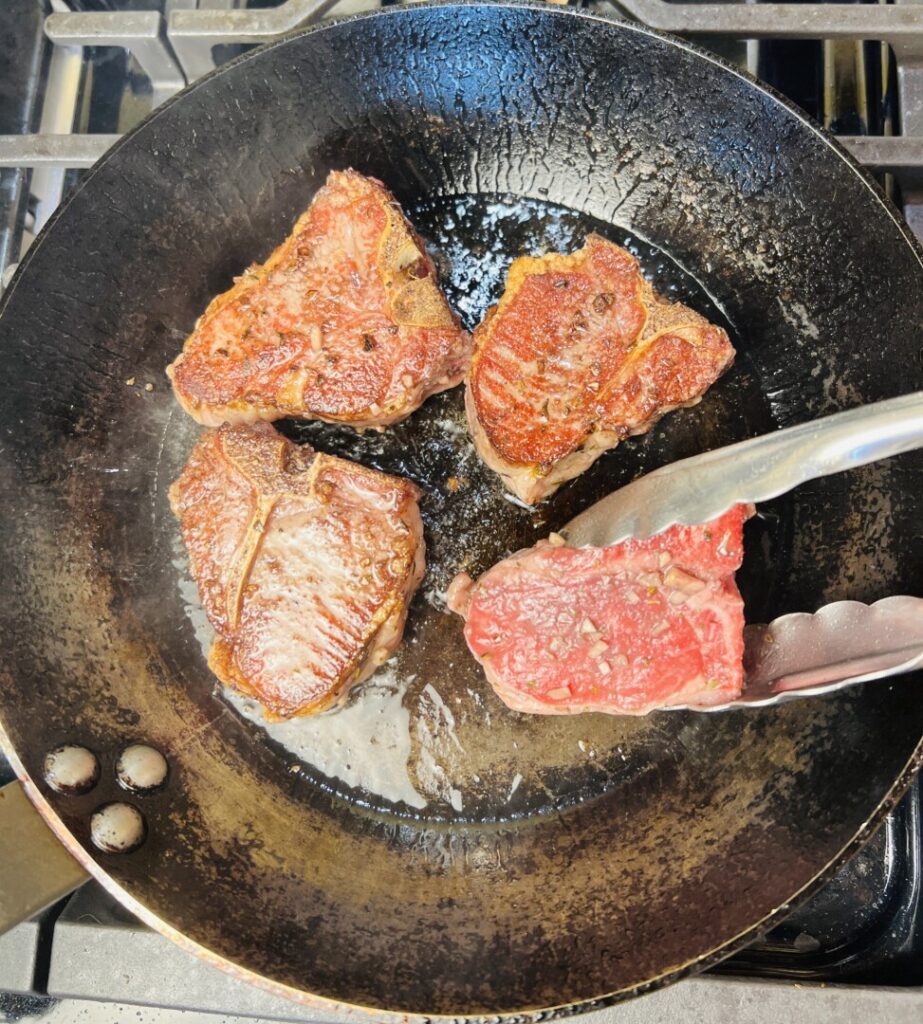
To pan-sear the chops, start with a sauté pan preheated over a high flame. For best results use a well-seasoned carbon steel pan such as the De Buyer one I use. https://amzn.to/3YwJSKr To view a video of how to season a carbon steel pan, use this link: https://prepholdcook.com/tutorials/how-to-season-a-carbon-steel-pan-with-chef-lou/
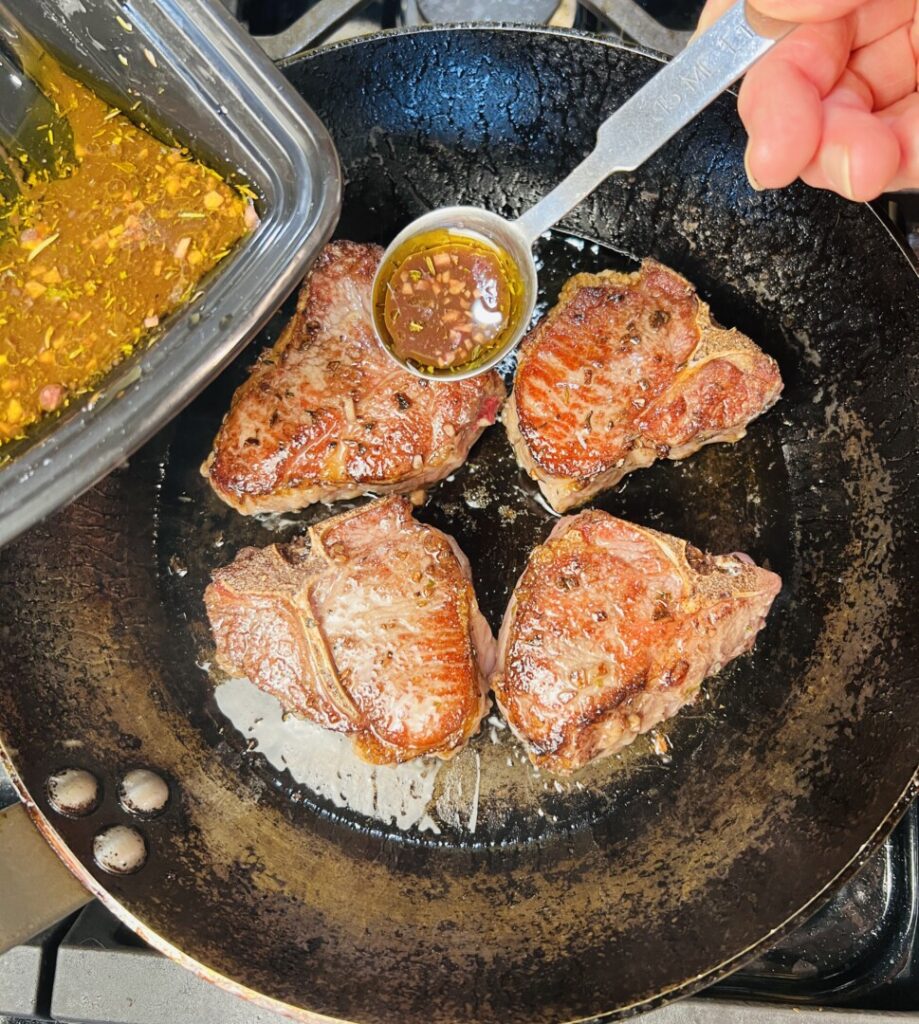
After removing the chops from the marinade, be sure to blot them dry for proper browning. Sear on both sides, then baste with a little marinade for extra flavor. Place the chops on the vegetables, and then finish cooking both in the oven. For medium-rare chops, roast for 10 minutes or less. Use the chef’s “touch test” to determine doneness. Here’s how it works: https://youtu.be/sQT2VO64Rr4
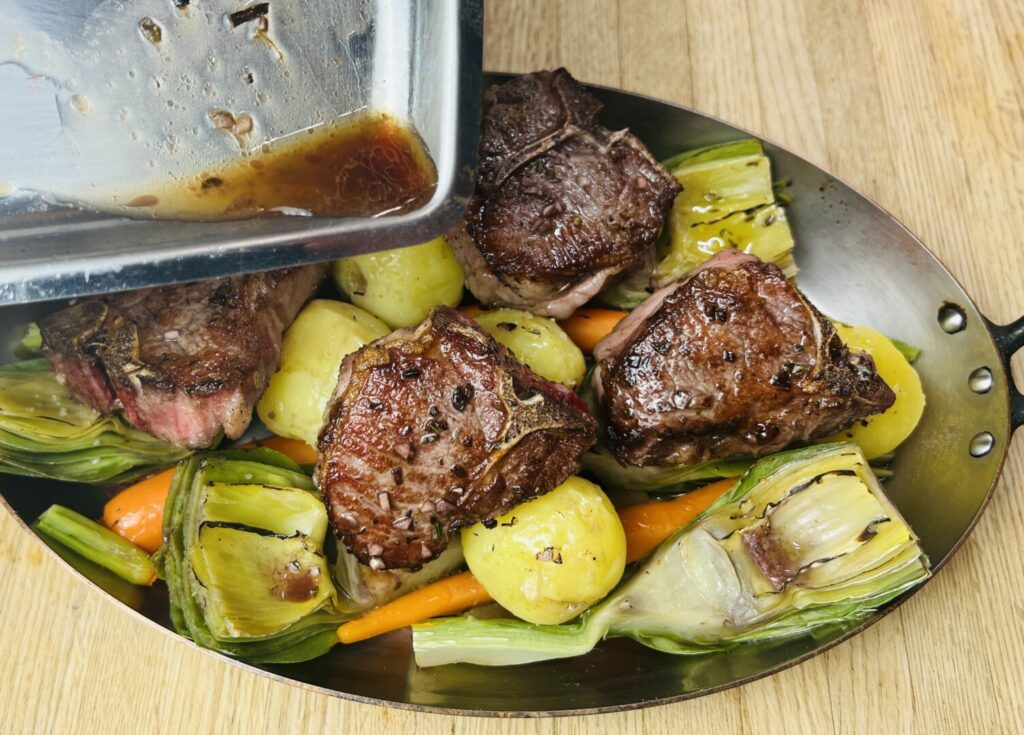
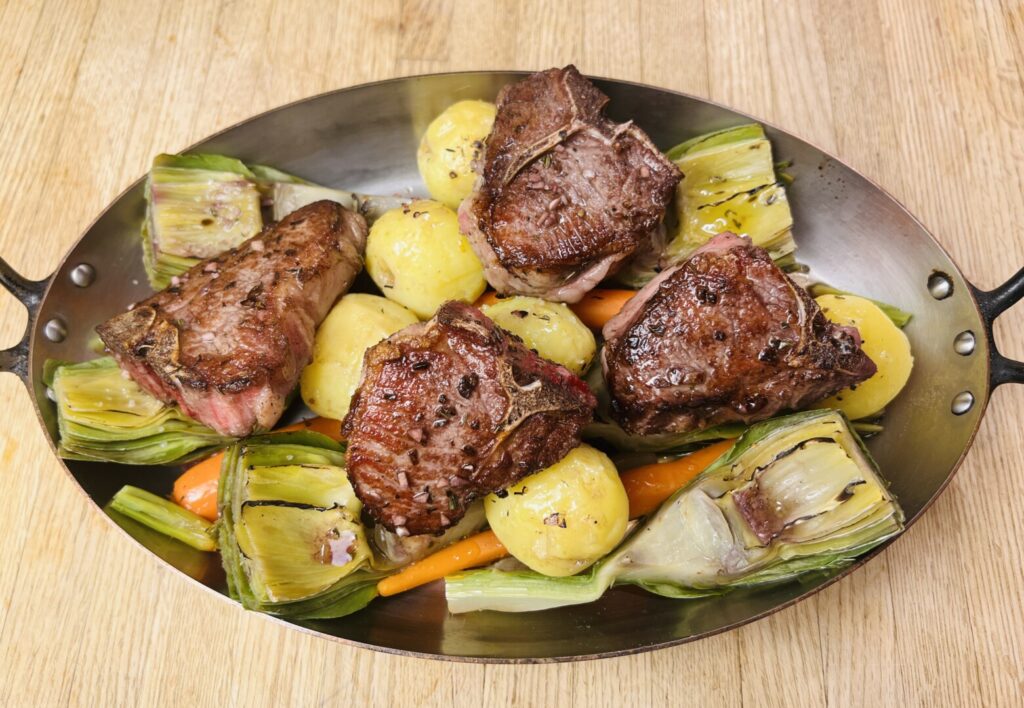
Now you’re ready to plate.
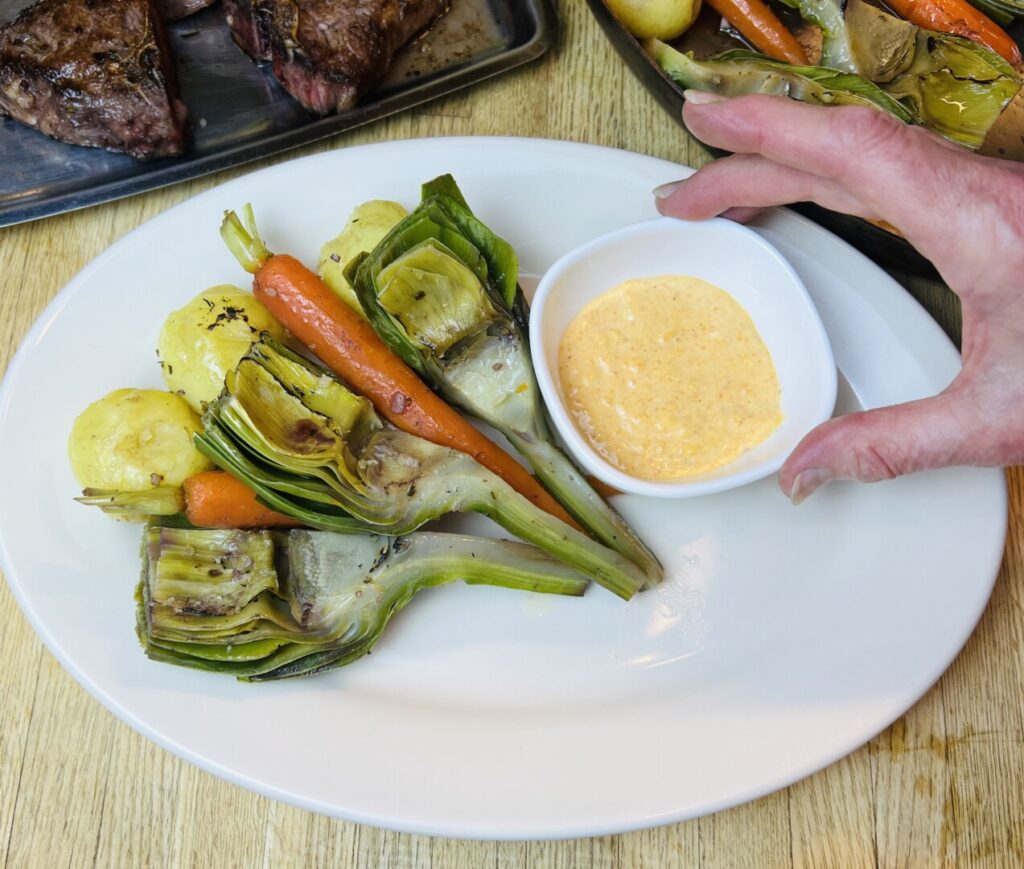
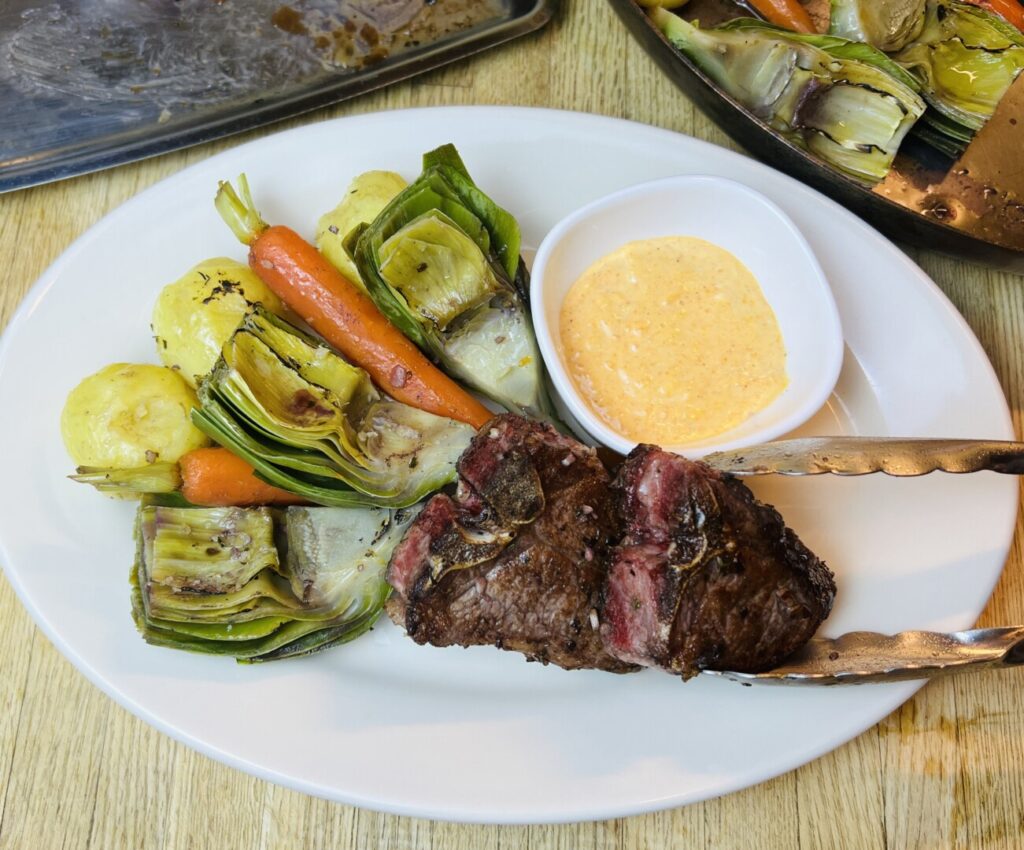
Provençal Lamb Chops with Roasted Artichokes, Carrots, New Potatoes, and Springtime Rouille
Ingredients
step 1 ingredients
- 1 large garlic clove
- 1/3 c red wine
- 1/4 c extra-virgin olive oil
- 1/4 tsp kosher salt
- 1/8 tsp dried tarragon
- 1/8 tsp dried thyme
- 1/8 tsp dried marjoram or oregano
- 4 (4-oz) loin lamb chops
step 2 ingredients
- 1/2 lemon
step 3 ingredients
- 1 large artichoke (see recipe notes)
step 4 ingredients
- 4 young carrots, with tops and/or stems
- 1/4 young carrot
step 5 ingredients
- 6 small new potatoes
step 6 ingredients
- 1 Tbsp extra-virgin olive oil
- 1/4 tsp smoked paprika
- 1/8 tsp cayenne powder
- 1/4 lemon
- 1 large garlic clove
- 1/4 c mayonnaise, preferably Duke's brand
- to taste kosher salt
step 8 ingredients
- 2 Tbsp extra-virgin olive oil
- to taste kosher salt
step 10 ingredients
- 1 Tbsp pure olive oil (not extra-virgin)

Instructions
PREP: Mise the recipe ahead of time.
1. Trim and marinate the lamb chops:
- Mince the garlic and place it in a container just large enough to hold the lamb chops snug. (For efficiency, mince the step 6 garlic at the same time.)
- Stir in the wine, olive oil, step 1 salt, tarragon, thyme, and marjoram.
- If necessary trim the chops of excess fat, leaving a fat rim a little less than ¼-inch thick around the edges.
- Place the chops in the marinade, turn over to coat all surfaces, and then refrigerate for at least 2 hours and up to 2 days. After 2 days’ marination, remove the chops from the marinade and hold both separately.
2. Set up your equipment mise-en-place for the artichokes:
- Bring at least 3 qt water to the boil in a saucepan. Obtain a plate or pan lid that will fit snugly inside the diameter of the saucepan.
- Prepare a bowl of cold water for refreshing.
- Have ready a serrated knife, chef knife, paring knife, and “spider” strainer or slotted spoon.
- Have ready the lemon half.
3. Fabricate and par-cook the artichoke:
- Use the serrated knife to cut off and discard the (pointed-end) top third of the artichoke. Trim off about ¼ inch of the stem end and discard. Rub the cut surfaces with the lemon half to help prevent enzymatic browning.
- Place the artichoke on the work surface, cut-side-down and stem-up. Using the chef knife and starting at the end of the stem, cut each artichoke in half. Keeping one of the halves upright as before, cut it through the stem into 3 even-size wedges. Repeat with the other artichoke half.
- Use the paring knife to cut away and discard the hairy “choke” parts on the inside of the artichoke wedges. After trimming each one, immerse it in the water cut-side-down.
- Immediately transfer the artichoke wedges into the boiling water. Squeeze the juice of the lemon half into the water and drop the lemon half in, as well. Fit the plate down into the saucepan onto the water’s surface to keep the artichokes submerged.
- Return the water to a brisk simmer and cook the artichokes for about 5 minutes.
- Uncover and remove an artichoke wedge. Use the paring knife to test the doneness; when inserted, the knife should penetrate but meet with some resistance.
- Use the strainer to transfer the artichoke wedges into the bowl of water. Place the bowl under cold running water for about 3 minutes, and then continue refreshing the artichoke wedges for about 5 minutes longer.
- Remove the artichokes from the refreshing water and blot dry on paper towels.
- If prepping ahead, store the artichoke wedges in a plastic bag with a folded paper towel in the bottom.
4. Fabricate, blanch, and refresh the carrots; and make carrot purée:
- Trim off and discard the tops of the young carrots, leaving about 1/2 inch of stem.
- Peel the carrots. If the carrots are too long to fit on the intended dinner plate, whittle down the ends.
- Use a paring knife to trim and scrape away any discoloration near the stems.
- Peel the additional carrot section and cut it into rough ½-inch dice.
- Fill a sauté pan with water and bring it to the boil. Prepare a bowl of cold water near the stove.
- Add the whole carrots and diced carrots to the pan. Cook at a lively simmer for about 6 minutes until the whole carrots are crisp-tender. (A knife inserted in the thick end of a carrot will meet with a little resistance.)
- Transfer the whole carrots to the bowl of cold water, then place the bowl in the sink under cold running water and refresh the carrots for about 2 minutes.
- Continue cooking the diced carrots about 2 minutes longer until very soft.
- Transfer the diced carrots into the cold water and refresh a minute or so until cold.
- Drain all of the carrots and blot dry on paper towels.
- Place a small mesh strainer into a bowl and add the diced carrots to it. Use a plastic spatula to force the carrots through the strainer. Be sure to scrape the carrot from the back of the strainer into the bowl.
- If prepping ahead, place the whole carrots into a container lined with a folded paper towel.
5. Poach and peel the potatoes:
- Place the potatoes in a saucepan, cover with water, and bring to the simmer. Cook about 6 minutes, depending on size, until the potatoes are partially done; a knife inserted into a potato will meet with a little resistance.
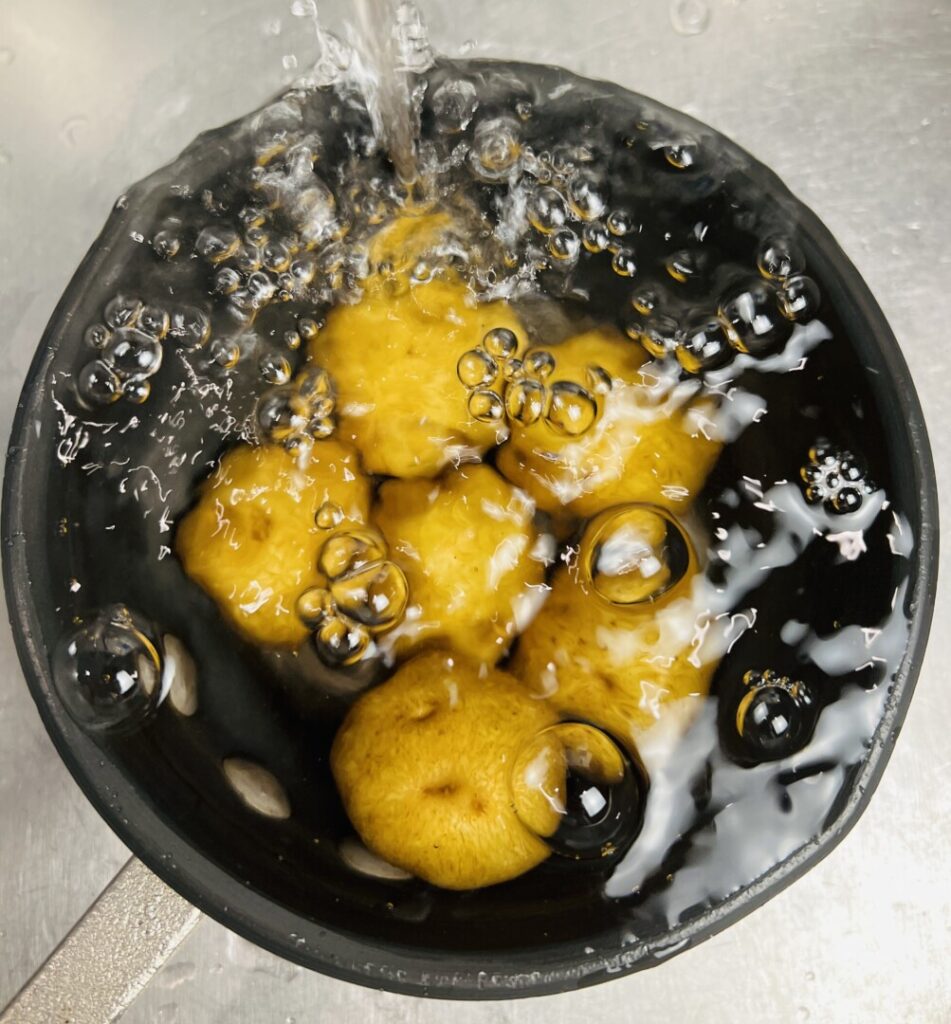
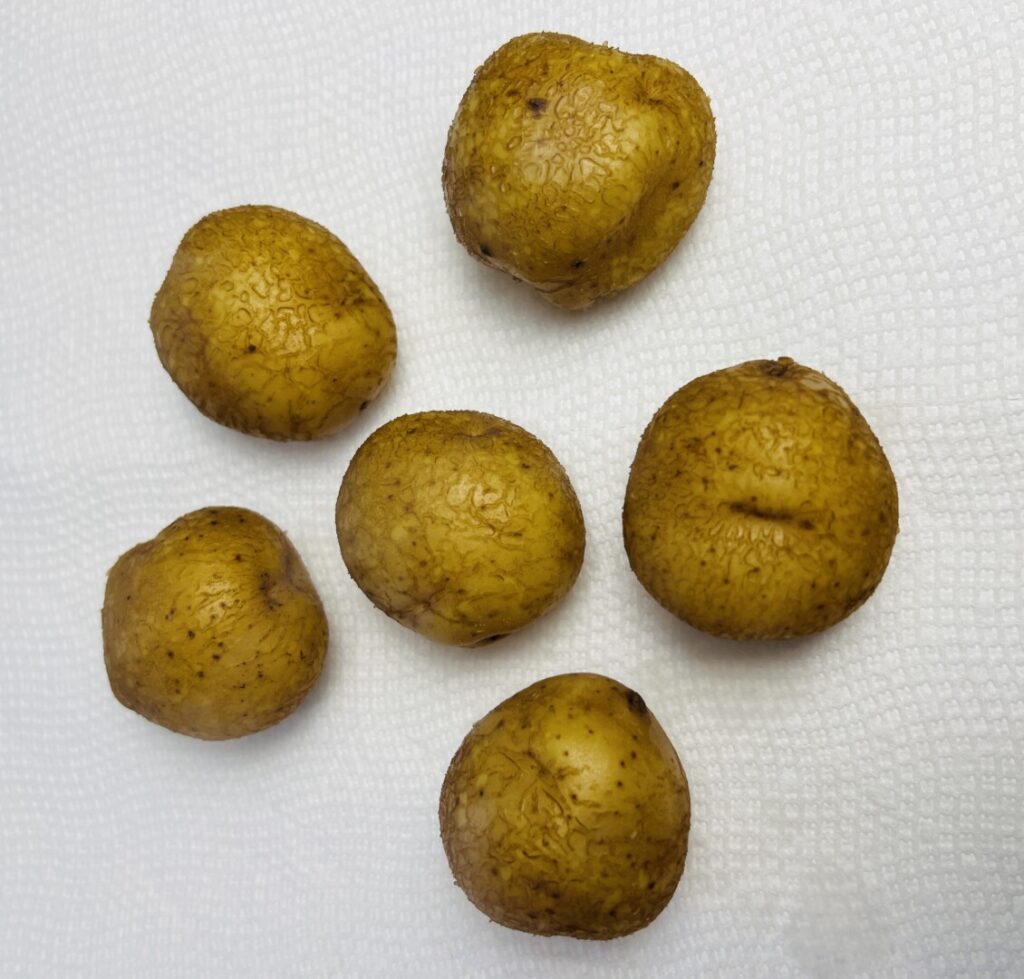
- Rinse the potatoes under cold water until cool enough to handle.
- Use a paring knife to scrape off the skins.
- If prepping ahead, place the potatoes in a plastic bag.
6. Make the rouille:
- Place the step 6 olive oil in a small sauté pan over low heat, and add the smoked paprika and cayenne. While stirring, heat the oil just until it’s very warm and the spices become fragrant. Don’t allow the mixture to overheat and scorch.
- Immediately add the carrot purée. Raise the heat to medium and cook, stirring constantly, until the purée reduces and thickens, and oil begins to separate out at the edges.
- Scrape the purée into a small bowl and cool to room temperature.
- Use a swivel peeler to remove a strip of zest from the lemon. Mince the zest and add it to the bowl along with some juice from the lemon.
- If you haven’t already done so, mince the step 6 garlic. Add it to the bowl.
- Stir in the mayonnaise.
- Season the rouille with salt and, if necessary, balance the flavor with a little more lemon juice.
- If prepping ahead, transfer the rouille into a container.
7. Assemble the remaining ingredients.
HOLD: Refrigerate all ingredients up to 5 days; remove the lamb chops from the marinade after 2 days and reserve the marinade.
COOK! Finish and plate your dinner.
8. Preheat an oven to 450°F.
9. Roast the artichokes, carrots, and potatoes:
- Combine the artichokes, carrots, and potatoes in a gratin dish or other baking dish. Drizzle on the step 9 olive oil and half the lamb marinade. Season with a little salt and toss to combine.
- Place the vegetables in the oven and roast for about 15 minutes until hot through and beginning to brown at the edges.
10. Pan-sear the lamb chops:
- Place a sauté pan over high heat until hot. Blot the lamb chops dry on paper towels.
- Add the step 9 olive oil to the pan, swirl to coat, and add the chops. Sauté about 1 minute until the bottoms brown.
- Turn over the chops and baste with half of the remaining marinade. Continue sautéing about 1 minute longer.
- Place the chops on top of the vegetables and return to the oven for about 2 minutes longer, depending on the thickness of the chops. Use the “chef’s touch test” (insert video link) to determine doneness: medium rare is recommended.
11. Plate:
- Spoon the rouille into individual dip dishes.
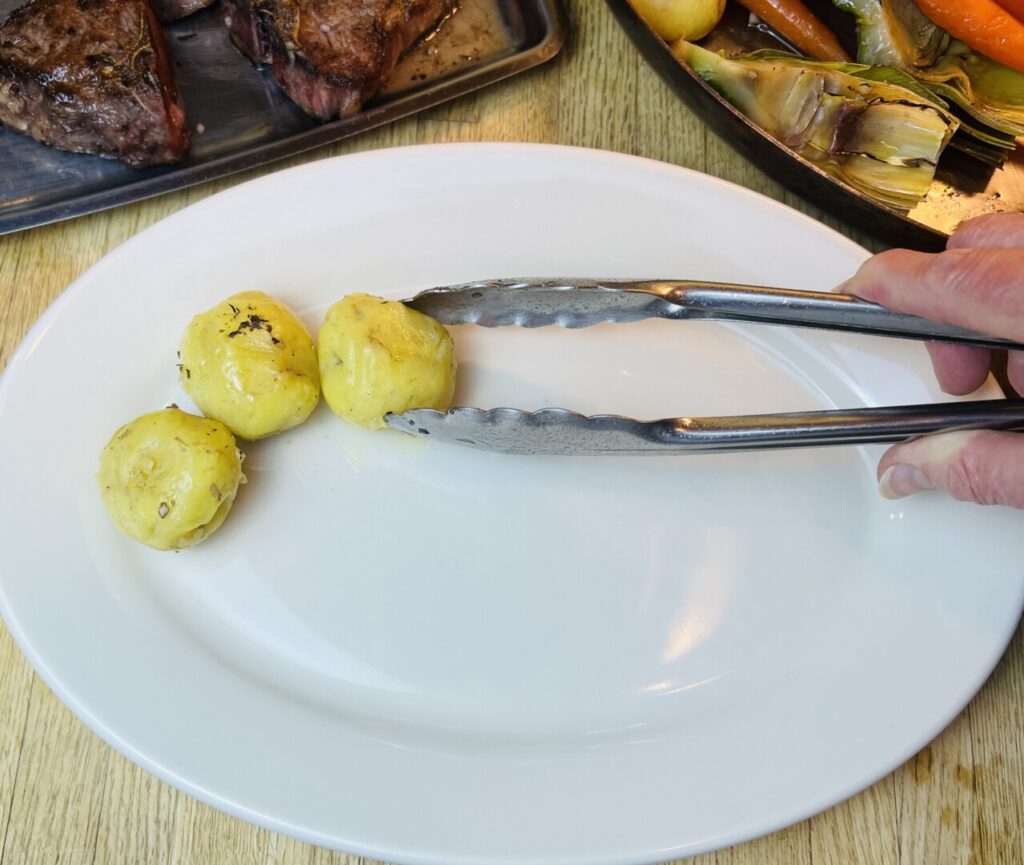
- Arrange three potatoes across the back left of each warmed dinner plate.
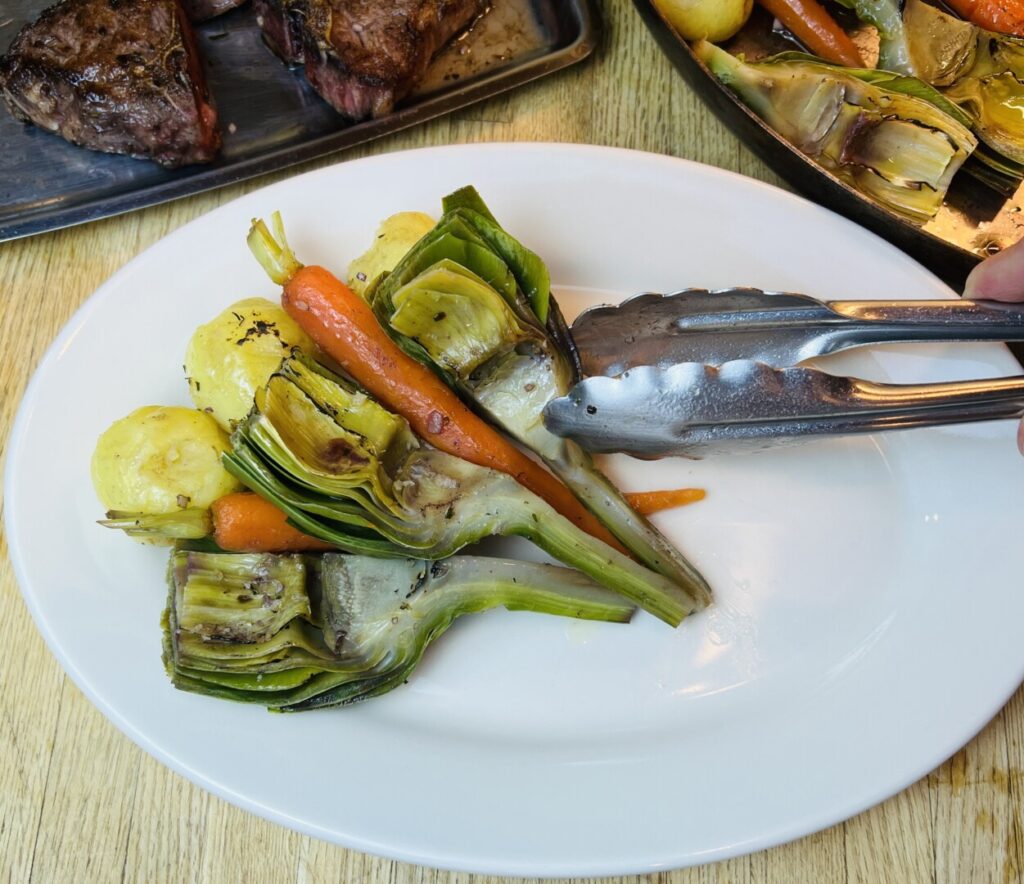
- Alternate 3 artichoke wedges (stems inward) and 2 carrots (points inward) on the front left of each plate, propped against the potatoes.
- Place a dip dish of rouille on the back right of each plate.
- Arrange 2 chops, one leaning against the other, on the front of each plate.